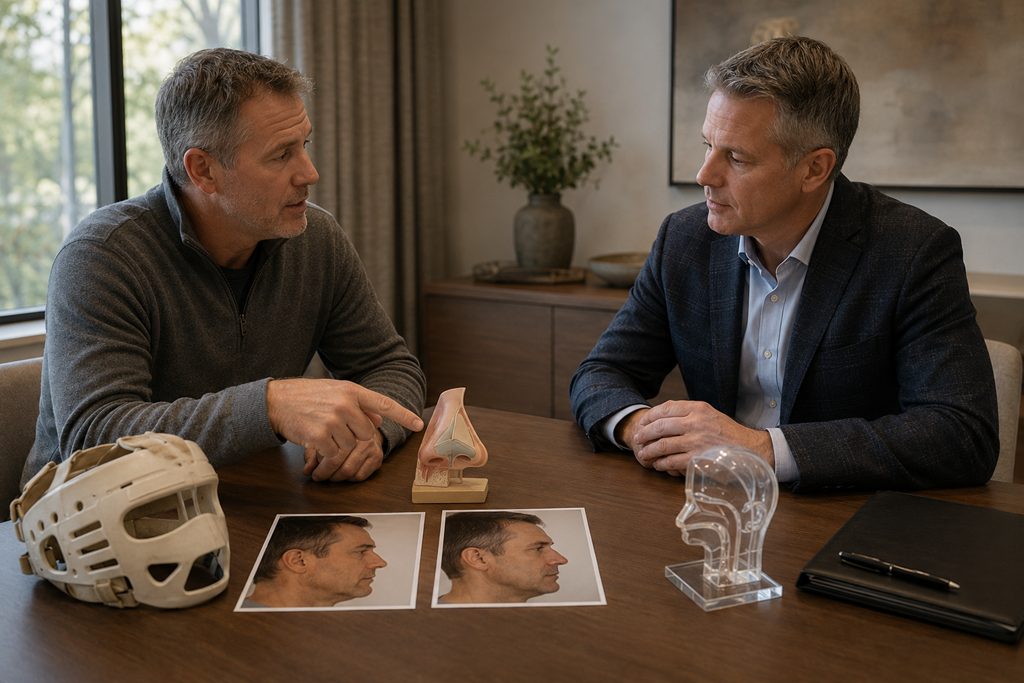
Rhinoplasty may be worth exploring when you can describe a specific appearance or breathing concern, understand that surgery has limits and risks, and feel prepared to evaluate the decision without pressure. It is less about reaching a “perfect” nose and more about deciding whether a carefully discussed change fits your priorities, health, expectations, and willingness to go through recovery.
Many people reach this decision point after thinking about one feature for years, noticing a change after an injury, experiencing breathing concerns, or becoming more aware of how their nose relates to the rest of their face. The difficult part is often not recognizing the concern. It is deciding whether that concern is important enough to justify surgery and everything that comes with it.
A consultation can help you explore that question, but it should not be treated as confirmation that you need a procedure. Only a qualified provider who evaluates your health, anatomy, symptoms, and goals can discuss whether you may be a candidate.
Start With the Change You Actually Want
A useful goal is usually more specific than “I want my nose to look better.”
You might be concerned about the bridge from certain angles, the shape or position of the tip, changes caused by an injury, visible asymmetry, or the way the nose relates to other facial features. You may also be experiencing difficulty breathing through your nose and want to understand whether structure could be contributing.
Rhinoplasty may address appearance, breathing, or both, depending on the person’s anatomy and concerns. It is not automatically the correct treatment for every cosmetic preference or breathing problem.
Before comparing Sacramento-area surgeons, try to explain your concern without relying only on labels such as “too large,” “crooked,” or “unbalanced.” Consider when you notice it, which views matter to you, and what kind of change you believe would feel meaningful.
The goal is not to design your own surgery. It is to give the surgeon enough information to understand what is motivating the decision.
A Real Goal Still Has to Allow for Limits
Wanting a change does not mean every imagined result can be created safely or predictably.
The structure of the nose, skin characteristics, prior injuries or procedures, facial proportions, breathing function, and healing response can all influence what a surgeon considers realistic. A change that looks appealing in isolation may also affect how the nose relates to the chin, cheeks, eyes, and overall facial balance.
This is why bringing a celebrity photograph or highly edited image to a consultation has limited value. It may help communicate a general preference, but another person’s nose cannot simply be transferred onto your face.
A more useful consultation focuses on questions such as:
- Which parts of my goal appear realistic?
- Which parts may be limited by my anatomy?
- What tradeoffs would the proposed change involve?
- What might remain unchanged even after surgery?
Realistic expectations do not require you to lower every preference. They require you to understand the difference between a goal, a possibility, and a promised result.
Separate Appearance Goals From Breathing Concerns
Some people primarily want a cosmetic change. Others are more concerned about airflow, obstruction, an old injury, or a combination of appearance and function.
It is important to describe these concerns separately, even when they appear connected. A nose that looks uneven does not necessarily explain a breathing problem, and a breathing concern may involve structures that are not obvious from appearance alone.
A provider may need to evaluate the nasal passage and other possible causes before discussing whether surgery is appropriate. Structural conditions such as a deviated septum or nasal valve problem can affect airflow, but personal evaluation is necessary to understand what is contributing to a specific symptom.
Avoid assuming that a cosmetic change will automatically improve breathing or that a functional procedure will create the exact cosmetic change you want. Ask the surgeon to explain how each proposed change relates to appearance, function, or both.
Consider Whether the Recovery Fits Your Life
The decision extends beyond how you might look after healing. It also includes how recovery could affect work, transportation, family responsibilities, exercise, social plans, and follow-up appointments.
The most noticeable portion of recovery and the final refinement of the nose are not necessarily on the same timeline. The American Society of Plastic Surgeons notes that initial swelling may settle over several weeks while the nasal contour can continue refining for up to a year. Individual experiences vary.
Before committing, ask yourself whether you are prepared for:
- Temporary swelling, bruising, congestion, or visible dressings
- Limits on normal activities during early recovery
- A result that changes gradually rather than appearing final immediately
- Follow-up visits and continued communication with the surgical team
- The possibility that healing may not match your preferred schedule
For Sacramento residents balancing work, caregiving, commuting, or household obligations, recovery planning may be just as important as choosing an available surgery date.
Being able to schedule a procedure does not necessarily mean it fits your current responsibilities.
Risks and Revision Possibilities Belong in the Decision
Rhinoplasty is surgery, and no surgeon can guarantee a particular appearance, breathing result, level of symmetry, recovery experience, or freedom from complications.
Potential risks include infection, changes in sensation, scarring or healing problems, difficulty breathing, dissatisfaction with appearance, and the possibility of additional surgery. The risks that matter most can vary according to the individual and the proposed procedure.
A useful consultation should make room for these topics without either minimizing them or presenting them in a frightening way.
Listen for clear explanations of:
- The risks most relevant to your health and surgical plan
- How complications are handled
- What follow-up care is included
- When a concern should be reported
- Under what circumstances revision surgery might be discussed
- What financial or recovery responsibilities a revision could involve
The possibility of revision does not mean a poor outcome is expected. It means that healing and surgical results are not completely predictable, and that possibility should be understood before making a commitment.
Imaging Should Support the Conversation, Not Decide It
Some practices use photographs, profile analysis, or computer-generated simulations to help patients and surgeons discuss possible changes.
These tools can make an abstract goal easier to describe. They may help you notice that you prefer a subtle adjustment rather than a dramatic one, or that a proposed change affects the whole face differently than expected.
However, a simulation should be treated as a communication aid rather than a preview that guarantees the final result. Computer-generated images cannot fully account for anatomy, surgical variables, or individual healing.
A helpful question is not simply, “Can you make me look like this image?”
A better question is, “Which parts of this image represent realistic possibilities, and which parts should I not interpret as predictable?”
The Consultation Should Reduce Ambiguity
A rhinoplasty consultation should feel like an evaluation and discussion, not a sales presentation.
A surgeon may review your goals and health history, examine and measure your face and nose, take photographs, explain possible approaches, and discuss risks, limitations, recovery, and expected outcomes.
Pay attention to whether the surgeon:
- Lets you finish explaining your concerns
- Distinguishes between cosmetic and functional goals
- Explains what may not be achievable
- Discusses risks without dismissing your questions
- Uses understandable language
- Gives you space to think before scheduling
- Appears comfortable recommending more evaluation or no procedure when appropriate
A provider who agrees with every requested change without explaining limits may not be giving you the information needed for an informed decision.
You should also be able to leave the consultation without paying a deposit, selecting a date, or defending your hesitation. Taking time to consider the information is a normal part of evaluating elective surgery.
Surgeon Fit Involves More Than Before-and-After Photos
Photographs can help you understand a surgeon’s aesthetic approach, but they should not be the only basis for comparison.
Ask about the surgeon’s training, relevant board certification, experience performing rhinoplasty, approach to cosmetic and functional concerns, surgical facility, follow-up process, complication policies, and experience with revision cases.
Professional organizations recommend asking about certification, procedure-specific training, hospital privileges, facility accreditation, risks, recovery, and how complications are handled.
When reviewing photographs, look for examples involving concerns or facial characteristics that are reasonably relevant to your own. Do not assume that a surgeon can reproduce another patient’s result.
The most useful comparison is not which provider promises the largest change. It is which provider communicates clearly about what is realistic for you.
Signs You May Need More Time
You do not have to reject rhinoplasty simply because you are uncertain. Uncertainty may mean that you need better information, a second opinion, or more time to define your goal.
It may be sensible to pause when:
- You cannot explain what change you want beyond looking “better”
- Your preferred result depends on copying another person’s face
- You expect complete symmetry or perfection
- The decision began mainly because of repeated comments from someone else
- You feel pressured by a discount, deadline, financing offer, or scheduling request
- You are not prepared for recovery or gradual healing
- Risks and revision possibilities still feel too unclear
- Different providers have given conflicting explanations that you have not resolved
A pause is not a failure to decide. It can protect you from making a permanent choice before your expectations and practical circumstances are settled.
Questions That Can Make a Consultation More Useful
You do not need to arrive with a long medical checklist. A few focused questions can reveal how a surgeon thinks and communicates.
Consider asking:
- What parts of my goal appear realistic?
- What limitations does my anatomy create?
- Could the proposed cosmetic changes affect breathing?
- How are my appearance and functional concerns being evaluated separately?
- What risks are most relevant to the proposed plan?
- What should I expect during early recovery and longer-term refinement?
- How often do you perform rhinoplasty?
- What training and board certification are relevant to this procedure?
- How do you handle unexpected healing concerns or possible revisions?
- What should I understand before deciding whether to proceed?
Clear answers should leave you with a better understanding of the tradeoffs, not simply more enthusiasm for surgery.
The Right Decision Is About Fit, Not Perfection
Rhinoplasty may fit your goals when your concern is specific and personally meaningful, the proposed changes are realistic, the risks and recovery are acceptable to you, and you trust the surgeon’s qualifications and communication.
It may not fit your goals when the expected result depends on perfection, another person’s appearance, guaranteed breathing improvement, an exact simulation, or a recovery experience no provider can promise.
For Sacramento-area patients, the next reasonable step may be a consultation, a second opinion, or simply more time to think. A consultation is an opportunity to gather information—not an obligation to schedule surgery.
The most informed decision is the one that accounts for the whole experience: your reasons, facial balance, breathing concerns, health, expectations, risks, recovery responsibilities, provider fit, and willingness to accept uncertainty.