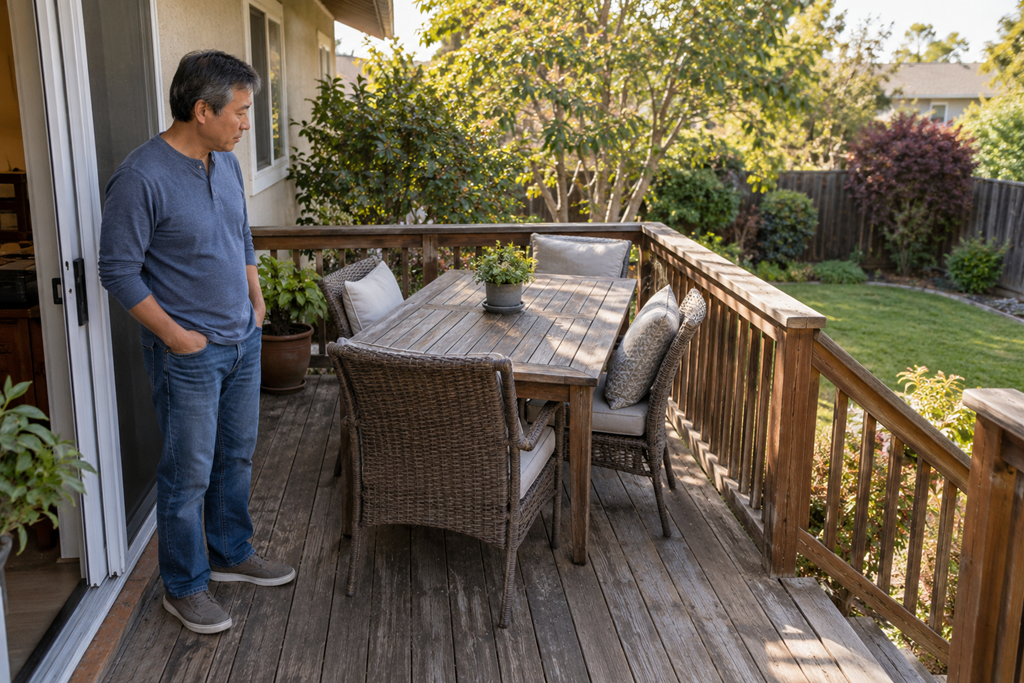
Deciding whether to repair or replace an aging deck is not always as simple as identifying damaged boards. A deck may have a few visible problems that can be addressed individually, or those problems may point to larger concerns involving the structure beneath the walking surface. For Sacramento-area homeowners, the important question is whether targeted repairs can reasonably address the deck's condition and intended use, or whether a more extensive replacement would provide a better long-term solution. Understanding what separates these situations can help you prepare for a professional assessment and evaluate recommendations without committing to more work than necessary.
A deck often becomes a familiar part of a home. It may be where family members gather, where outdoor furniture sits, or where homeowners enjoy their yards. Because it is used regularly, gradual changes in its condition can be easy to overlook.
The challenge is that visible wear does not always reveal the full condition of a deck. A weathered surface may cover a sound supporting structure, while a deck that looks reasonably attractive from above may have hidden deterioration.
The goal is not to diagnose structural problems yourself. It is to understand which observations matter, what a qualified professional should evaluate, and how to compare the practical consequences of repairing or replacing the deck.
What usually determines whether a deck can be repaired
The repair-versus-replacement decision generally depends on three connected questions:
- How extensive is the damage? A limited problem affecting a few replaceable components is different from deterioration affecting multiple parts of the deck.
- Is the supporting structure still suitable? Surface repairs may be insufficient when important structural components are damaged, unstable, or improperly connected.
- Will repairs provide a reasonable long-term solution? A technically possible repair is not always the most practical choice if other parts of the deck are approaching the end of their useful life.
A deck consists of more than the boards people walk on. Its supporting components and connections also influence whether it can continue serving its intended purpose.
That distinction matters when discussing repairs with a contractor.
For example, replacing several deteriorated deck boards may be reasonable when the surrounding components and underlying structure are in suitable condition. However, replacing surface boards alone would not resolve deterioration involving supporting framing, connections, or the attachment to the home.
The presence of damage does not automatically mean the entire deck must be replaced. Likewise, the possibility of making a repair does not automatically mean repairing is the better investment.
A professional evaluation should help establish which parts can remain, which need attention, and whether the proposed work addresses the underlying issues.
Recognizing the difference between surface wear and deeper problems
One of the most useful distinctions a homeowner can understand is the difference between cosmetic deterioration, localized component damage, and potential structural concerns.
These conditions may look similar at first but lead to different recommendations.
Surface wear that may not require major reconstruction
Decks can show visible aging without necessarily requiring complete replacement.
Examples include:
- Faded or uneven coloring.
- Worn surface finishes.
- Minor cosmetic imperfections.
- Weathering caused by repeated exposure to sunlight and moisture.
- Limited surface deterioration that does not necessarily affect underlying components.
Sacramento-area decks may experience substantial sun exposure, seasonal rain, and changing outdoor conditions. These factors can affect appearance and maintenance needs, although exposure alone does not determine whether a deck should be replaced.
A deck that looks worn may need maintenance, refinishing, or selected component repairs rather than extensive reconstruction.
However, appearance alone cannot establish that its structure is sound.
Localized damage that may be repairable
Some problems affect specific portions of a deck rather than the entire assembly.
Examples include a deteriorated board, a damaged stair component, or a railing section requiring attention.
A contractor may be able to repair or replace affected components while retaining suitable surrounding materials.
Whether this approach is appropriate depends on how the components connect, whether deterioration extends beyond the visible area, and whether the remaining structure can properly support the proposed repair.
A small visible problem can sometimes require more extensive work than expected once it is evaluated.
Conditions that deserve structural evaluation
Other observations raise questions about the deck's supporting system.
These may include:
- Noticeable movement or instability during ordinary use.
- Sagging or uneven sections that appear to have developed over time.
- Deterioration around posts, beams, joists, or important connections.
- Loose, unstable, or damaged guardrails.
- Concerns involving stairs or landings.
- Visible separation or deterioration where an attached deck connects to the home.
- Repeated damage appearing in several parts of the deck.
These observations do not establish a diagnosis or prove that full replacement is necessary.
They indicate that the condition should be evaluated before deciding on repairs.
If a deck appears unstable, has a failing railing, or shows signs of significant structural deterioration, avoid using the affected area until a qualified professional has assessed it. Do not attempt to test its strength by adding weight, jumping on it, or moving damaged components.
Why the structure underneath matters as much as the deck surface
Homeowners naturally notice deck boards first because they are visible and frequently used.
However, a deck's supporting framework, connections, and foundations may be more important to the repair-versus-replacement decision than its appearance.
The condition of the supporting framework
The framework helps transfer loads through the deck's supporting components.
When a contractor evaluates an older deck, questions about the condition of the joists, beams, posts, connections, and supporting elements may affect whether the existing structure can remain.
If these components are suitable, replacing worn surface materials may be a reasonable option.
If important structural components are deteriorated or unsuitable, a surface-only project would leave those concerns unresolved.
How the deck connects to the house
Some decks are attached to a home, while others use a freestanding structural arrangement.
For an attached deck, the connection to the building deserves particular attention.
A professional may need to evaluate the attachment, surrounding materials, visible signs of moisture-related deterioration, and other relevant structural details.
Problems at this connection may change the project considerably, even when the deck's walking surface looks acceptable.
Whether the existing structure can support the proposed work
A homeowner considering new decking materials may assume they can simply be installed over the existing framework.
That is not necessarily the case.
Material weight, fastening requirements, structural condition, spacing, manufacturer specifications, and applicable construction requirements can influence whether a particular replacement material is suitable.
This is especially relevant when changing from an existing wood surface to a different type of decking.
The important question is not merely whether the new material looks attractive. It is whether the overall deck assembly can appropriately accommodate the proposed change.
When targeted deck repairs may make practical sense
Repairing an existing deck can be attractive when problems are limited, the supporting structure is suitable, and the repairs can provide a reasonable period of continued service.
Consider a deck with several deteriorated surface boards but otherwise satisfactory conditions identified through a professional evaluation.
Replacing those boards may be more appropriate than removing the entire deck, particularly when the homeowner is satisfied with its size, layout, and materials.
Other situations that may favor repairs include:
- The deck has isolated damage rather than widespread deterioration.
- Supporting components are found to be suitable for continued use.
- The proposed repairs address the cause of the identified problem.
- Replacement materials can be integrated appropriately with the existing assembly.
- The remaining deck components have a reasonable expected useful life.
- The homeowner does not need a substantial layout or design change.
There are still limitations.
New boards may not match older boards exactly in color or appearance. Some existing materials may be difficult to match. A repair may also reveal adjacent damage requiring additional work.
An effective repair proposal should explain those possibilities rather than treating the initial visible damage as the complete project scope.
It should also distinguish between resolving an underlying condition and simply improving the deck's appearance.
When replacement may be the more sensible direction
Complete replacement becomes more relevant when deterioration is widespread, structural concerns are substantial, or the existing deck can no longer reasonably support the homeowner's intended use.
A contractor may recommend replacement when multiple connected components require significant work or when retaining the old structure would introduce limitations that undermine the proposed improvements.
Replacement may also be worth considering when:
- Damage affects numerous parts of the deck.
- Significant structural components are unsuitable for continued use.
- Previous repairs have not resolved recurring problems.
- The deck's configuration no longer fits the household's needs.
- A major redesign would require substantial reconstruction.
- The cost and limitations of extensive repairs make replacement more practical over the intended ownership period.
However, replacing a deck is not automatically better simply because it is older.
Age is useful context, but age alone does not establish the condition of the materials, the quality of the original construction, or the remaining service life.
A well-maintained older deck may have different needs from a newer deck with poor drainage, unsuitable connections, or premature deterioration.
When replacement is recommended, ask which specific conditions make continued use of the existing structure impractical.
A clear explanation should connect the recommendation to observed conditions, project requirements, or documented limitations rather than relying on the deck's age or appearance alone.
The repair-versus-replacement decision at a glance
The following comparison can help organize the main factors before reviewing a contractor's recommendation.
Decision factor | Repair may be worth considering when | Replacement may be worth considering when |
|---|---|---|
Extent of deterioration | Damage is localized and surrounding components are suitable | Deterioration affects multiple connected areas |
Supporting structure | Professional evaluation supports retaining it | Significant supporting components require reconstruction |
Deck surface | Selected boards or components need attention | Much of the surface and supporting assembly needs work |
Previous work | An isolated issue can be addressed effectively | Problems repeatedly return or repairs continue accumulating |
Layout and function | The existing design still meets household needs | The deck requires major changes in size, access, or configuration |
Long-term value | Limited repairs provide reasonable continued use | Major repair expenses still leave substantial limitations |
These are decision factors, not automatic rules. The actual recommendation depends on the deck's condition and the work required.
How the remaining useful life changes the calculation
A major reason this decision can be difficult is that repairing one component does not reset the age or condition of the entire deck.
Suppose a homeowner replaces several boards while other materials remain substantially weathered.
The repaired area may perform satisfactorily, but other aging components could require attention later.
That possibility does not make the initial repair a mistake. It simply means the expected remaining service life should be part of the conversation.
A useful question is:
If these repairs are completed, what significant concerns could reasonably remain?
A contractor cannot predict exactly when every component will deteriorate. However, an experienced professional should be able to explain observed limitations, known concerns, and areas that could require future attention.
This is particularly relevant when repairs would involve several expensive components while leaving much of the original assembly in place.
The homeowner is not just comparing today's repair price with today's replacement price. The broader consideration is what each option is likely to provide over the period the deck is expected to remain in use.
Why repair and replacement estimates can be difficult to compare
Repair and replacement proposals may cover fundamentally different amounts of work.
A repair estimate might include replacing several boards, correcting a localized railing problem, or reconstructing a limited section.
A replacement estimate could include removing existing materials, addressing underlying site or structural conditions, constructing a new deck, and completing associated stairs, railings, and finishes.
The replacement estimate will often involve a larger scope, but a higher price does not by itself establish that replacement is unnecessary.
Likewise, an inexpensive repair proposal may not represent good value if significant conditions remain unaddressed.
Look closely at what will remain
For a repair proposal, determine which existing components will stay in place.
Ask whether the contractor has evaluated those components and what limitations remain.
For a replacement proposal, clarify whether the existing deck will be completely removed or whether any suitable structural components are proposed for reuse.
The word replacement does not necessarily mean every component will be replaced unless the scope specifically says so.
Understand what could change after work begins
Deck projects sometimes reveal conditions that were not fully visible during the initial assessment.
Hidden deterioration, existing connection problems, or unsuitable underlying components may change the amount of work required.
Ask how those discoveries would be documented, explained, priced, and approved before additional work proceeds.
That matters particularly for projects where substantial portions of the deck must be opened or removed to evaluate concealed conditions.
Compare the complete scope, not just the total
When reviewing proposals, consider whether they identify:
- Components to be repaired, replaced, or retained.
- Materials and product specifications.
- Structural work included in the price.
- Removal and disposal responsibilities.
- Stair and railing work, when applicable.
- Finish details and expected appearance.
- Any necessary permit or inspection responsibilities.
- Conditions that could trigger additional work.
- Project scheduling assumptions.
- Workmanship warranty terms and relevant material warranty information.
Not every item applies to every deck project.
The goal is to understand what each proposal actually delivers before deciding which option offers reasonable value.
How future plans for the deck can influence the recommendation
Condition is central to this decision, but the homeowner's intended use also matters.
A deck that still serves its original purpose may be a reasonable repair candidate when its condition supports that approach.
A homeowner planning substantial changes may reach a different conclusion.
Keeping the existing layout
When the deck's current size, access, and configuration remain satisfactory, preserving suitable components may avoid unnecessary reconstruction.
In that situation, the decision is primarily about condition and the scope of needed repairs.
Changing the deck's configuration
If the homeowner wants to enlarge the deck, reposition stairs, change elevations, or redesign access to the yard, the proposed changes may affect the supporting structure.
Extensive modifications can make replacement or partial reconstruction worth evaluating even if some existing components remain serviceable.
Accommodating different uses
A homeowner may want to change how the deck is used, such as adding a different furniture arrangement or planning for an outdoor feature.
Not every deck is suitable for every intended load or use.
A qualified professional should evaluate whether the existing structure can support the proposed changes and whether modifications are feasible.
Homeowners should avoid assuming that a deck designed for ordinary residential use can accommodate substantially different loading conditions without assessment.
What a professional deck evaluation should help establish
A useful evaluation should provide more than a quick visual opinion about whether the deck looks old.
The professional should explain which conditions are visible, what can reasonably be assessed, and whether further investigation is necessary.
The appropriate level of evaluation depends on the deck, its accessibility, the concerns identified, and the proposed project.
What areas need attention?
The evaluation may involve surface materials, framing, posts, connections, stairs, railings, and other relevant components.
For an attached deck, the connection to the home may require particular consideration.
Homeowners do not need to perform their own structural inspection. They should understand which portions of the deck the professional evaluated and whether any important areas could not be assessed.
Are the concerns localized or widespread?
This distinction often determines whether limited work is realistic.
A professional should be able to distinguish between a problem confined to a replaceable component and deterioration that affects surrounding or supporting elements.
When damage may extend into concealed areas, ask how that uncertainty affects the recommendation.
Can suitable components remain?
A contractor recommending partial reconstruction should identify which components can be retained and why.
A contractor recommending full replacement should explain what makes retaining the existing assembly impractical or inappropriate.
When significant structural uncertainty exists, an evaluation by a qualified structural professional may be appropriate.
What does each realistic option involve?
The homeowner should understand whether the practical choices are:
- A limited repair.
- A more extensive repair or partial reconstruction.
- A full replacement.
These are not always three equally suitable alternatives.
Sometimes the deck's condition rules out a particular approach. In other situations, more than one option may be technically feasible, and the decision depends on budget, remaining service life, and homeowner priorities.
Questions worth asking before approving deck work
You do not need an extensive technical checklist to have a productive conversation with a deck contractor.
A few targeted questions can reveal whether the recommendation is based on the deck's actual condition.
1. Which specific conditions support your repair or replacement recommendation? Ask the contractor to identify the relevant parts of the deck and explain the concern.
2. What existing components can safely and appropriately remain? This helps distinguish limited repairs from larger structural work.
3. Are there concealed areas that have not been evaluated? Understand what is known and what might change after work begins.
4. If I choose repairs, what limitations or future concerns should I expect? The answer helps evaluate the potential remaining useful life.
5. Would a partial rebuild be a reasonable alternative? Some projects may fall between replacing a few components and reconstructing the entire deck.
6. What is included in the proposed price, and what might cost extra? Ask about materials, removal, structural work, stairs, railings, and unforeseen conditions.
7. How would the recommendation change if I wanted to alter the deck's layout or materials? This connects the immediate project with future needs.
8. What professional qualifications, approvals, and inspections are relevant to the proposed work? Ask how the contractor handles requirements applicable to the project.
Clear answers should help you understand both the recommendation and its limitations.
If two professionals provide substantially different opinions, identifying the specific conditions behind each recommendation is often more useful than arguing over which opinion sounds more convincing.
Reasons to question a repair or replacement recommendation
Deck projects can involve legitimate differences in professional judgment.
One contractor may propose substantial repairs while another recommends replacement because they approach the scope, reuse of existing components, or long-term expectations differently.
A difference alone is not proof that either contractor is unreliable.
However, certain situations deserve additional clarification.
Replacement is recommended without explaining the condition
A recommendation based primarily on the deck looking old may not provide enough information.
Ask which components are unsuitable, which conditions cannot reasonably be corrected, and why less extensive work is not appropriate.
Repairs are proposed without discussing structural concerns
Replacing visible surface materials may be reasonable, but the recommendation should not ignore relevant concerns involving supporting components or connections.
If the deck has noticeable instability, significant deterioration, or other potential structural problems, a purely cosmetic proposal may not address the actual concern.
The proposed scope remains vague
Descriptions such as "fix damaged areas" or "rebuild deck as needed" may be insufficient when approving a significant project.
The written scope should identify the planned work and explain how unforeseen conditions will be handled.
The decision is presented as unnecessarily urgent
Some deck conditions justify restricting use and obtaining an assessment promptly.
That is different from pressuring a homeowner to approve an expensive project immediately without an adequate explanation.
Safety concerns should be taken seriously, while the proposed solution should still be described clearly.
Preparing for an estimate without diagnosing the deck yourself
Before contacting a Sacramento-area deck professional, gather a few details that will make the initial conversation more useful.
Start with your main concern. Is the deck showing visible deterioration, developing movement, requiring repeated repairs, or simply looking older than you would like?
If you know approximately when the deck was built or last substantially repaired, that information can provide context. You do not need a complete construction history.
Photographs of visible concerns may be useful, provided they can be taken safely from accessible areas. Avoid going beneath an unstable deck, dismantling materials, or disturbing suspected structural problems.
It also helps to identify your priorities.
For example, are you primarily trying to preserve a functional deck at a reasonable cost, or would you welcome a larger redesign if replacement turns out to be justified?
Let the contractor know whether you hope to retain the existing layout or are considering changes.
Finally, consider whether you want to compare both repair and replacement possibilities, assuming the existing condition allows that choice.
This makes the purpose of the evaluation clearer from the beginning.
Making a decision when both options appear reasonable
Sometimes a professional assessment does not produce one obvious answer.
The existing deck may be repairable, but extensive work might cost enough to make replacement attractive.
Or the homeowner may prefer replacement even though targeted repairs could provide additional useful service.
In these situations, it helps to evaluate the alternatives through a few practical priorities.
Start with suitability. Any proposed option needs to address relevant structural and functional concerns. A lower-cost approach is not a reasonable substitute for necessary work.
Consider the amount of existing material being retained. Understand what remains and whether those components introduce foreseeable limitations.
Think about expected use. If the deck's size, configuration, and appearance still meet your needs, repairs may offer satisfactory value. If you anticipate substantial changes, replacement may make more practical sense.
Review uncertainty. A repair proposal with significant unknowns may deserve additional investigation before approval. A replacement proposal may also contain uncertainties involving concealed or underlying site conditions.
Evaluate the overall project, not just the initial price. Material quality, workmanship, scope, future maintenance, and anticipated continued use can all influence value.
You can also request another qualified opinion when the proposed work is extensive, recommendations conflict, or the explanation does not adequately establish why one approach is preferable.
The objective is not to obtain the lowest possible recommendation. It is to choose a clearly explained scope of work that fits the deck's condition and your intended use.
Choose the work your deck actually needs
The most useful repair-versus-replacement decision begins with understanding the deck's condition rather than assuming that visible wear requires a complete rebuild.
Localized deterioration may support a targeted repair when the remaining structure is suitable. Widespread damage, significant structural concerns, or substantial changes in intended use may make replacement more appropriate.
For Sacramento-area homeowners, the next step is to obtain a condition-based professional evaluation that explains what can remain, what needs work, and what each realistic option would involve.
A sound decision does not require you to become a deck construction expert. It requires enough understanding to recognize a well-explained recommendation, compare meaningful differences in project scope, and avoid approving work based on appearance or price alone.