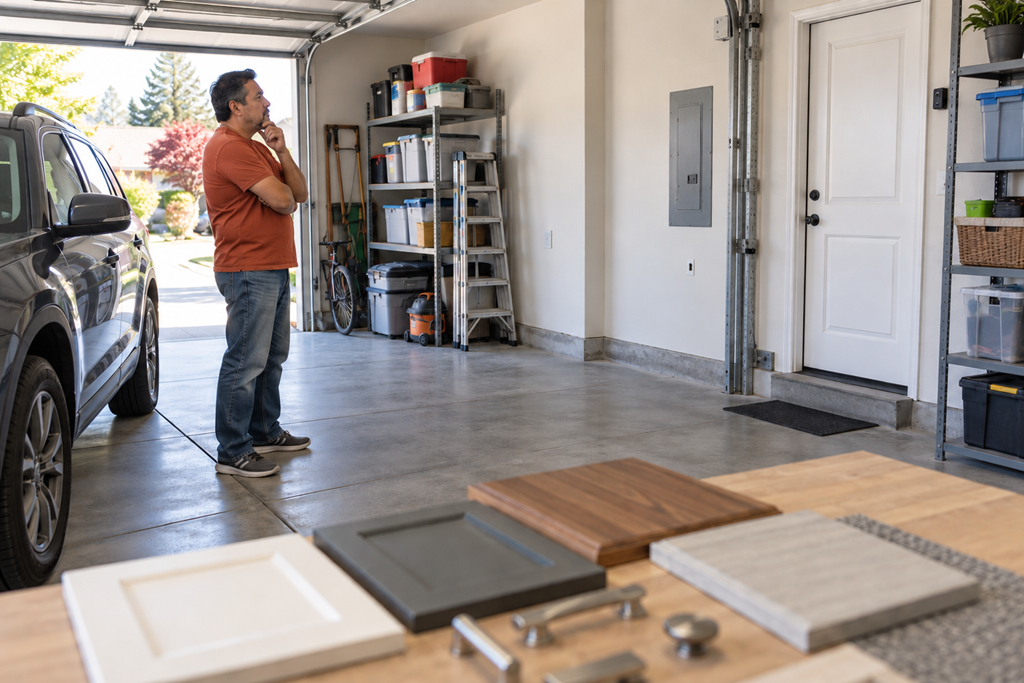
The best way to evaluate a garage cabinet company is to look beyond attractive cabinet samples and ask how carefully the company understands your actual garage, storage needs, and daily use of the space. A strong evaluation should leave you with a clear picture of what is being proposed, what the installation includes, how the design fits around existing features, and what happens if conditions or priorities change before the project is complete.
That can be harder than it sounds. Garage cabinets are highly visual, so it is easy to focus first on door styles, colors, finishes, hardware, and impressive-looking layouts. Those details matter, but they do not tell you whether the company has designed something that will work well in your particular garage.
For Sacramento-area homeowners comparing garage cabinet companies, the more useful question is not simply, “Do I like these cabinets?” It is, “Has this company shown that it understands my space and what I need the cabinets to accomplish?”
A Good Evaluation Starts With the Garage, Not the Cabinet Catalog
A garage cabinet company should spend enough time understanding the physical space before recommending a layout.
That means looking at more than the longest empty wall.
A garage may also contain doors, windows, outlets, utility equipment, garage-door tracks, steps, wall transitions, floor edges, work areas, parked vehicles, and frequently used walkways. Some areas may need to remain accessible even if they appear to offer convenient cabinet space.
The company does not necessarily need to turn the visit into an exhaustive inspection. But its recommendation should reflect the garage that actually exists rather than a cabinet arrangement that could have been proposed for almost any home.
Notice what receives attention during the estimate.
If most of the conversation centers on finishes and upgrades before anyone has asked how the garage is used, that may be a reason to slow down and ask more questions.
The Layout Should Reflect What You Actually Need To Store
Cabinet capacity can look impressive on a drawing while still being poorly matched to the household using it.
Before comparing designs, think about what you expect the cabinets to handle.
For one homeowner, the priority may be reducing visible clutter from household supplies and seasonal items. Another may need accessible storage for automotive products, gardening supplies, sports equipment, tools, or bulky items that do not fit neatly into standard cabinet compartments.
You do not need to design the cabinets yourself.
The important part is whether the company asks enough questions to understand those priorities before proposing the solution.
A useful recommendation should make it easier to picture where your actual belongings would go—not simply show how much cabinetry can fit along the walls.
More cabinetry is not automatically a better design
A wall filled from end to end with cabinets can look organized in a rendering or sample photo.
That does not automatically mean it is the best use of the garage.
Cabinets can affect open wall space, movement around vehicles, access to household features, and the flexibility to store items that may not belong inside cabinetry at all.
A company that is willing to leave some space open when appropriate may be thinking more carefully about function than one that treats every available section of wall as a place to sell another cabinet.
Pay Attention to How the Design Handles the Existing Garage
A garage cabinet proposal should acknowledge features that affect where cabinetry can reasonably go.
You might notice whether the company discusses the relationship between the proposed cabinets and:
- entry doors and their swing areas
- garage-door components
- utility or household equipment
- windows and existing wall features
- parking and walking clearance
- workbenches or other storage systems that will remain
- frequently accessed areas
- uneven or interrupted wall and floor areas
The goal is not to become an expert in cabinet installation.
It is to see whether the person preparing the proposal appears to be considering the entire environment instead of treating the project as a row of boxes attached to an empty wall.
If something in the garage could affect the proposed layout, ask how the company plans to account for it.
A clear answer can tell you a great deal about how carefully the project has been considered.
The Estimate Should Explain What You Are Actually Buying
Two garage cabinet proposals can look similar at first glance while including different scopes of work.
Before comparing prices, make sure you understand what each company is proposing.
The estimate or proposal should make it reasonably clear what cabinetry is included, where it will be located, what major materials or finishes have been selected, and what installation-related work is part of the quoted scope.
If existing storage must be removed, items need to be moved, or some portion of the garage requires separate preparation, find out whether that responsibility belongs to the company or the homeowner.
The same applies to details that were discussed verbally.
If an important feature influenced your decision, it is reasonable to ask where that feature appears in the written proposal.
This does not require a complicated contract review. You are simply trying to reduce the chance that you and the company are picturing different versions of the finished project.
Product Samples Are Useful, but They Should Not Carry the Whole Decision
Samples can help you compare finishes, surfaces, hardware, and general appearance.
They cannot show you by themselves how well the final cabinets will fit your garage.
When looking at samples, consider asking how the material and finish being recommended relate to the conditions in your particular space. A Sacramento-area garage can have different exposure to sunlight, heat, dust, moisture, and daily use depending on its location and configuration.
Rather than assuming every product performs the same way in every setting, ask the company to explain why the proposed materials make sense for your garage.
You can also ask what maintenance expectations or limitations are worth knowing before choosing a finish.
The quality of the explanation may be as useful as the sample itself.
Communication Before the Sale Can Reveal a Lot
You are not only evaluating cabinetry. You are evaluating the company that will be responsible for turning the proposal into a finished installation.
Notice how questions are handled.
A provider does not need to have an instant answer to every unusual situation. In some cases, saying that something needs to be checked before giving a firm answer is more useful than making a quick promise.
What matters is whether communication feels specific and understandable.
Be cautious when important questions repeatedly receive vague answers such as:
- “That won't be a problem.”
- “We always take care of that.”
- “We'll figure it out when we get there.”
Those statements may eventually prove accurate, but they do not explain what is actually included or how the situation will be handled.
A clearer response gives you something concrete to compare with another provider.
Questions Worth Asking Before You Hire
A short set of practical questions can reveal how thoroughly a garage cabinet company has thought through the project:
- How did you decide on this particular layout?
- Are there any parts of my garage that limit where cabinets can go?
- What storage needs did you design this proposal around?
- What is included in the quoted installation?
- Is there anything I am expected to remove, move, or prepare beforehand?
- What happens if an unexpected condition affects the planned layout?
- Who should I contact if I have questions before or during the project?
- What warranty or service information should I review before hiring?
You do not need every company to answer these questions in exactly the same way.
The purpose is to learn enough about each proposal that you can make a meaningful comparison instead of choosing mainly from cabinet appearance or total price.
A Lower Quote Can Still Represent a Different Project
Price matters, but a price difference does not always mean two companies are charging differently for the same thing.
One proposal may include more cabinetry. Another may use a different configuration, material, hardware package, installation scope, or level of preparation.
A lower estimate may be a perfectly reasonable choice if the scope fits your needs.
The problem comes when homeowners compare only the totals without first checking whether the proposals describe comparable projects.
When prices differ, ask what accounts for the difference.
That gives each company an opportunity to explain its recommendation without requiring you to assume that either the higher or lower quote is automatically better.
Watch for a Proposal That Moves Faster Than Your Understanding
One of the simplest signs that you may need more information is feeling ready to approve a project while still being unable to explain what you are getting.
Perhaps the cabinet style looks great, but you are unsure why the layout was chosen.
Maybe you understand the total price but not what installation work is included.
Or you may have discussed an important access or storage concern that never appeared in the final proposal.
Those are reasonable reasons to ask another question before committing.
A garage cabinet project does not have to be complicated for the expectations to be clear.
The Best Fit Should Make Sense in Your Actual Garage
Evaluating a garage cabinet company is less about finding the most impressive showroom presentation and more about determining whether the company's recommendation fits your home, belongings, priorities, and use of the space.
Look for signs that the garage itself shaped the proposal: thoughtful questions, attention to fixed features, a layout tied to real storage needs, a clearly explained scope, and straightforward answers when something is uncertain.
When you can understand both what is being proposed and why it fits your garage, comparing Sacramento-area garage cabinet companies becomes much more useful than simply comparing cabinet samples and bottom-line prices.