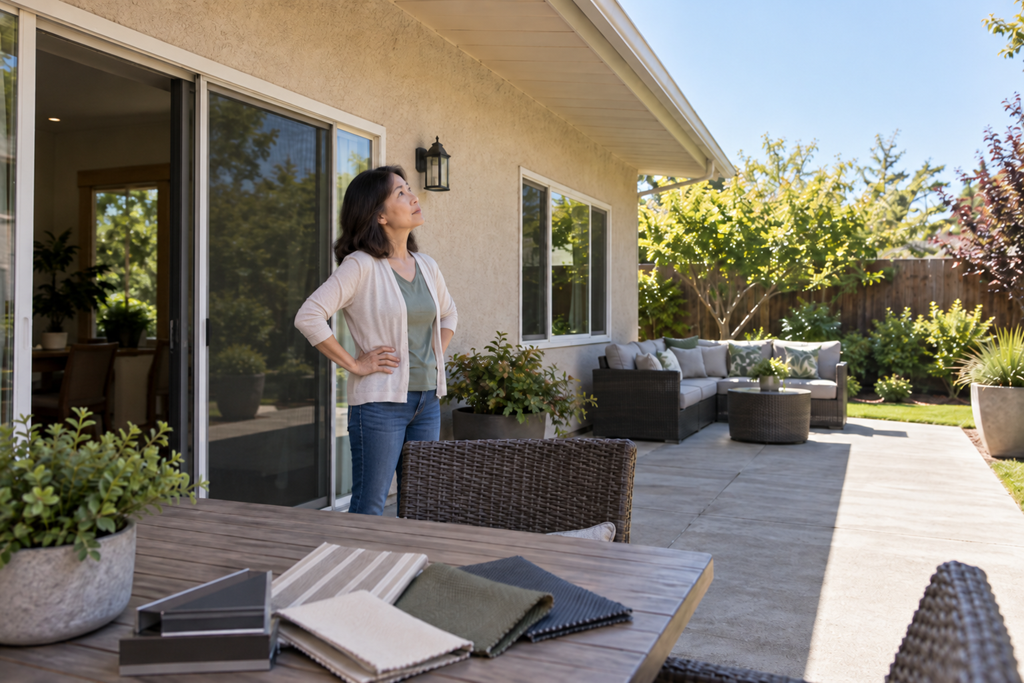
A good awning installation company should do more than show you fabric colors, product styles, and a price. Before recommending anything, the company should take time to understand where the awning will go, what you want it to accomplish, how the surrounding area is used, and what property conditions could affect the installation. For Sacramento-area homeowners, that kind of evaluation can make it easier to compare companies based on how thoughtfully they approach the project, not just how polished the sales presentation feels.
Choosing an awning can initially seem like a product decision. You may be thinking about shade, appearance, patio comfort, or covering a particular window or doorway. But once you start talking with installation companies, the more important question becomes whether the company is evaluating the awning in the context of your actual property.
That distinction can tell you a lot before you hire anyone.
A Thoughtful Evaluation Starts With the Actual Space
Before discussing specific awning options in detail, a prospective company should want to understand the area where the awning may be installed.
That does not mean the homeowner needs to understand mounting methods or other technical details. Those are matters for a qualified professional to evaluate. From the consumer side, what matters is whether the company appears to be looking beyond a single measurement or product choice.
For example, an evaluation may involve considering the relationship between the proposed awning location and nearby doors, windows, rooflines, gutters, walkways, patio furniture, landscaping, or other exterior features.
The company should also be interested in what is happening below and around the awning.
A patio used for afternoon meals may have different priorities from a window where the main concern is direct sun. A frequently used doorway creates different considerations from an area of the yard that receives little foot traffic.
The point is not that one situation automatically requires a particular awning. It is that the recommendation should come after the property and the homeowner's goal have been understood.
The Recommendation Should Follow the Goal, Not Lead It
One useful way to evaluate a company is to notice the order of the conversation.
Does the representative first try to understand what you are hoping the awning will improve? Or does the conversation immediately become a presentation about a particular model, fabric, feature, or upgrade?
A company may offer fixed, retractable, manual, motorized, or other awning configurations. You do not need to become an expert in all of them before requesting an estimate.
Instead, listen for an explanation of why the proposed option fits your situation.
A recommendation becomes more useful when the company can connect it to the actual space and your priorities rather than simply describing the product's features.
If you want afternoon shade on a Sacramento-area patio, for example, the company should understand the area you are trying to shade and how you normally use it. If appearance is a major concern, the discussion should include how the awning relates visually to the home rather than focusing only on a fabric sample viewed by itself.
Pay Attention to the Questions the Company Asks You
Homeowners often prepare questions for contractors, but the questions a company asks the homeowner can be just as revealing.
A thoughtful company may want to know when the area is typically used, what problem you are trying to solve, whether you are primarily concerned with shade or weather protection, how important visibility and openness are, and whether there are particular doors, windows, seating areas, or walkways that need to remain convenient.
For Sacramento-area properties, sun exposure, heat, dry conditions, and seasonal rain may naturally be part of the broader discussion when they are relevant to the proposed location.
The company does not need to turn the consultation into a lengthy interrogation. The important thing is that the recommendation appears connected to your property and your intended use.
If very little is asked about either one, it is reasonable to ask how the recommended awning was selected.
Look Beyond Fabric Samples and Attractive Product Photos
Fabric color, pattern, frame finish, and overall appearance matter. They are simply not the whole decision.
It is easy for an awning consultation to become centered on the most visually appealing parts of the project because those choices are easy to see and discuss. A sample may look excellent on a table while still telling you very little about how the completed awning will relate to the house.
Try to keep the larger setting in mind.
Consider where the awning would begin and end, what sits beneath it, which nearby features could matter, how people normally move through the area, and what the space looks like from inside and outside the home.
You are not trying to design the installation yourself. You are checking whether the company appears to be thinking about the complete setting rather than treating the awning as an isolated product.
The Estimate Should Make the Proposed Scope Easier to Understand
Once you receive an estimate, look for enough detail to understand what the company believes it is providing.
The exact format can vary from one company to another. What matters is whether you can reasonably identify the proposed awning, the general project scope, major included features, installation work, and any important items that are excluded or handled separately.
For example, if a motorized awning is being considered, ask whether any electrical work that may be needed is included in the proposed scope or would be handled separately.
If an existing awning must be removed, ask whether removal and disposal are included.
If there are property conditions that could change the scope after further evaluation, ask how those situations would be communicated before additional work or cost is approved.
These questions are less about demanding a particular estimate format and more about reducing assumptions.
A low price and a high price can both be difficult to evaluate when you are not sure whether the companies are proposing the same work.
Clear Communication Matters Before Installation Begins
You can also learn a great deal from how a company handles ordinary questions before you hire it.
Notice whether explanations are specific enough to understand. If you ask why a certain awning is being recommended, does the answer connect back to your property and priorities? If something is not included, is that explained clearly? If there are different options, can the representative describe the practical differences without pressuring you toward the most expensive one?
You do not need every answer to be immediate.
Sometimes a representative may need to verify a detail before responding. A willingness to check rather than guess can be more useful than an instant answer that later changes.
What you are looking for is communication that allows you to understand what is being proposed and why.
Be Cautious When the Decision Feels Rushed or Vague
Not every concern during an estimate means a company should automatically be rejected. Misunderstandings happen, and different companies have different consultation styles.
Still, certain patterns are worth slowing down for.
A recommendation made with little attention to the actual installation area may deserve additional questions. So may an estimate whose scope remains difficult to understand after you ask for clarification.
Pressure to make an immediate decision can also make comparison harder, especially when you are still trying to understand how one proposal differs from another.
The goal is not to find a presentation that sounds perfect. It is to gather enough useful information that you can compare the substance of the proposals rather than reacting mainly to price, personality, or appearance.
Useful Questions to Ask Before Hiring
A few focused questions can reveal how well the company has thought through your project:
- What did you notice about this property that influenced your recommendation?
- Why are you recommending this awning type for the way we plan to use the area?
- What is included in the estimate, and what would be handled separately?
- Are there property conditions that could change the proposed scope?
- How would you communicate with us if something unexpected affects the project?
- What should we understand about operation, care, and warranty responsibilities before choosing this option?
You do not need to ask every question in exactly these words. The goal is to understand the reasoning behind the proposal well enough to compare it with another company's approach.
A Better Comparison Is About More Than the Awning Itself
Evaluating an awning installation company is not just about deciding whether you like its products.
It is also about seeing whether the company takes time to understand the property, listens to what you want the awning to accomplish, explains why a particular option fits, and gives you enough information to understand the proposed scope.
That approach can make comparisons much more useful. Instead of asking only, "Which awning do I like?" or "Which quote costs less?" you can also ask, "Which company seems to understand what this project actually needs?"
For Sacramento-area homeowners preparing to hire an awning installation company, that is a practical place to start.