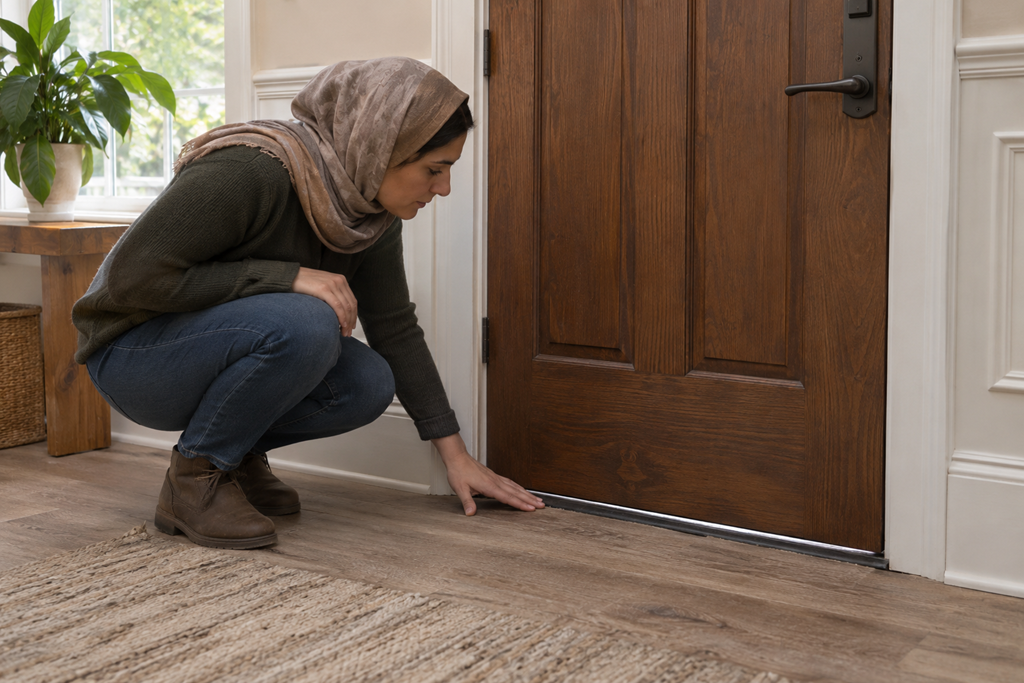
Cold air coming in under a closed door can make an entryway uncomfortable, even when the rest of the room feels warm. The problem often involves a gap between the bottom of the door and the threshold, but the cause is not always obvious. Worn seals, uneven contact, or a door that no longer closes properly can all contribute. Understanding where the air enters helps you choose a reasonable way to reduce the draft without creating new problems.
A noticeable draft does not automatically mean the door needs replacing. In many cases, the first step is to examine how the door meets the floor or threshold, identify any visible gaps, and determine whether ordinary maintenance or a removable draft barrier might help.
The goal is to reduce unwanted airflow while keeping the door comfortable to use, easy to close, and able to latch properly.
Find out where the cold air is entering
Before adding anything to the bottom of a door, pay attention to where the draft actually appears.
Cold air near the floor may seem to be coming from underneath the door, but the opening could be along the lower corner, the side of the frame, or the area where the door meets its threshold.
A few observations can help narrow down the source:
- Feel for airflow near the bottom edge. With the door fully closed, carefully move your hand near the bottom and lower corners to see where the draft is most noticeable.
- Look for visible gaps. During daylight, check whether outside light is visible beneath or around the door. A visible gap can indicate incomplete contact, although not every air leak produces visible light.
- Notice whether the draft changes when the door is closed firmly. If the airflow varies depending on how the door rests against the frame, uneven closure or sealing may be contributing.
- Check for worn or displaced materials. Look at the existing bottom seal or sweep for cracks, missing sections, looseness, or uneven contact.
- Pay attention to when the draft occurs. Air movement may be more noticeable during windy conditions or when indoor and outdoor temperatures differ.
These observations do not provide a complete diagnosis, but they can help distinguish an ordinary sealing problem from an issue involving the door's fit.
If the door closes smoothly, the surrounding frame appears sound, and the gap is relatively localized, a modest improvement may be reasonable.
Check the bottom seal before adding another barrier
Many exterior doors have a component along their bottom edge designed to limit airflow.
This component is commonly called a door sweep or bottom door seal. Depending on the door design, it may use flexible vinyl, rubber, brush-like material, or another sealing surface.
When the door closes, the seal is intended to make appropriate contact with the threshold or adjacent surface.
Over time, that contact can become inconsistent.
For example, a flexible seal may become compressed, a section may tear, or the material may no longer reach the threshold evenly. A sweep can also become loose or displaced.
Start by looking at the existing seal rather than assuming that a second layer is needed.
If there is ordinary dirt or loose debris around the contact area, gently clean it using a method appropriate for the surface. Debris can sometimes interfere with consistent contact.
If the seal is visibly worn or damaged, replacing that component may be more appropriate than covering it with another product.
However, replacement materials need to match the door's design, dimensions, and intended installation method. An overly thick or poorly fitted seal can make the door difficult to close or cause it to drag.
Avoid stacking multiple sealing materials over an existing sweep without understanding how they affect the door's operation.
Consider a removable draft stopper for a temporary improvement
A removable draft stopper can help reduce the sensation of cold air near a closed door without requiring a permanent modification.
These products commonly take the form of a weighted fabric tube or another flexible barrier placed along the inside bottom edge.
They are most useful when the goal is to make a room more comfortable while deciding whether the door needs additional attention.
A draft stopper may be worth considering when:
- The draft is concentrated near the floor.
- The door is otherwise functioning normally.
- You want a removable option rather than installing hardware.
- You are renting and cannot modify the door without permission.
- You need a temporary comfort measure while arranging a more lasting correction.
A rolled towel may also provide a temporary barrier, allowing you to see whether blocking airflow at floor level improves comfort before purchasing anything.
These approaches have limitations.
A loose barrier does not repair worn weatherstripping, correct an uneven threshold, or address a door that hangs incorrectly. It may also need to be repositioned whenever the door is opened.
Keep removable barriers from becoming tripping hazards or interfering with normal passage, including access through doors used for emergency exit.
For a frequently used exterior entry, a properly fitted door seal is generally a more convenient long-term approach than a loose barrier that must constantly be moved.
Understand how door sweeps and thresholds work together
The gap beneath a door is not always caused by a missing sweep.
The threshold—the surface at the bottom of the doorway—also affects whether the door can form a consistent seal.
Some thresholds include sealing surfaces or adjustable components, while others have a different construction.
If the bottom of the door meets the threshold on one side but leaves a gap on the other, the problem may involve uneven contact rather than the absence of sealing material.
This distinction matters because adding a thicker sweep does not necessarily correct an underlying alignment problem.
A bottom seal needs enough contact to limit unwanted airflow without creating excessive friction.
Too little contact leaves an opening. Too much contact can make the door drag, wear the seal prematurely, or become difficult to latch.
For ordinary homeowner observation, focus on whether the gap appears uniform and whether the door closes normally.
If the threshold looks loose, damaged, significantly uneven, or affected by moisture, avoid forcing an adjustment or covering the condition with additional material.
A door professional can evaluate whether the threshold, bottom seal, or door alignment needs attention.
Make sure the door closes and latches properly
A door that does not sit correctly in its frame may continue to allow cold air inside even after a new seal is added.
Pay attention to how the door behaves during normal use.
Does it close without needing an extra push? Does the latch engage smoothly? Does the door scrape the threshold? Is there an uneven gap around the lower corners?
These details can reveal whether the problem extends beyond the bottom seal.
For example, a door that has shifted slightly may make firm contact at one corner while leaving an opening elsewhere.
Similarly, an exterior door that does not close completely against its weatherstripping can allow airflow around multiple edges.
Do not attempt to solve a closing problem by adding layers of foam, adhesive strips, or other material that make the door harder to operate.
A draft reduction measure should never prevent a door from closing, latching, locking, or opening normally.
If the door requires unusual force or has recurring alignment problems, identifying the cause is more useful than repeatedly replacing sealing materials.
Remember that cold air near the floor may have another source
Not every cold sensation near a doorway comes from air entering beneath the door.
Cold air entering around the sides of the frame can move downward and collect near floor level. A poorly sealed adjacent window or another nearby opening may create a similar sensation.
Sometimes the door and surrounding surfaces are simply colder than the room, making the entryway feel uncomfortable even without a strong, concentrated draft.
This is why it helps to compare the bottom edge with the corners and sides before choosing a product.
If the cold sensation is spread across the entire entryway rather than concentrated beneath the door, a bottom draft stopper may provide only limited improvement.
Avoid assuming that every temperature difference is an air leak or that a single accessory will correct the entire problem.
The most useful response depends on the actual location and cause of the unwanted airflow.
Know when an ordinary draft becomes a door repair concern
A minor bottom-edge draft is often a household comfort issue, but some conditions deserve a closer evaluation.
Consider contacting a qualified door repair or replacement professional if:
- The door repeatedly fails to latch or lock properly.
- The frame appears warped, loose, or damaged.
- The door drags heavily against the threshold.
- A substantial gap remains despite an appropriately fitted seal.
- There are signs of recurring water intrusion or deterioration around the doorway.
- The draft returns repeatedly after reasonable maintenance.
- The opening appears visibly uneven or the door no longer sits correctly in the frame.
These conditions do not automatically mean that the entire door needs replacement.
A localized repair may be sufficient, depending on the condition of the door, threshold, frame, and surrounding materials.
For renters, report persistent gaps, damaged seals, or operational problems to the property owner or manager, especially when a permanent modification would require approval.
The important distinction is between reducing an ordinary draft and attempting to compensate for a door that is no longer functioning as intended.
Choose a lasting improvement based on the actual gap
Reducing cold air beneath a door usually begins with understanding how the bottom edge meets the threshold.
If the door operates normally and the existing seal is worn, an appropriate replacement seal may address the gap. If the concern is temporary, a removable draft stopper or rolled towel may improve comfort without modifying the door.
If the bottom gap is uneven, the door sticks, or the frame appears damaged, additional sealing material may only conceal the underlying issue.
After trying a reasonable improvement, close and open the door several times. Confirm that it still moves freely, latches properly, and does not create a tripping hazard or obstruct an exit.
The most useful improvement is one that reduces unwanted airflow while preserving the door's normal function. A small amount of careful observation can help you avoid unnecessary purchases and recognize when the problem requires more than a household draft barrier.
If you're considering a door draft stopper, replacement door sweep, or another product to help reduce cold air entering beneath your door, explore the Home Comfort And Weather Protection category at the Sacramento Local Pros Store. You'll find household weather-protection options to consider based on your door's condition and your specific needs.
Disclosure: Sacramento Local Pros may earn a commission from qualifying purchases made through links on the Sacramento Local Pros Store.