Cryotherapy is usually easier to evaluate when you think of it as a possible supporting part of your wellness routine rather than the routine itself.
The most useful question is not simply, “Does cryotherapy work?” A better question is, “What specific role do I expect this service to play, and how will I decide whether it is useful for me?”
That distinction matters because cryotherapy can easily become surrounded by broad promises. A Sacramento resident may hear that it can help with recovery, soreness, energy, mood, sleep, inflammation, performance, or general well-being. Without a clearly defined purpose, it can be difficult to separate a personally useful experience from an appealing list of claims.
Start By Defining What You Want From the Experience
Before scheduling cryotherapy, identify the specific reason you are considering it.
You might be exploring it as an occasional recovery experience after physically demanding activity. You might want to know whether supervised cold exposure leaves you feeling temporarily refreshed or more comfortable. You may simply be curious about whether it deserves a place in your broader self-care routine.
These are more useful starting points than expecting the service to improve your health in a general or undefined way.
A narrow goal also gives you something practical to evaluate. Instead of wondering whether the session “worked,” you can pay attention to the particular experience that led you to schedule it.
For example, did it seem relevant to the recovery concern you discussed? Was the experience comfortable enough to consider again? Did the provider explain what could and could not reasonably be expected?
Cryotherapy Is Not One Identical Service Everywhere
The word cryotherapy can refer to different forms of cold exposure. A provider may offer localized treatment, partial-body exposure, or whole-body cryotherapy, and the equipment, preparation, temperatures, and intended uses may differ.
That means two businesses using the same general term may not be offering the same experience. When comparing Sacramento-area providers, ask what type of cryotherapy is being offered rather than assuming every chamber, device, or appointment works the same way.
Understanding the specific service also helps prevent an important misunderstanding: information about one type of cryotherapy should not automatically be applied to every other type.
Keep the Foundations and the Add-Ons in Separate Lanes
A wellness routine generally includes the ordinary practices that shape daily life, such as sleep, movement, nourishment, stress management, and appropriate medical care.
Cryotherapy is better viewed as a possible add-on to those foundations.
An add-on should support the larger routine rather than compete with it. If frequent appointments begin replacing adequate rest, regular activity, professional care, or other priorities, the routine may be becoming organized around the service instead of the service fitting into the routine.
This does not mean cryotherapy has no place. It means its place should remain proportionate.
A wellness service can feel worthwhile without becoming essential. You should also be able to pause or discontinue it without feeling that you have abandoned your entire approach to well-being.
Look for Modest, Observable Expectations
Broad expectations are difficult to evaluate. Phrases such as “total reset,” “complete recovery,” or “whole-body transformation” may sound appealing, but they do not tell you what you are realistically supposed to notice.
A more useful provider conversation separates immediate sensations from larger health claims.
A person may leave a session feeling refreshed, temporarily more comfortable, uncertain that anything changed, or simply pleased that they tried something new. None of those individual reactions proves that the service will produce a broader or lasting health outcome.
Research involving whole-body cryotherapy has also produced different findings depending on the population, purpose, and outcome being studied. One systematic review found insufficient evidence to determine whether it reduced muscle soreness or improved subjective exercise recovery compared with passive rest or no whole-body cryotherapy.
That uncertainty does not require an automatic yes or no. It supports keeping expectations specific, personal, and measured.
Frequency Should Follow a Reason, Not a Package
It can be tempting to decide how often to schedule cryotherapy based on the package presented at the front desk.
A better approach is to understand why a particular frequency is being recommended.
The provider should be able to explain:
- What the proposed schedule is intended to accomplish
- Why that schedule may fit the goal you described
- What you should pay attention to between appointments
- When it would make sense to continue, pause, or reconsider
- Whether you can begin with a single appointment before making a larger commitment
A recommendation is more useful when it has a clear purpose. “Most clients buy this package” is not the same as explaining why that number of sessions may be relevant to you.
Preparation and Screening Are Part of the Service
Cryotherapy involves intentional exposure to cold, so provider communication should begin before the session.
You should be given an opportunity to discuss relevant health information, medications, cold sensitivity, recent procedures, previous reactions to cold, and any concerns that may affect whether the service is appropriate for you.
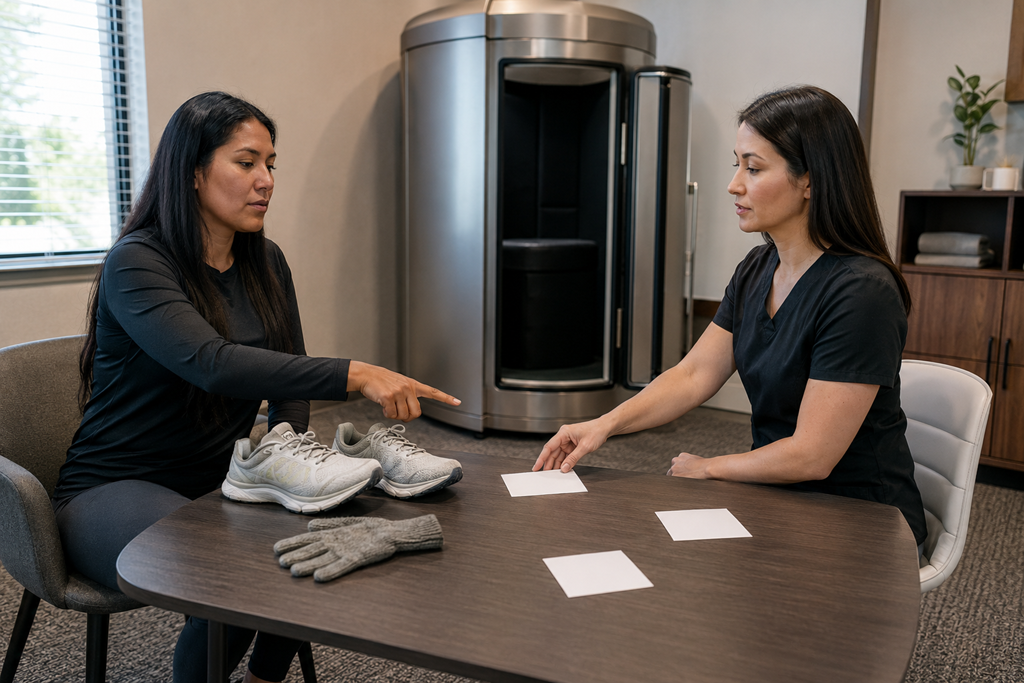
The provider should also explain preparation requirements, protective items, what the experience may feel like, how you will communicate during the session, and how the session can be stopped.
Safety reviews of whole-body cryotherapy have documented adverse events and emphasize the importance of appropriate screening, preparation, protective measures, and supervision.
A provider who treats these conversations as routine rather than inconvenient is giving you useful information about how the business approaches client care.
Useful Questions to Ask a Cryotherapy Provider
A few focused questions can help you understand how the service may fit into your routine:
- What type of cryotherapy do you provide?
- What is this particular service intended to help with?
- What results should I not expect from it?
- What health information should I share before participating?
- What protective items and preparation steps are required?
- How is the session monitored, and how can I stop it?
- Why would you recommend more than one appointment?
- How should I decide whether continuing is worthwhile?
Clear answers do not guarantee that cryotherapy will be useful for you. They do make it easier to distinguish an informed decision from one based mainly on promotional language.
Be Cautious When One Service Is Presented as the Answer to Everything
A long list of promised benefits can make a wellness service appear more comprehensive than it really is.
Be cautious when a provider suggests that cryotherapy can replace medical evaluation, resolve many unrelated concerns, guarantee recovery, or produce predictable results for nearly everyone.
Similar caution is appropriate when questions are dismissed, limitations are avoided, or a large package is presented before your goals and health information have been discussed.
Good communication may sound less exciting than an expansive promise, but it gives you more useful information for making a decision.
The Right Place in Your Routine May Be a Small One
Cryotherapy does not have to become a central habit to have a place in your routine.
You may decide that an occasional session feels useful after certain activities. You may try it once and conclude that the experience is not valuable enough to repeat. You might also decide to discuss it with a healthcare professional before proceeding.
Each of those outcomes can reflect thoughtful decision-making.
The goal is not to force cryotherapy into your routine. It is to understand the service well enough to decide whether it naturally supports the routine you already have.
A Practical Way to Think About the Decision
Think of cryotherapy as an optional service with a defined purpose, realistic limits, and a need for appropriate screening.
Before committing, make sure you understand the type of cryotherapy being offered, what the provider believes it may help with, what cannot be promised, and how you will judge the experience for yourself.
For Sacramento-area residents comparing cryotherapy providers, clear explanations, careful preparation, and reasonable expectations are more useful than an extensive list of claims.
This article is educational and is not medical advice. Discuss personal health concerns, risks, candidacy, or treatment decisions with a qualified healthcare professional.