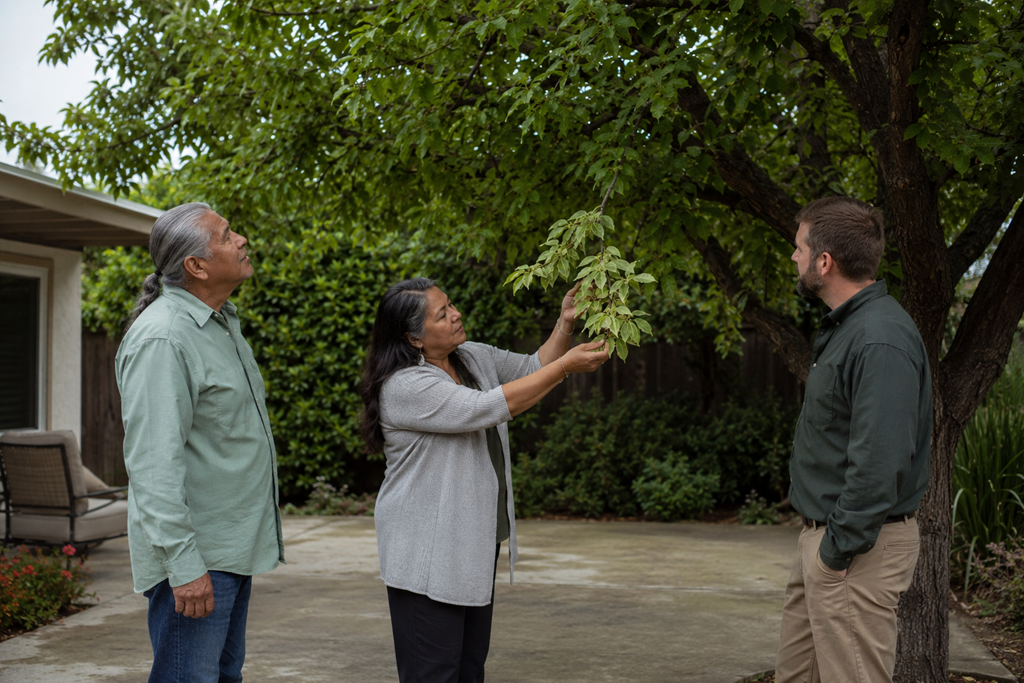
Early tree stress often appears as a change from the tree’s normal pattern rather than one dramatic symptom. A canopy may look slightly thinner, leaves may be smaller or discolored, or one section may respond differently from the rest. Noticing those shifts early can help a Sacramento-area homeowner decide whether the tree simply needs observation or whether a qualified tree professional should evaluate it.
Tree stress can be easy to miss because many early signs look ordinary when viewed separately. A few yellow leaves, a bare twig, or dry soil may not seem important. The concern becomes clearer when the change is new, concentrated in one area, spreading over time, or appearing alongside other unusual conditions.
The goal is not to diagnose the tree from the ground. It is to recognize meaningful changes, document what you see, and make a better-informed decision about whether professional attention may be appropriate.
Look for changes in the tree’s usual pattern
The most useful comparison is often not between your tree and a neighboring tree. It is between the tree’s current appearance and its own normal appearance.
Different tree varieties naturally produce different leaf colors, canopy shapes, bark textures, and seasonal responses. Two trees growing next to each other may react differently to heat, dry conditions, sun exposure, irrigation, pruning, or seasonal rain.
That is why a single symptom rarely tells the whole story. A tree may deserve closer attention when something looks noticeably different from previous seasons or when one part of the tree behaves differently from the rest.
Changes worth observing may include:
- A canopy that appears thinner than usual
- Leaves that are noticeably smaller, paler, curled, or unusually dry
- One branch or canopy section losing leaves before surrounding areas
- New clusters of bare twigs among otherwise leafy growth
- A gradual reduction in the amount of new growth
- Leaf drop occurring in a concentrated area rather than evenly throughout the tree
These observations do not prove that the tree has a serious problem. They provide useful context that a tree professional can evaluate.
The canopy may reveal stress before the trunk does
Homeowners often focus on the trunk because it is easier to inspect from the ground. However, the canopy may show an early change first.
A stressed tree may produce fewer leaves, smaller leaves, shorter new shoots, or uneven growth. One side may remain full while another becomes increasingly sparse. The upper canopy may also appear less dense, allowing more light through than it did previously.
The important detail is the pattern. A few missing leaves are usually less informative than a section that continues to thin over time.
Viewing the tree from several safe positions can make these differences easier to notice. Looking from only one side may hide a sparse upper branch or make a naturally open canopy appear fuller than it is.
Avoid standing directly beneath branches that appear cracked, detached, or unstable. Do not climb the tree or attempt to remove questionable limbs simply to investigate them.
Leaves can provide clues without providing a diagnosis
Leaves respond to many conditions, including seasonal changes, watering patterns, root disturbance, insects, disease, heat, and ordinary aging. That makes leaf appearance useful but not definitive.
One discolored leaf is rarely meaningful. A repeated or spreading pattern deserves more attention.
For example, a homeowner might notice that leaves on one side of a tree are consistently smaller than those on the opposite side. Another tree may develop browning along the edges of many leaves rather than on only a few isolated leaves. Some trees may begin dropping leaves in one concentrated area while the rest of the canopy remains intact.
The location and distribution of the change can be more informative than the color alone.
It also helps to consider whether anything recently changed around the property. Adjustments to irrigation, landscaping, drainage, paving, fencing, soil level, or nearby construction may affect the area around a tree even when the trunk has not been touched.
The ground around the tree adds important context
Tree health is connected to conditions above and below the soil. Although roots are mostly hidden, changes at ground level can reveal conditions worth mentioning during a professional evaluation.
Look from a safe distance for visible changes such as:
- Newly compacted soil where vehicles, equipment, or repeated foot traffic have passed
- Soil erosion that has exposed roots
- A recent trench, paved surface, retaining feature, or landscape installation near the tree
- Water consistently collecting in one area
- Soil that remains unusually dry while nearby lawn areas receive regular irrigation
- Mulch or soil newly piled against the base of the trunk
- A raised ridge, crack, or unusual movement in the soil near the root area
These signs do not all mean the same thing. Some may be harmless, while others may help explain changes in the canopy.
The practical question is not simply, “Does the soil look dry?” It is, “Has something changed around the root area at the same time the tree’s appearance changed?”
Bark and branch changes may deserve a closer look
Mature bark naturally develops ridges, plates, color variations, and irregular textures. Not every crack or rough patch indicates stress.
A newer change may be more useful to document than a feature that has looked the same for years.
Examples include bark separating in a new area, a fresh crack, unusual moisture or residue, a newly exposed section of wood, or fungal growth appearing near the trunk or root area. Repeated dieback at branch tips may also provide context when it appears alongside canopy thinning or leaf changes.
Avoid scraping, drilling, cutting, peeling, or probing the bark to investigate. Those actions can damage the tree and may make the original condition harder to evaluate.
A clear photograph taken from a safe position is usually more helpful than attempting to inspect the area physically.
Several small changes can matter more than one obvious symptom
Tree stress is often recognized through a combination of modest changes.
A thinner canopy alone may reflect normal pruning or seasonal growth. Dry soil alone may not indicate a problem. A small bark irregularity may have been present for years.
However, a thinning canopy combined with smaller leaves, newly compacted soil, and progressive branch-tip dieback creates a more meaningful pattern.
This is why it helps to avoid two common reactions:
The first is assuming that one unusual leaf means the tree is failing.
The second is dismissing several gradual changes because none of them looks dramatic on its own.
Early observation should lead to better questions, not an immediate conclusion.
Photographs can make gradual changes easier to recognize
Tree stress may develop slowly enough that day-to-day changes are difficult to see. Photographs can provide a simple visual reference without requiring technical inspection.
A homeowner can photograph the entire tree from the same safe location and capture closer views of any visible canopy, bark, or soil changes. Comparing those images later may show whether the condition is stable, improving, spreading, or becoming more noticeable.
Useful background information may include:
- Approximately when the change was first noticed
- Which part of the tree appears affected
- Whether the condition seems to be spreading
- Recent changes to watering or drainage
- Nearby digging, paving, landscaping, or construction
- Recent pruning or storm damage
- Whether branches, leaves, or bark have changed at the same time
This information can help a local tree professional understand what has been happening before recommending any work.
Know when an evaluation may be worth discussing
Some early changes can be observed for a period, while others may justify a professional evaluation sooner.
Consider contacting a qualified tree professional when the condition is becoming more noticeable, affecting multiple parts of the tree, or appearing alongside structural changes.
Examples may include progressive canopy thinning, several newly dead branches, a fresh trunk crack, sudden changes in the tree’s lean, movement in the surrounding soil, or a questionable branch positioned over a driveway, walkway, structure, or frequently used area.
The purpose of an evaluation is not automatically to recommend removal or major work. A good evaluation should help distinguish between a condition that can be monitored and one that may require pruning, site adjustments, treatment, or another response.
Questions to ask a tree professional
When scheduling an evaluation, concise questions can help you understand the reasoning behind any recommendation:
- Which visible signs appear most significant?
- Does the condition look recent, longstanding, or progressive?
- Could soil, irrigation, drainage, or nearby property changes be contributing?
- Is continued observation reasonable?
- What changes should prompt another evaluation?
- What work is being recommended, and what specific concern would it address?
Clear answers should connect the proposed service to visible conditions rather than relying on vague statements about the tree being unhealthy.
Early attention is about context, not panic
Noticing early tree stress does not mean assuming the worst. It means paying attention when a tree begins to depart from its usual pattern.
A few photographs, a basic record of recent property changes, and an understanding of where the symptoms appear can make a professional conversation more productive. Sacramento-area homeowners who notice gradual changes early are better prepared to ask focused questions, understand recommendations, and decide whether monitoring or professional service makes sense.