The cost of pool tile cleaning can vary because the visible waterline is only one part of the job. The amount and type of buildup, the tile material, how easy the pool is to access, the size of the area being cleaned, and the cleaning method a provider considers appropriate can all change the scope. For Sacramento-area homeowners, the useful question is not simply “What does pool tile cleaning cost?” but “What conditions is this estimate based on?”
That distinction matters because two pools that appear similar from across the yard may require very different amounts of work. One may have a light, fairly consistent line of residue around an easily accessible perimeter. Another may have heavier deposits, multiple tiled areas, raised sections, decorative features, or access limitations that make the service more involved.
Understanding those differences can make it easier to compare pool tile cleaning estimates without assuming that every provider is pricing exactly the same job.
The Visible Waterline Does Not Always Tell the Whole Story
Pool tile cleaning is often associated with the noticeable line that develops near the water level. That may be the most obvious part of the problem, but it does not necessarily reveal the full cleaning scope.
A provider may need to consider how far the buildup extends, whether it is consistent around the pool, and whether additional tiled surfaces are involved.
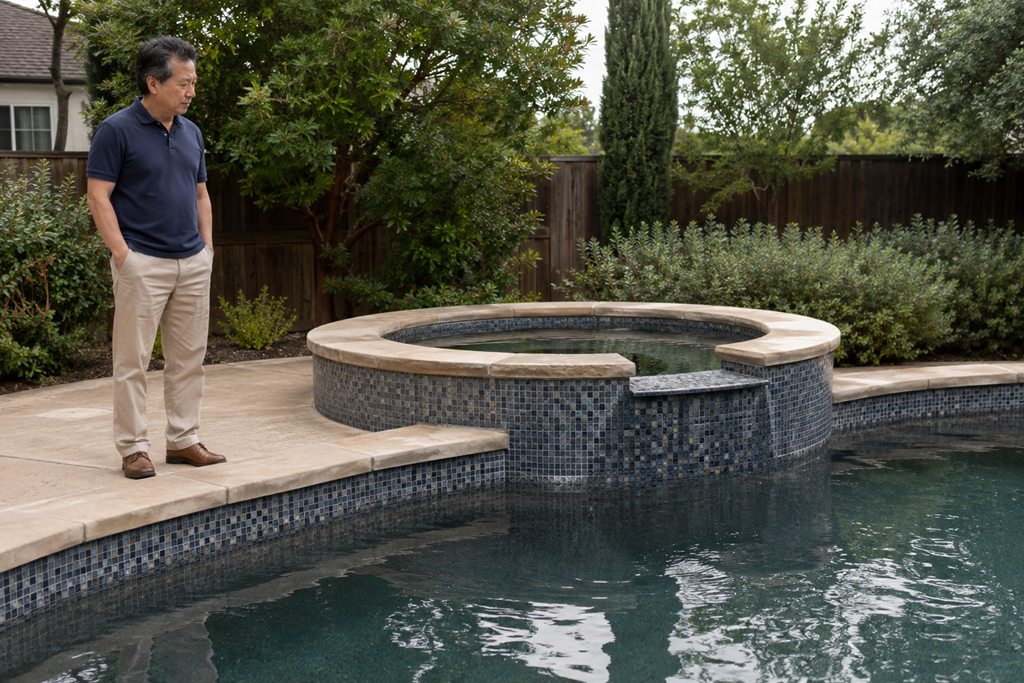
For example, a pool might have tile around the main perimeter as well as a raised spa, steps, decorative sections, spillways, or other tiled features. Even when each individual area looks modest, the combined amount of surface to be addressed can change the overall job.
This is one reason a quick description such as “I need the waterline cleaned” may not be enough to predict what an estimate will include.
The Type and Amount of Buildup Can Change the Job
Not every discolored or coated waterline represents the same condition.
Some pools may have relatively light surface residue. Others may have more substantial mineral deposits or buildup that has accumulated unevenly over time.
The difference matters because a lightly affected surface and a heavily coated one may not require the same amount of attention.
The important point for a homeowner is not to diagnose the buildup independently. It is to understand how the provider is defining the condition they are proposing to clean.
When comparing estimates, it can be helpful to determine whether providers are looking at the same areas and describing the existing buildup in similar terms.
Tile Material and Surface Details Can Affect the Approach
The tile itself can also influence the service.
Pool tile comes in different materials, finishes, shapes, textures, and decorative configurations. A broad area of relatively uniform tile presents a different working surface from intricate mosaics, textured tile, small individual pieces, or areas with numerous edges and transitions.
That does not automatically mean one type will always cost more than another. It means the physical surface is part of the service scope.
A useful estimate should make it reasonably clear what tiled surfaces are being considered rather than treating every pool perimeter as interchangeable.
Access Can Matter Even When the Pool Is Not Large
A homeowner may understandably focus on the size of the pool, but the way the service area can be reached may matter too.
Consider two pools with approximately the same amount of tile. One sits in an open backyard with straightforward access from the side of the property. The other is behind a narrow gate, close to landscaping, surrounded by tight walkways, or positioned in a yard where equipment placement is less convenient.
The tile-cleaning need may look similar, while the working conditions are different.
Access does not automatically make a project difficult or expensive. It is simply one of the practical details worth clarifying before assuming that a price from one property should apply to another.
The Amount of Tile Matters More Than Simply “Having a Pool”
Pool dimensions can be useful context, but they do not always tell you how much tile is actually involved.
A relatively compact pool may contain a significant amount of decorative tile, a raised spa, multiple tiled elevations, or other features. A larger pool may have a simpler perimeter.
That is why estimates based only on a general pool description can be difficult to compare.
If one provider is considering only the main waterline and another is including additional tiled features, their prices may look different even though neither estimate is necessarily inconsistent.
The difference may simply be scope.
The Cleaning Method Can Affect What the Estimate Includes
Providers may also evaluate which cleaning approach is appropriate for the particular tile and buildup they observe.
Homeowners do not need to become experts in cleaning techniques to compare services effectively. What matters more is understanding what a provider proposes to do and what areas that proposed service covers.
If two estimates use different approaches, comparing the final price alone may hide an important distinction.
One quote could represent a narrowly defined service for a particular section of tile, while another could reflect broader treatment of several tiled areas or a different process based on the surface conditions.
A short explanation from the provider can often make that difference much easier to understand.
Small Physical Details Can Add Up
Cost differences are not always caused by one dramatic condition.
Sometimes several ordinary factors combine:
- heavier buildup in one section
- more tiled perimeter than expected
- a raised spa or decorative feature
- a surface that requires a different cleaning approach
- restricted access to part of the pool
- additional setup or protection considerations
None of these details automatically tells you what the service should cost.
Together, however, they help explain why pool tile cleaning is difficult to reduce to one universal price based solely on the fact that a home has a pool.
What to Ask When Comparing Pool Tile Cleaning Estimates
You do not need a long interrogation or technical checklist. A few direct questions can reveal whether two estimates actually describe comparable services.
Consider asking:
- Which tiled areas are included in this estimate?
- Does the quoted scope include the spa or other tiled features?
- How would you describe the buildup you are seeing?
- Is access to any part of the pool affecting the proposed service?
- What cleaning approach are you recommending for this tile?
- Are there areas that are specifically not included?
The goal is not to challenge the provider's price. It is to understand what that price represents.
Once the scope is clearer, comparing estimates becomes more meaningful.
A Lower Estimate May Simply Describe a Smaller Job
One common source of confusion is assuming that two prices are directly comparable because both providers use the phrase “pool tile cleaning.”
The service descriptions may actually be different.
A lower estimate might cover only the primary waterline. Another could include a raised spa or additional tiled features. One provider may be evaluating light buildup while another has accounted for more extensive deposits in certain areas.
That does not mean the higher quote is automatically better, or that the lower quote is automatically incomplete.
It means the scope deserves as much attention as the price.
When an estimate differs substantially from another, asking what each provider has included can be more useful than immediately deciding which number seems more attractive.
The Most Useful Price Is One You Understand
Pool tile cleaning costs can be influenced by several ordinary property and service conditions rather than one simple pricing factor. The amount and type of buildup, tiled surface area, material, layout, access, additional features, and proposed cleaning approach can all affect what a provider is actually being asked to address.
For Sacramento-area homeowners, the practical takeaway is to compare the work behind the number.
When you understand which surfaces are included, what condition the provider is evaluating, and what service is being proposed, you are in a much better position to decide whether different estimates are truly comparable before scheduling the work.