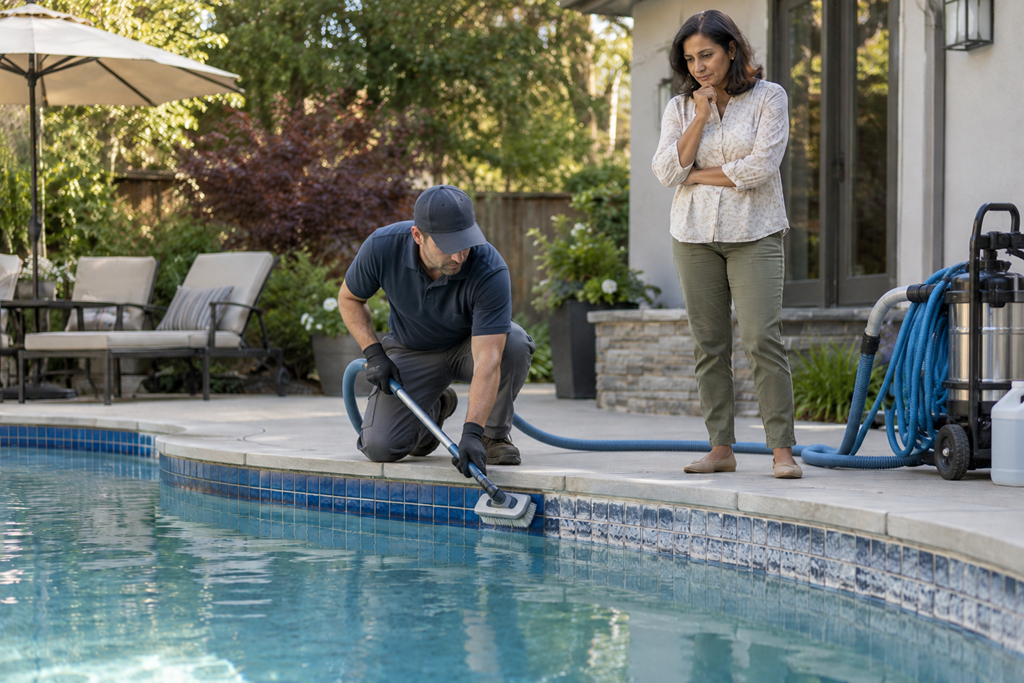
Before pool tile cleaning, it is common for the waterline to look dull, chalky, uneven, or discolored even when the rest of the pool is well maintained. After professional cleaning, the biggest change is usually a cleaner, more uniform tile surface—but cleaning does not necessarily make older tile look brand-new or correct damage that is already present.
That distinction can make the experience easier to understand. Pool tile cleaning is primarily about removing buildup from the tile surface. It is not the same as replacing tile, repairing damaged grout, restoring worn finishes, or correcting every visible imperfection around the pool.
For Sacramento-area homeowners considering the service, knowing what the tile looks like before cleaning—and what may remain afterward—can help set more realistic expectations before scheduling a local professional.
The Waterline Usually Tells the Story Before Cleaning
The most noticeable reason homeowners consider pool tile cleaning is often a visible band of buildup near the waterline.
Depending on the pool and its condition, that area may appear chalky, cloudy, rough, streaked, or simply less vibrant than the tile farther above the water. The change may be gradual enough that homeowners do not realize how different the surface looks until they examine it closely.
This can create an understandable assumption: if the visible material can be removed, the tile underneath should look exactly as it did when it was new.
Sometimes the improvement can be substantial. But the condition of the underlying tile still matters.
A useful way to think about the service is that cleaning can reveal the tile that is already there. It cannot change the age, finish, wear, chips, cracks, grout condition, or other existing characteristics of that tile.
A Good Pre-Service Conversation Separates Buildup From Tile Condition
Before scheduling the work, it helps to understand what the provider believes you are seeing.
Some visible discoloration may be surface buildup that cleaning is intended to address. Other marks or variations may be part of the tile itself or may reflect wear that cleaning will not remove.
Homeowners do not need to diagnose the difference themselves. That is one reason a professional evaluation can be useful.
The important part is communication.
If a section looks particularly rough, faded, stained, chipped, or uneven before the appointment, ask what the provider expects cleaning to improve and what may still be visible afterward.
This gives you something more useful than a general promise that the tile will be "clean." It gives you a clearer picture of what the service is actually intended to change.
Preparation May Depend on the Provider's Cleaning Process
There is no reason to assume that every pool tile cleaning appointment will be prepared or carried out exactly the same way.
The cleaning method, pool design, accessibility of the waterline, amount of buildup, surrounding materials, and provider's process can all affect how the service is approached.
A provider may have specific instructions about access to the pool area, movable furniture or belongings, pets, gates, or other practical considerations. Depending on the process being used, other preparation may also be discussed before the appointment.
The simplest approach is to ask what the provider needs from you rather than trying to prepare the pool based on assumptions.
That conversation can also clarify whether the pool can be used immediately afterward or whether the provider recommends waiting for a period of time based on the work performed.
The Biggest After-Cleaning Change Is Often Visual Consistency
After cleaning, homeowners commonly expect to notice the greatest difference along the portion of tile that previously carried the most visible buildup.
Colors may appear clearer. The waterline may look less cloudy or chalky. A surface that previously looked uneven because of deposits may appear more consistent.
But the result does not have to look perfectly uniform to indicate that cleaning made a meaningful difference.
One section of a pool may have had heavier deposits than another. Tile exposed to different conditions may also have aged differently. Grout and tile can change over time independently of the buildup being removed.
This is why it is helpful to judge the finished work against the actual starting condition rather than against an imagined brand-new surface.
Cleaning Can Make Existing Imperfections Easier to Notice
There is another after-cleaning effect that can surprise homeowners: once buildup is gone, features of the underlying tile may become more noticeable.
A small chip that blended into a cloudy waterline may stand out more clearly. Older grout may look different next to freshly cleaned tile. Natural variation between tile pieces can become easier to see.
That does not automatically mean the cleaning caused the condition.
The important question is whether the imperfection was already present, whether it represents ordinary wear, and whether it is something that should be discussed separately with an appropriate professional.
Taking a few photographs before service can provide a simple visual reference if you want to remember what the area looked like beforehand.
"Cleaner" And "Like New" Are Different Expectations
One of the most useful expectations to establish before pool tile cleaning is the difference between cleaning and restoration.
A cleaning service can focus on surface deposits without promising to return every tile, grout line, or finish to its original appearance.
This matters particularly with an older pool.
A homeowner may be very satisfied with a waterline that looks dramatically cleaner even though small signs of age remain. Another homeowner may be expecting a flawless appearance and feel disappointed by the same result.
Neither reaction is really about cleaning alone. It is about what the homeowner expected the service to accomplish.
That is why questions about anticipated results are worth asking before committing.
A Few Questions Can Clarify What You Should Expect
When comparing Sacramento-area pool tile cleaning providers, you can keep the conversation simple and focused on the condition of your own pool.
Useful questions may include:
- What parts of what I am seeing appear to be removable buildup?
- Are there visible conditions that you would not expect cleaning to change?
- What preparation do you need from me before the appointment?
- How should I evaluate the finished tile once the cleaning is complete?
- If damaged tile or grout becomes more noticeable afterward, is that outside the scope of this service?
Clear answers can help distinguish the cleaning itself from separate repair or restoration work.
Look at the Finished Surface in the Context of Where It Started
After the appointment, compare the waterline with what you saw beforehand rather than judging it only from memory.
Look at the overall cleanliness and consistency of the tile. If certain areas still look different, ask whether you are seeing remaining buildup, a characteristic of the tile, grout variation, or an existing condition that cleaning was not intended to address.
This is also a reasonable time to ask questions if the finished appearance differs materially from what was discussed before the service.
You do not need to expect absolute visual perfection to evaluate whether the work met the agreed-upon scope.
The Most Useful Expectation Is a Realistic One
Pool tile cleaning can make a noticeable difference when buildup has dulled or obscured the waterline, but the service should be understood for what it is: cleaning the existing surface, not creating a completely new one.
Before hiring a local pro, try to get a clear explanation of what appears cleanable, what may remain, what preparation is required, and what the finished tile is reasonably expected to look like.
That makes it easier to evaluate the result based on the actual condition of your Sacramento-area pool rather than an assumption that every visible imperfection will disappear.