Replacing a lawn with low-maintenance landscaping is not just a choice between grass and gravel. For Sacramento-area homeowners, the more useful question is what they want the yard to do after the lawn is gone—how it should look, how much upkeep still feels reasonable, how the space will be used, and what kind of long-term care they are actually willing to take on.
That distinction matters because “low-maintenance” can mean very different things from one homeowner to another. One person may want to stop mowing every week. Someone else may want to reduce watering, simplify seasonal cleanup, create more usable space, or spend less time managing plants.
Removing a lawn can support those goals, but the replacement still needs to fit the property and the way the household actually uses the yard.
Low-Maintenance Does Not Mean No-Maintenance
One of the easiest assumptions to make is that replacing turf will eliminate most yard work.
Usually, it changes the work instead.
A planted landscape may require less frequent attention than a traditional lawn but still involve pruning, cleanup, irrigation monitoring, mulch renewal, or plant replacement over time. Decorative rock eliminates mowing but can still collect leaves and debris. Hardscape may reduce planted areas but creates its own cleaning and surface-care considerations.
Even a landscape designed around simplicity still needs some attention.
That does not make lawn replacement a poor choice. It simply means homeowners are better served by asking what kind of maintenance they would rather have instead of assuming maintenance will disappear completely.
Think About What the Yard Needs to Do
Before focusing on materials, it helps to look at how the space functions now.
A lawn may currently serve several purposes without the homeowner consciously thinking about them. It might provide an open area for children or pets, create separation between a patio and property boundary, offer a route through the yard, or simply provide visual openness.
Replacing that lawn with one uniform surface may solve the mowing problem while creating a yard that works less naturally for everyday life.
For example, a homeowner who rarely uses the center of a lawn may prefer to divide the area into several simpler zones. Another household may discover that keeping some open space matters more than eliminating every section of grass.
The important question is not simply, “What should replace the lawn?”
It is, “What do we want this part of the property to do when the lawn is gone?”
That question can make conversations with landscaping professionals much more productive.
The Replacement Material Changes the Future Chores
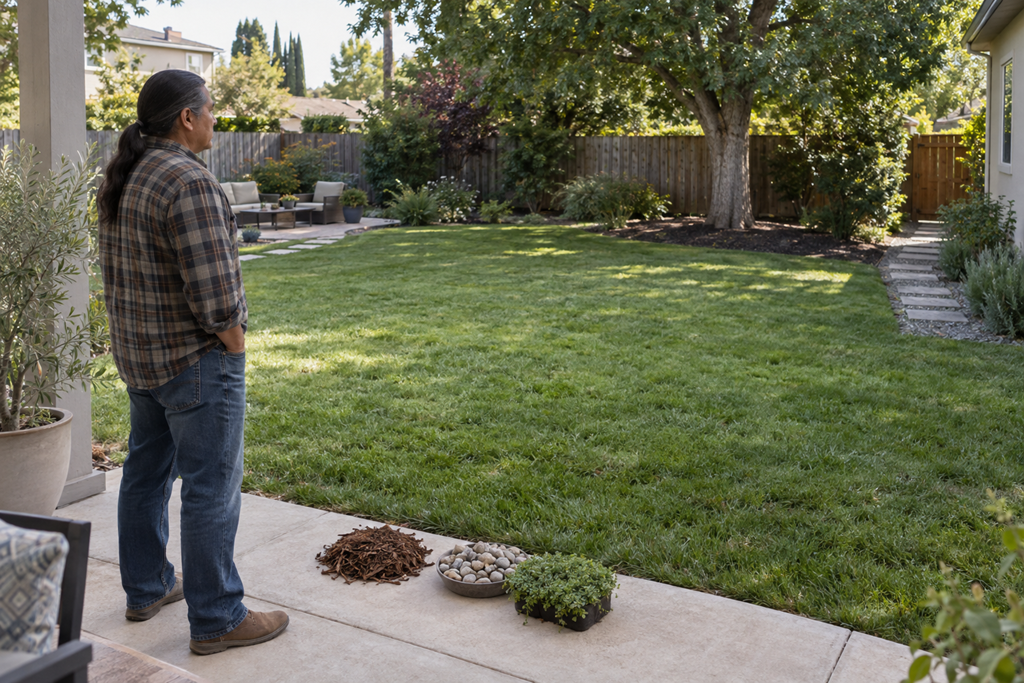
Low-maintenance landscaping can include many different combinations of planted areas, mulch, rock, pathways, hardscape, groundcovers, seating areas, or other landscape elements.
Those choices do not create the same experience.
A homeowner who dislikes mowing may be comfortable with occasional plant trimming. Someone who wants less plant care may prefer more hardscape or non-living materials. Another homeowner may place more importance on shade, greenery, pet use, outdoor seating, or the appearance of the property from the street.
This is why comparing landscaping plans only by how much lawn they remove can be misleading.
Two proposals might eliminate the same amount of turf while creating very different yards—and very different future maintenance routines.
Before choosing a design, it can help to ask a provider to explain what routine care each major part of the proposed landscape is likely to need.
Sacramento Conditions Can Make Certain Tradeoffs More Noticeable
Sacramento-area homeowners may also want to consider how strong sun, heat, dry periods, and seasonal rain interact with the proposed landscape.
A large exposed area may experience sunlight differently from a shaded section beneath established trees. Some surfaces may feel warmer in direct sun. Planted areas may have different watering considerations from non-planted spaces. Seasonal rain can also make drainage and water movement important parts of the overall project discussion.
These conditions do not point to one universally correct landscape.
They are reasons to evaluate the property as a whole rather than choosing a replacement material based mainly on appearance.
A landscaping professional should be able to discuss how the proposed design relates to the property's existing sun exposure, shade, drainage patterns, vegetation, irrigation, access, and intended use without making the conversation unnecessarily complicated.
What Is Already in the Yard Can Affect the Project
The lawn itself is only the visible surface.
Existing irrigation, trees, roots, slopes, drainage patterns, edging, walkways, gates, patios, utility areas, and other landscape features may affect how a lawn replacement project is approached.
That is another reason a simple idea such as “remove the grass and put something else there” can become more involved once the property is evaluated.
Homeowners do not need to diagnose these conditions themselves.
What matters is recognizing that a useful estimate should reflect the actual property rather than treating the lawn as an isolated rectangle.
If one proposal seems unusually simple compared with others, it is reasonable to ask what has and has not been included in the proposed scope.
A Lower-Maintenance Yard Should Still Feel Like Your Yard
It is easy to become focused on eliminating a disliked chore.
But a yard is also part of the way a home looks, feels, and functions.
If the main goal is reducing mowing, a homeowner may not need to remove every section of turf. If the goal is reducing overall yard work, replacing grass with a complicated planting design may not accomplish that. If outdoor entertaining is important, the useful space may matter more than maximizing planted or non-planted areas.
This is where personal priorities matter more than adopting a particular landscaping style.
A successful conversation with a local landscaping provider should help connect the physical design to the homeowner's actual expectations rather than simply presenting lawn removal as the goal.
Questions Worth Asking Before Approving a Plan
A few focused questions can reveal whether a proposal fits what you actually want:
- What regular maintenance should I expect after this landscape is established?
- Which parts of the yard are being kept, removed, or changed?
- How does the plan account for the way we use this space?
- Are existing irrigation or drainage conditions relevant to the proposed work?
- How might sun and shade affect the different areas of the design?
- What is included in the project scope, and what would remain my responsibility afterward?
The answers can also make it easier to compare proposals that look similar at first glance.
A lower price, fewer plants, or more hardscape does not automatically mean a landscape will be simpler to live with. Understanding the complete plan gives the homeowner a better basis for comparison.
Be Careful With the Phrase “Low-Maintenance”
“Low-maintenance” is useful as a goal, but it is not a precise description of a landscape.
A provider may interpret it as less mowing. A homeowner may mean less watering, fewer recurring chores, less seasonal cleanup, or fewer areas requiring attention.
Those are not necessarily the same objective.
Explaining what you personally want to spend less time doing can be much more useful than simply asking for a low-maintenance yard.
It also gives landscaping professionals something more specific to respond to when suggesting options or preparing an estimate.
The Best Starting Point Is the Life You Want After the Lawn
Before replacing a lawn, think beyond the moment when the grass disappears.
Consider how you expect to walk through the space, use it, maintain it, look at it from inside the home, and care for it over the years ahead. Then use those priorities when discussing materials and project scope with local landscaping professionals.
For Sacramento-area homeowners, that perspective can turn lawn replacement from a simple surface change into a more thoughtful decision about how the property should function. The goal is not necessarily to create a yard with no work at all. It is to create one whose appearance, use, and ongoing care make more sense for the household living with it.