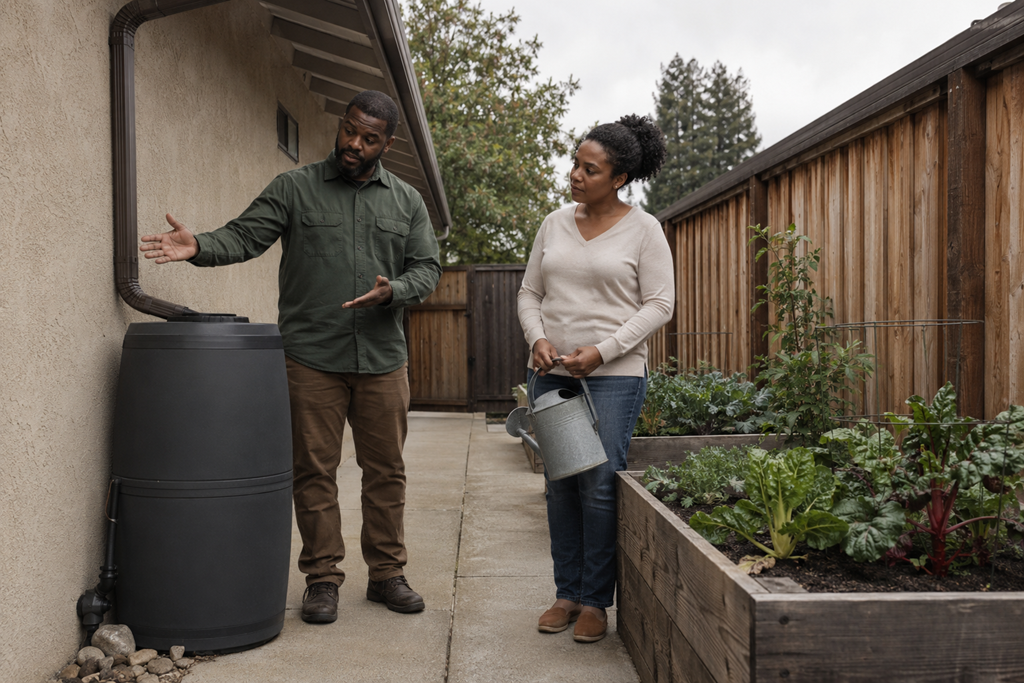
Thinking about a rainwater collection system starts with a simple question: what do you actually want the system to do? For many Sacramento-area homeowners, the idea sounds straightforward—capture rain from the roof and use it later—but the right setup depends on the property, intended use, storage space, drainage patterns, maintenance expectations, and how much seasonal rainfall is realistically available.
A rainwater collection system can be as simple as a small barrel connected to a downspout or as involved as a larger storage system designed around several outdoor uses. Before comparing tanks, pumps, or installation estimates, it helps to understand the actual problem you want the system to solve.
For some homeowners, the goal is watering garden beds. For others, it may be supporting landscaping, reducing some outdoor water use, managing roof runoff more intentionally, or preparing the yard for a more drought-aware maintenance routine. Those goals sound related, but they can lead to very different system designs.
Start With the Use, Not the Equipment
One of the easiest ways to get confused is to start by asking, “What size tank should I get?”
That question matters, but it is not the best starting point. A better first question is, “Where would the collected water actually be used?”
A homeowner who wants to water a few raised beds may not need the same type of system as someone hoping to support several planting areas across the yard. A compact setup near one downspout may be enough for one purpose, while a larger property may require a more planned approach to storage, placement, overflow, and distribution.
Starting with the intended use helps keep the conversation practical. It also makes estimates easier to understand because the proposed system should connect clearly to the homeowner’s goal.
If a provider recommends a system before discussing how the water will be used, where it will go, and how the property drains, that may be a sign to slow down and ask more questions.
The Roof and Gutters Shape What Is Possible
Rainwater collection depends on more than the tank itself. The roof area feeding the system, the gutter layout, and the downspout locations all affect what can be captured.
Two homes can have similar yard sizes but very different collection potential. One may have a large roof section that drains neatly toward a usable side yard. Another may have downspouts in awkward places, limited storage space, or rooflines that make collection less straightforward.
This is why a good early discussion should include the actual path rainwater already takes. Where does water leave the roof? Where does it flow after it reaches the ground? Does it move toward planting areas, paved surfaces, low spots, fences, or areas near the home?
A rainwater collection system should work with the property’s layout, not fight against it.
Sacramento’s Weather Pattern Changes the Expectations
Rainwater collection can be useful, but it should be understood in the context of seasonal rainfall and dry stretches.
In the Sacramento area, homeowners may think about rainwater differently than someone in a wetter climate. A system may fill during rainy periods, but that does not mean it will provide an unlimited supply through long dry periods. Storage capacity, roof catchment area, and actual water use all affect how long collected water may last.
This does not make a system pointless. It simply means the system should be planned with realistic expectations.
For example, a rainwater collection setup may be a helpful supplement for certain outdoor uses, but it may not replace regular irrigation needs for every yard. The right question is not only “How much can I collect?” but also “How much will I actually need, and when?”
Placement Can Matter as Much as Capacity
A larger tank is not automatically better if it does not fit the property well.
Storage containers need space, stable support, access for inspection, and a practical connection to the downspout or drainage route. The placement should also avoid creating new problems with walkways, gates, windows, utility areas, side-yard access, or everyday movement around the home.
A system that looks good on paper can become frustrating if it blocks access, is hard to clean, creates awkward hose routes, or sits in a location where overflow is not handled well.
This is especially important on smaller Sacramento-area lots, narrow side yards, and homes where downspouts are close to fences, driveways, patios, or frequently used outdoor paths.
Before focusing on appearance or storage volume, it helps to ask whether the location makes sense for daily use and long-term maintenance.
Overflow Should Not Be an Afterthought
Every rainwater collection system needs a plan for what happens when storage is full.
This is easy to overlook because the homeowner is usually focused on saving water, not releasing it. But during heavier rain, water may continue entering the system after the tank has reached capacity. That extra water still needs somewhere appropriate to go.
Poorly planned overflow can contribute to pooling, erosion, soggy areas, or water movement toward places where the homeowner does not want it. The goal is not just to collect rainwater. The goal is to collect it without creating a drainage issue elsewhere.
A qualified professional should be able to explain how overflow will be managed and how the system fits with the property’s existing drainage pattern.
Maintenance Is Part of the Decision
Rainwater collection systems are often described in simple terms: rain falls, water collects, and the homeowner uses it later. The real-life version usually requires more attention than that.
Leaves, roof debris, dust, insects, sediment, and other material can affect the system over time. Gutters, screens, filters, inlets, outlets, valves, and overflow areas may need periodic inspection or cleaning.
This does not mean the system has to be difficult. It means the homeowner should understand the maintenance before committing.
A system that is easy to reach, easy to inspect, and easy to understand is usually more practical than one that looks tidy but is difficult to service. If a tank is hidden behind heavy landscaping or placed in a tight corner, routine maintenance may become something the homeowner avoids.
Before moving forward, ask what parts of the system need attention and how realistic that care will be for your household.
Not Every Use Has the Same Requirements
Collected rainwater is not automatically suitable for every use.
Water intended for basic outdoor irrigation may involve different considerations than water intended for more sensitive uses. The collection surface, storage method, filtration, distribution, and local requirements can all affect what is appropriate.
This is where homeowners should be careful about assumptions. A rainwater collection system is not just a container of free water. It is a system connected to a roof, gutters, debris exposure, storage conditions, and intended uses.
A provider should be able to explain what the collected water can reasonably be used for, what limitations apply, and what additional components may be needed for certain uses.
Questions Worth Asking Before Comparing Estimates
Before comparing rainwater collection proposals, it helps to ask a few practical questions:
- What outdoor use is this system being designed to support?
- Which roof area or downspout will feed the system?
- Where will the tank or storage container be placed?
- How will overflow be handled when the system is full?
- What routine maintenance will the homeowner be responsible for?
- What parts of the system may need professional service over time?
- What assumptions are being made about rainfall, storage, and water use?
- Are there any site conditions that make a smaller or simpler setup more realistic?
These questions can help turn a vague idea into a clearer project conversation. They also make it easier to compare providers because the homeowner can look beyond tank size and price alone.
A Good System Should Match the Homeowner’s Real Life
The best rainwater collection system is not always the biggest, most complicated, or most visually hidden option. It is the one that fits the property, supports a realistic use, and can be maintained without becoming a burden.
For Sacramento-area homeowners, the decision is often less about whether rainwater collection sounds useful in theory and more about whether a specific system makes sense for the home, yard, roof layout, and everyday habits.
Before thinking about a rainwater collection system as a purchase, think about it as a planning conversation. The more clearly you understand the purpose, placement, overflow, maintenance, and limits, the easier it becomes to evaluate whether a proposed system is a practical fit.