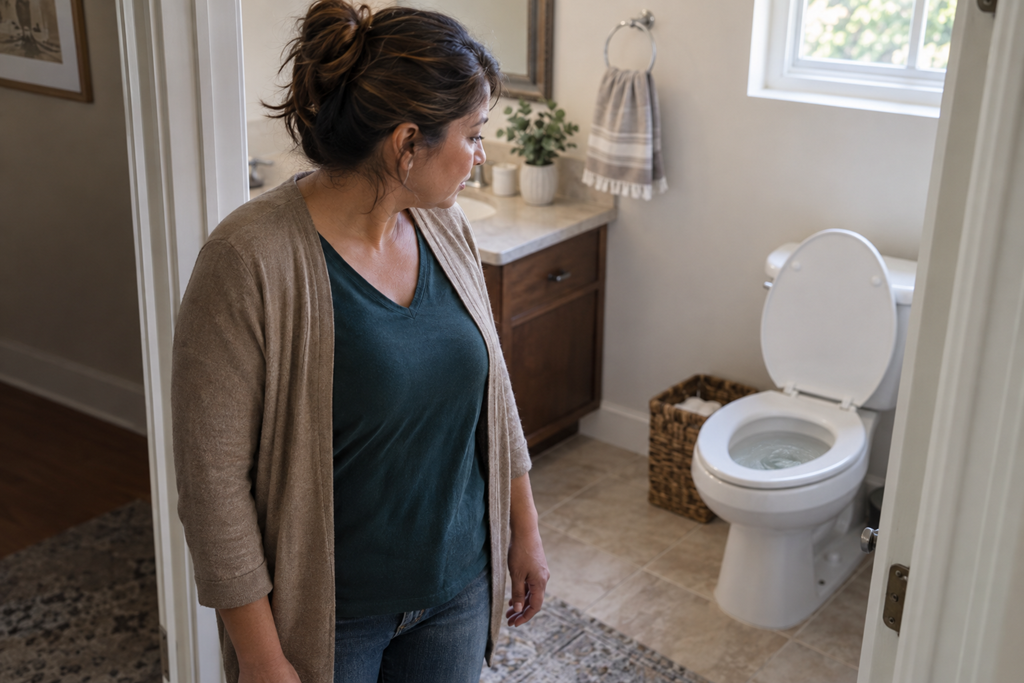
If your toilet keeps running, the main issue is that water is not fully stopping when the flush cycle should be finished. Sometimes the sound is constant, and other times the toilet becomes quiet for a while before refilling again. Either pattern can point to an internal tank component that is not sealing, filling, or shutting off as intended, so the useful next step is to understand the pattern before deciding whether a repair should be discussed.
A running toilet can be easy to overlook because the toilet may still flush normally and there may be no water on the floor. The problem often shows up as a sound instead: water continuing to move after a flush, a tank that seems to refill longer than expected, or a toilet that suddenly begins filling again even though no one has used it.
For Sacramento-area homeowners and renters, recognizing that pattern can make it easier to describe the problem clearly when deciding whether to contact a plumbing professional.
A Running Toilet Usually Means the Cycle Is Not Fully Ending
A toilet normally uses water during a flush and then refills until the tank reaches the appropriate level and the water flow stops.
When a toilet keeps running, some part of that process is not reaching a complete stopping point.
The exact reason can vary. A seal may not be closing completely, a filling component may not be shutting off properly, or another internal part may be interfering with the normal cycle. Sometimes the toilet runs continuously. In other cases, a small amount of water slowly escapes from the tank and causes the toilet to refill periodically.
Those two situations can sound different, but they share the same basic issue: the toilet is continuing to use water after the flush should be complete.
The Pattern Can Be More Useful Than the Noise Itself
One of the easiest mistakes is assuming every running toilet has the same cause.
A toilet that continues running immediately after every flush may be behaving differently from one that becomes quiet and then unexpectedly refills several minutes later.
You do not need to diagnose the internal component yourself to notice the difference.
It can be useful simply to know whether the problem is constant or intermittent, whether it follows nearly every flush, and whether the toilet otherwise appears to be operating normally.
That information can give a plumber a clearer starting point than simply saying, “The toilet is making a noise.”
Why a Running Toilet Is Easy to Put Off
Unlike a clogged toilet or water spreading across a bathroom floor, a running toilet may not feel disruptive enough to demand attention.
The toilet may still work. The bathroom may remain completely usable. There may be no visible damage at all.
That is precisely why the problem can linger.
Water may continue moving through the toilet even though no one is actively using it. Over time, that unnecessary water use can become one practical reason to have a persistent problem evaluated rather than treating the sound as an ordinary quirk of the toilet.
A running toilet may also become irritating simply because the repeated filling noise keeps returning throughout the day.
The Cause Is Often Inside the Tank, but the Exact Part Matters
Several components inside a toilet tank work together during flushing and refilling.
A sealing component helps hold water in the tank until the toilet is flushed. The fill mechanism allows the tank to refill and then stops the incoming water. Other parts connect the handle and flushing mechanism or control when the tank has reached its intended water level.
Wear, misalignment, mineral buildup, or deterioration of one of these components can sometimes interfere with the normal cycle.
That does not mean every running toilet needs the same part replaced.
Replacing components based only on a guess can miss the actual reason the toilet continues running. If the problem persists or repeatedly returns, identifying which part of the cycle is failing can be more useful than assuming the most familiar component must be responsible.
A Running Toilet Is Not the Same as a Visible Leak Around the Toilet
The word “running” can create some confusion because people sometimes associate it with water leaking onto the bathroom floor.
A running toilet usually refers to water continuing to move through the toilet internally when the toilet should be idle.
Water appearing around the base of the toilet, on the floor, or elsewhere outside the fixture is a different symptom and may need to be described separately when contacting a plumbing professional.
That distinction can help prevent an unclear service request.
Instead of simply reporting that the toilet “leaks,” explaining whether you are hearing continuous filling, noticing periodic refilling, or seeing actual water outside the toilet gives the provider more useful information.
Notice What Happens Before You Schedule Service
You do not need to take the toilet apart to gather useful information.
Simply paying attention to the behavior can help.
Notice whether the toilet continues running immediately after it is flushed or becomes quiet before starting again later. Consider whether the problem happens every time or only occasionally. If more than one toilet is behaving unusually, that is also worth mentioning when arranging service.
These observations do not diagnose the problem, but they can make the conversation with a local plumbing provider more specific.
They may also help you explain how long the issue has been happening and whether the behavior appears to be changing.
A Few Useful Questions to Ask a Plumbing Provider
If you decide to have the toilet evaluated, a few straightforward questions can help you understand the recommendation without turning the conversation into a technical lesson.
You might ask:
- What appears to be causing the toilet to keep running?
- Is the problem limited to one internal component?
- Is the recommended repair addressing the cause of the running or only the symptom?
- Does anything else about the toilet's condition affect whether repairing it makes sense?
- What should I expect the toilet to do differently once the problem is corrected?
Clear answers can make it easier to understand what you are paying to have addressed and whether the proposed work matches the problem you originally noticed.
Be Cautious About Jumping Straight to Replacement
A toilet that keeps running does not automatically mean the entire toilet needs to be replaced.
In many situations, the problem may involve an internal component rather than the fixture as a whole.
At the same time, the age, condition, history, and other problems associated with the toilet can affect what a plumbing professional recommends.
If replacement is suggested, it is reasonable to ask what condition makes replacement preferable to repairing the part responsible for the running. That allows you to understand the reasoning rather than making the decision based only on the symptom.
The Useful Takeaway
A toilet that keeps running is usually telling you that its flush-and-refill cycle is not fully stopping as intended. The sound may be constant or intermittent, and the bathroom may otherwise look completely normal.
You do not need to identify the failed component yourself. Paying attention to when the running occurs, how often it happens, and whether there are any separate visible water problems can give you useful information before contacting a Sacramento-area plumbing professional.
Understanding the behavior first can make it easier to describe the problem, ask clearer questions, and evaluate the recommended repair without making a rushed assumption about what needs to be replaced.