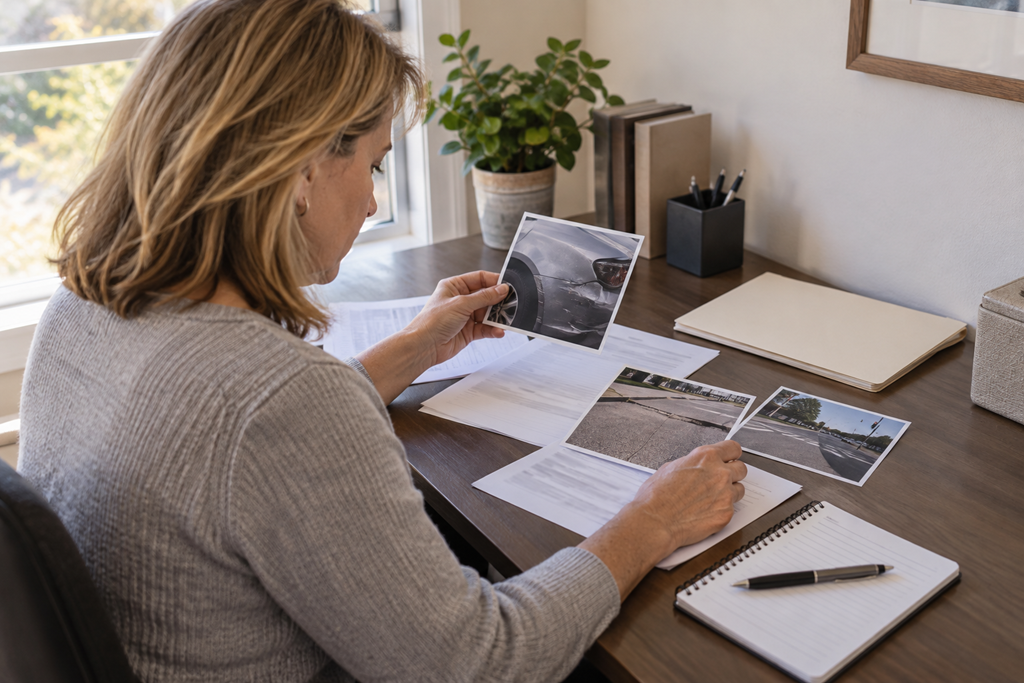
Before speaking with a personal injury lawyer, it helps to gather the basic information that explains what happened, what has happened since, and what questions you want answered. You do not need to build a perfect case file before the conversation. The goal is simply to give the lawyer enough organized context to understand your situation and help you know what may be worth discussing next.
For Sacramento-area residents, preparing for this type of conversation can feel more complicated than it needs to be. You may have photographs in one place, insurance correspondence somewhere else, appointment information on your phone, and details you are trying to remember from weeks or months ago. It is also common to wonder which information actually matters.
A little organization can make the conversation easier without requiring you to decide what is legally important on your own.
You Are Preparing Context, Not Building the Case
One of the most useful things to understand before contacting a personal injury lawyer is that you are not expected to arrive already knowing the legal significance of everything that happened.
Your job is to explain the situation as accurately as you can.
That means gathering information that helps answer basic questions such as what occurred, when it occurred, who was involved, what happened afterward, and what records or communications already exist.
You do not need to determine who was legally responsible, calculate what a claim might be worth, or decide which details ultimately matter most. Those are issues to discuss with a qualified legal professional who can evaluate the circumstances of your particular situation.
Thinking of preparation this way can make the process much more manageable.
Start With a Simple Account of What Happened
Before the conversation, take a few minutes to reconstruct the basic sequence of events in plain language.
You might want to have the approximate date and location of the incident, the people or organizations involved, and a basic description of what happened readily available. If there were important events immediately afterward, those can be useful to remember as well.
This does not need to become a lengthy written narrative.
A few notes that help you remember the sequence can be more useful than trying to create something that sounds formal or legal. If you are unsure about a detail, it is better to identify that uncertainty than to feel pressure to fill in the gap.
The purpose is to make the initial conversation easier to follow.
Gather the Records You Already Have
Personal injury situations can generate information from several different sources. Bringing together what you already have can help prevent the first conversation from becoming a search through emails, drawers, photographs, and files.
Depending on the situation, existing materials might include photographs, incident-related correspondence, insurance communications, medical records or bills already in your possession, reports you were provided, receipts, or other documents connected to what occurred afterward.
You may also have emails, letters, or other communications involving businesses, insurers, property owners, employers, witnesses, or other parties.
You do not need to decide in advance whether every document is important.
It can be enough to place potentially relevant materials together so you can describe what you have and provide them if the lawyer wants to review them.
Just as importantly, you do not need to postpone an initial conversation simply because your records are incomplete. If something is missing, you can explain that during the consultation.
Make Note of What Has Happened Since
The incident itself is only part of the information a lawyer may want to understand.
It can also be helpful to think through what happened afterward.
For example, there may have been appointments, expenses, missed work, insurance communications, follow-up conversations, changes in your normal activities, or other events connected to the situation.
Rather than trying to determine which of these details has legal importance, simply organize the information you know.
A basic chronological outline can make it easier to explain the progression without relying entirely on memory during the conversation.
This can be especially helpful when several things happened close together or when different organizations became involved at different times.
Prepare the Questions You Actually Want Answered
It is easy to become focused on what information a lawyer may ask from you and forget that the consultation is also your opportunity to ask questions.
Writing down a few questions beforehand can help you evaluate whether the lawyer and the firm's approach seem like a good fit.
Useful topics might include:
- How would you evaluate whether this is the type of matter your firm handles?
- What additional information would you want to review?
- How are fees and potential costs explained?
- Who would normally communicate with me about the matter?
- What should I expect after the initial consultation if we decide to work together?
- Are there questions about my situation that I should be discussing with another qualified professional?
The goal is not to conduct an exhaustive interview. A handful of questions focused on your situation, communication expectations, and the lawyer's process can make the conversation more informative.
Do Not Feel Pressure to Have Every Detail Perfect
People sometimes delay speaking with a lawyer because they believe they need a completely organized file before making contact.
That is usually not what consultation preparation needs to mean.
You might not remember every date. You may not have every document. Some records may still be with another organization. You may not know the correct legal terminology for what happened.
Those gaps are different from intentionally guessing or presenting uncertain information as fact.
When you are unsure about something, simply saying that you are unsure gives the lawyer a more accurate picture than trying to make the story sound complete.
Similarly, avoid treating internet research as a substitute for discussing the specific circumstances with a qualified legal professional. General information can help you understand terminology or prepare questions, but it cannot determine how the law applies to your individual situation.
A Huge Stack of Paper Is Not the Goal
More material does not automatically mean better preparation.
Showing up with every email, receipt, photograph, and unrelated document you have collected can make the important parts harder to find.
A more useful approach is to bring the materials that appear reasonably connected to the incident and its aftermath, while knowing what other information may exist if the lawyer asks about it.
The same principle applies to written notes.
A short timeline and several meaningful questions are usually easier to work with than pages of disconnected thoughts assembled under pressure.
The objective is organization, not volume.
Your Preparation Also Helps You Evaluate the Lawyer
Preparing beforehand does more than help the lawyer understand your situation. It can also make it easier for you to evaluate the consultation itself.
When you know the basic information you want to discuss, you can pay more attention to how the lawyer responds.
Do they explain the process in understandable language? Do they distinguish what they know from what still needs to be evaluated? Are fee arrangements and communication expectations explained clearly? Do you understand what would happen next if you chose to work with the firm?
A consultation does not have to answer every question about the situation. It should, however, help you better understand the lawyer's role, what additional information may be needed, and whether you are comfortable with the way the firm communicates.
For Sacramento residents comparing personal injury lawyers, those practical considerations can be just as important as arriving with a well-organized folder.
Prepare Enough to Have a Useful Conversation
Preparing before speaking with a personal injury lawyer does not mean becoming your own investigator or trying to construct a legal argument.
Gather the basic facts, bring together the records already available to you, think through what has happened since the incident, and write down the questions you want answered.
If some information is missing or uncertain, identify that honestly rather than trying to make the story appear complete.
The purpose of preparation is to make the first conversation more useful and to help you better understand what the lawyer would need to evaluate your specific situation. Legal questions about your circumstances should ultimately be discussed with a qualified legal professional.