Before agreeing to tree trimming or removal, make sure you understand exactly what work is being recommended, why it is being recommended, and what the quoted scope actually includes. A short estimate can make the job sound simple, but the real decision may involve specific limbs, multiple trees, access limits, cleanup, stump work, nearby structures, and what happens if conditions look different once the crew is on site.
Tree work can be especially easy to oversimplify because homeowners often see the visible end result—branches trimmed back or a tree removed—rather than all the decisions that define the job. Two providers may both describe the work as “tree trimming,” for example, while actually proposing noticeably different scopes.
Before you agree, the goal is not to become an expert in tree care. It is to understand what you are approving well enough that the estimate, the recommendation, and your expectations are describing the same job.
“Trim the tree” can mean very different things
One of the first things to clarify is what the provider actually means by trimming.
An estimate may refer generally to trimming a tree without making it immediately obvious which portions of the canopy are involved, whether particular limbs are the focus, or whether the recommendation applies to the entire tree.
That distinction matters because a homeowner may hear “tree trimming” and picture a broad cleanup while the provider is pricing a much narrower scope. The opposite can happen as well: the homeowner may expect only a few visible branches to be addressed while the proposed work is considerably more involved.
A useful estimate should give you enough information to identify which tree or trees are included and what the intended work is meant to accomplish.
The same principle applies to removal. Confirm whether the quote covers only taking down the tree or also addresses what will remain afterward.
Understand why the work is being recommended
The recommendation itself deserves attention, not just the price.
Tree trimming may be discussed for reasons involving clearance, appearance, property access, branches near structures, or concerns about the condition of part of the tree. Removal is a substantially different decision and should not feel interchangeable with routine trimming.
If you are not clear about why a particular level of work has been recommended, ask.
For example, it is reasonable to want to understand why trimming is being suggested instead of simply monitoring the situation, or why removal is being recommended instead of a more limited service.
When the recommendation involves concerns about tree health, structural condition, or safety, consider asking what observations support the recommendation and whether evaluation by a qualified tree professional or arborist is appropriate for your situation.
You do not need to diagnose the tree yourself. You simply want the reasoning behind the recommendation to be understandable before you approve the work.
Look at the entire physical scope, not just the tree
The tree may be the most obvious part of the project, but it is not always the only factor that affects the work.
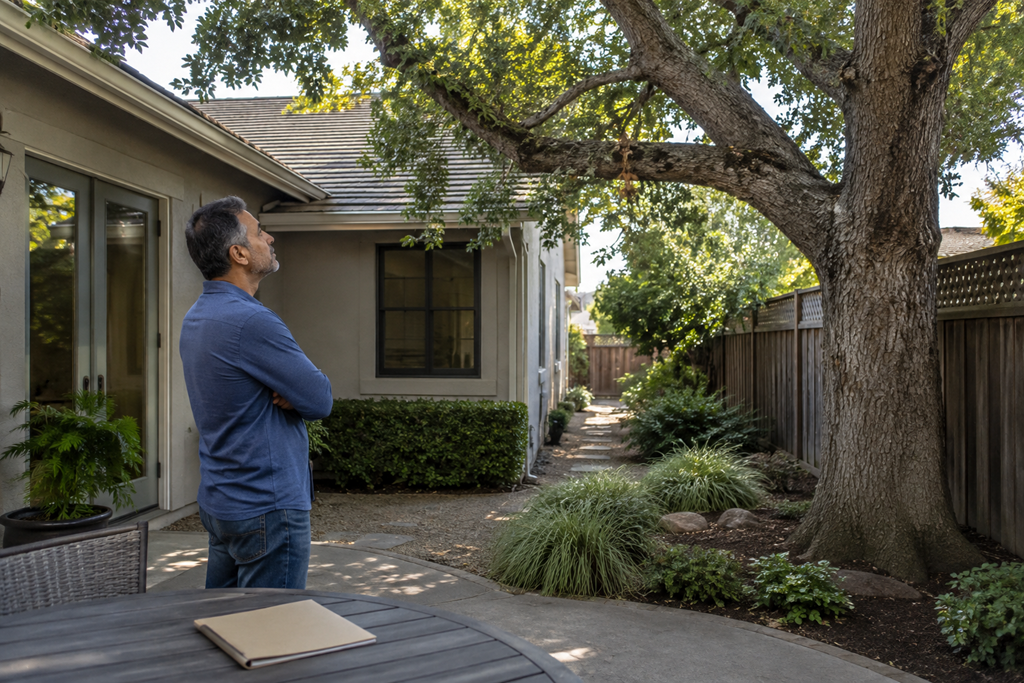
On Sacramento-area properties, trees may be located near houses, fences, patios, driveways, neighboring property, landscaping, utility areas, or narrow side-yard access points. Those relationships can affect how straightforward or complicated a project may be.
This is why an estimate based on a quick description such as “remove backyard tree” may deserve more clarification.
Consider whether the provider has accounted for issues such as:
- where the tree is located in relation to the home and other structures
- how the work area can be accessed
- whether more than one tree or section of the property is involved
- what areas need to remain protected or accessible
- how cut material will be removed from the property
You are not trying to determine how the provider should perform the work. You are confirming that the proposal reflects the actual property where the work will take place.
Cleanup can change what “finished” means
Homeowners and providers do not always mean the same thing when they talk about completing tree work.
A homeowner may naturally assume that once the trimming or removal is finished, branches, logs, leaves, and other resulting material will also be removed. A provider's quoted scope may handle cleanup differently.
That is worth clarifying before the job begins rather than discovering the difference afterward.
If a tree is being removed, also ask what the estimate says about the remaining stump and surrounding area. Tree removal and stump-related work are not necessarily the same service.
The important question is simple: What will the property look like when the quoted work is considered complete?
That question often reveals details that are easy to miss when attention is focused only on the tree itself.
Pay attention to what is excluded
Sometimes the most useful part of an estimate is not what it includes but what it leaves uncertain.
A proposal can appear detailed while still leaving important boundaries undefined.
For example, you may want clarification if you cannot tell whether the price includes debris hauling, work on multiple trees, stump-related services, difficult access considerations, or other parts of the property that were discussed during the estimate.
Exclusions are not automatically a problem. Different companies structure their services differently.
The concern is simply whether you understand those exclusions before making the decision.
If something you expected is not included, you can then decide whether you want it added, priced separately, or handled another way rather than assuming it is part of the agreement.
Ask what could cause the scope to change
Tree work can involve conditions that are not always completely obvious during an initial conversation.
Before agreeing, ask how the provider handles situations in which the actual conditions differ from what was expected when the estimate was prepared.
That does not mean you should expect the price to change. It means you should understand the process if the provider believes additional work is needed.
A useful question is:
If you discover something that changes the recommended work, will you discuss it with me before proceeding?
That gives you a clearer picture of how changes will be communicated instead of leaving you to assume how they will be handled.
Be careful when different quotes describe different jobs
Comparing tree-service estimates only by total price can be misleading when the providers are not proposing the same work.
One quote might cover a narrowly defined trimming job. Another may include broader trimming, hauling, cleanup, or work involving additional areas of the property.
A lower price does not automatically mean less value, and a higher price does not automatically mean a more complete service.
The first question should be whether the quotes are actually comparable.
If they are not, clarify the scope before deciding which proposal makes more sense for your property and priorities.
This can turn what initially looks like a price comparison into a much more useful comparison of what you would actually receive.
A few useful questions before you agree
You do not need a long interrogation. A handful of clear questions can often resolve the biggest uncertainties:
- Which tree or trees are included in this estimate?
- What specifically are you recommending be trimmed or removed?
- What is the reason for the recommended work?
- Does the quoted price include cleanup and debris removal?
- If a tree is removed, what happens with the stump?
- Are there access or property conditions that could affect the work?
- What is specifically excluded from the estimate?
- If the recommended scope changes, how will you communicate that before additional work proceeds?
The answers should help you understand the job in ordinary language.
If you still cannot tell what you are agreeing to after asking reasonable questions, that is useful information to have before committing.
The clearest estimate is the one you can picture
Before approving tree trimming or removal, try to picture the property after the quoted work is finished.
Which branches are different? Which tree is gone? What remains? Is the debris removed? What happens with the stump? Are all of the areas you discussed actually included?
If you cannot picture the finished scope from the explanation and estimate, there may still be details worth clarifying.
For Sacramento-area homeowners, taking a little time to understand those boundaries can make it much easier to compare providers based on the actual work being proposed rather than relying on a short service label or bottom-line price.
The goal is not to predict every possible condition. It is to make sure you understand the recommendation, the scope, the exclusions, and how unexpected changes would be handled before you say yes.