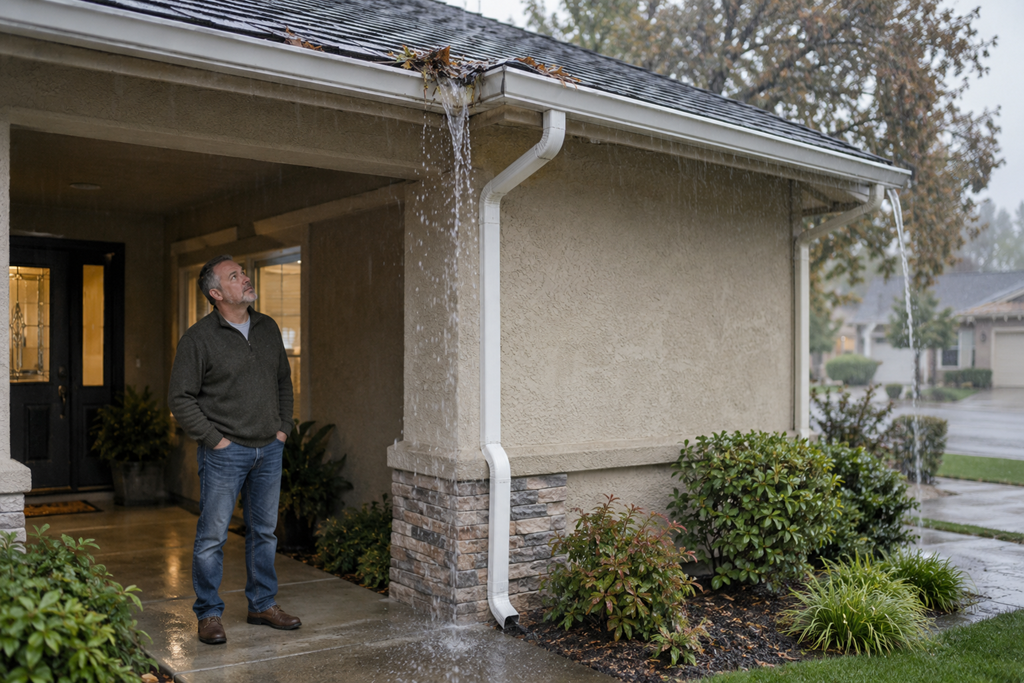
Clogged gutters can create problems that go well beyond water spilling over the edge during a storm. When leaves, roof debris, or other material block the normal path of rainwater, water may collect or move toward parts of the home that were not meant to handle it. For Sacramento-area homeowners, the important point is not to assume a clogged gutter is only a minor cleanup issue.
A blockage may be easy to overlook during dry weather. The gutters are above eye level, the house may otherwise look fine, and there may be no obvious reason to think about drainage. Then seasonal rain arrives and suddenly water is overflowing in one area, running down exterior surfaces, or collecting where it normally would not.
Understanding what that overflow can affect helps put gutter maintenance in perspective.
The Problem Is Often Where the Water Goes Next
A gutter has a fairly simple job: collect water coming off the roof and direct it toward the downspouts.
When that path becomes restricted, the water still has to go somewhere.
It may spill over the front of the gutter, collect near the roof edge, run across fascia or exterior trim, or fall repeatedly onto the ground below. Depending on the home's layout, overflowing water may also land close to exterior walls, walkways, planting areas, or other surfaces that were not intended to receive concentrated roof runoff.
That is why the visible clog is only part of the issue. The more useful question is what the blocked gutter is causing water to do.
Small Overflow Patterns Can Affect More Than the Gutter
One brief overflow does not automatically mean a home has suffered significant damage. What matters more is whether the same drainage problem keeps happening and what materials are repeatedly exposed.
Water regularly moving across painted wood or trim can contribute to deterioration over time. Persistent runoff can leave staining on exterior surfaces. Concentrated water hitting the same section of soil may create erosion or consistently wet areas near the house.
Debris itself can also hold moisture inside the gutter longer than an open drainage channel would. A gutter carrying accumulated wet material is dealing with a different condition than one that is draining normally.
These issues do not mean every clogged gutter has already created a larger repair problem. They explain why a recurring clog deserves more attention than simply noticing that water is spilling over.
The First Visible Sign May Be Somewhere Below the Roofline
Homeowners sometimes expect the gutter itself to provide the clearest warning.
In practice, the clue may appear somewhere else.
You might notice water dropping heavily from one section of the roof edge even though a nearby downspout appears quiet. There may be new splash marks on a wall, a particularly wet patch of ground beneath one portion of the eave, or discoloration developing on fascia or trim.
Those observations can help describe the problem when speaking with a local service provider.
Instead of simply saying, “I think the gutter is clogged,” you can explain where overflow occurs, whether it happens in one location or several, and what you have noticed around the surrounding exterior surfaces.
That gives the conversation more useful context.
Clearing a Blockage and Understanding Why It Happened Are Different Questions
Removing accumulated debris may restore drainage, but it does not necessarily explain whether the same situation is likely to return.
Tree coverage, the kinds of debris reaching the roof, gutter configuration, downspout locations, and routine maintenance can all affect how frequently material collects.
This distinction can be especially useful if you are considering gutter guards.
A gutter guard may be worth discussing when recurring debris is part of the problem, but a guard should not automatically be treated as a maintenance-free solution. Different systems handle different kinds of debris differently, and gutters and drainage paths can still require inspection and upkeep.
The better question is not simply whether a gutter guard can be installed. It is whether a particular approach makes sense for the conditions around your home and what maintenance would still be expected afterward.
Repeated Clogging Is More Useful Information Than a One-Time Mess
A single accumulation after unusual debris falls onto the roof is different from a section that repeatedly stops draining.
Patterns matter.
If the same portion of gutter overflows whenever there is meaningful rain, that may be useful information for a professional evaluating the drainage path. The obstruction could be concentrated in that section, near a downspout, or somewhere else along the route water is supposed to follow.
Similarly, if one side of the home consistently develops heavy runoff while other gutters appear to drain normally, mentioning that difference can help focus the evaluation.
You do not need to diagnose the cause yourself. Observing when and where the problem appears is often enough to make the service conversation more productive.
Avoid Treating the Symptom as the Whole Problem
One common misunderstanding is assuming that stopping the visible overflow automatically resolves every concern.
The overflow is a symptom of restricted drainage. Once the immediate obstruction is addressed, it may still be reasonable to look at the surrounding areas that have been exposed to repeated runoff.
That does not mean assuming damage exists.
It means checking whether there are visible changes worth discussing, such as deteriorated-looking trim, persistent staining, unusual wet areas, a gutter that appears loose or out of position, or runoff that continues even after debris has been addressed.
A qualified professional can help determine whether those observations are simply cosmetic, part of a gutter issue, or something that deserves further evaluation.
A Few Useful Questions Before Hiring a Local Pro
When speaking with a gutter cleaning, gutter repair, or gutter guard provider, the conversation can stay focused on the actual drainage problem.
You might ask what appears to be causing the recurring blockage, whether the gutters and downspouts are moving water as intended, whether there are visible areas around the roof edge or exterior that deserve additional attention, and what maintenance would still be needed if gutter guards were installed.
If a provider recommends a particular guard system, it is also reasonable to ask how that system is expected to handle the types of leaves, seeds, needles, or other debris that typically reach your roof.
Clear answers are generally more useful than broad promises that a product will eliminate gutter maintenance altogether.
The Goal Is Reliable Drainage, Not Just a Cleaner-Looking Gutter
For Sacramento-area homeowners, clogged gutters are worth thinking about as part of the home's overall water-management system rather than as an isolated housekeeping problem.
The important issue is not whether a few leaves are visible. It is whether water can move from the roof, through the gutter, into the downspout, and away from the immediate roof edge and exterior surfaces without repeatedly overflowing along the way.
Recognizing that connection makes it easier to describe what you are seeing, ask more useful questions, and understand what a local professional is recommending before agreeing to cleaning, repairs, or a gutter guard installation.