Dry rot repair usually moves through several stages: identifying the damaged wood, determining what allowed moisture to reach it, defining how far the damage extends, removing or repairing affected material, correcting the moisture source, rebuilding the area, and checking the finished work. The exact sequence can vary because the visible damage is not always the full scope of the problem.
For Sacramento-area homeowners, that uncertainty can make a dry rot project feel different from a repair with an obvious beginning and end. A deteriorated piece of trim may look like the entire problem from the outside, but a professional may need to examine the surrounding area before the repair scope becomes clear.
Understanding how the process usually develops can make estimates, project updates, and changes in scope easier to evaluate.
The first job is finding out what is actually damaged
Before repair decisions can be made, the affected area usually needs to be evaluated.
Homeowners often use dry rot as a general term for wood that has softened, deteriorated, or decayed. A professional may describe the condition more specifically after examining the material and the surrounding area.
The important question is not simply, “Where is the damaged wood?”
It is also, “Why did this area become vulnerable in the first place?”
A professional evaluation may consider the visible deterioration, nearby building materials, possible moisture exposure, and whether surrounding areas show signs that the problem extends beyond what can initially be seen.
This is one reason a quick cosmetic patch and a complete repair are not necessarily the same thing.
The visible spot may not reveal the full repair scope
One of the most confusing parts of dry rot repair is that the final scope may not be completely obvious during the first look.
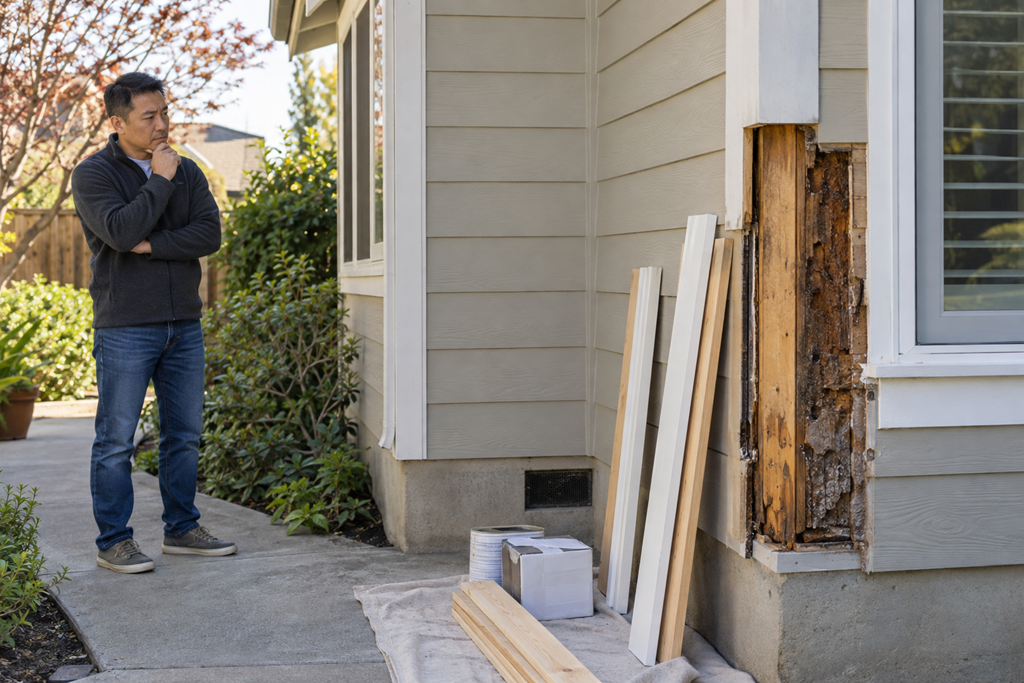
A damaged exterior board, window-trim section, door surround, fascia area, or other wood component can provide a starting point. But some neighboring material may be concealed behind finishes or adjoining components.
That does not mean every small area of deterioration will turn into a major project. It simply means the visible surface cannot always answer every question.
A contractor may be able to provide a reasonably defined estimate from the initial inspection while also explaining which portions of the project cannot be confirmed until the affected area becomes accessible.
That distinction is useful when comparing Sacramento-area providers.
An estimate that acknowledges uncertainty can sometimes be more informative than one that treats an unseen condition as though its scope is already known.
Opening the affected area can change what everyone knows
Once the project begins, the contractor may need access to the deteriorated material and the surrounding area.
At this stage, previously concealed conditions may become visible.
The findings may confirm that the original repair scope was accurate. In other situations, additional deterioration may be discovered nearby. Occasionally, the exposed area may show that the problem is more limited than initially feared.
This is an important point for homeowners to understand: a change in scope is not automatically a red flag.
What matters is how the change is explained.
If additional work is recommended, the provider should be able to describe what was discovered, where it was found, why it affects the repair, and how the proposed change relates to the original project.
A vague statement that “more work is needed” gives a homeowner much less useful information than a clear explanation of what changed after the area was opened.
The moisture issue matters as much as the damaged wood
Replacing deteriorated material without considering why it deteriorated can leave an important question unanswered.
Despite the word dry in the common term dry rot, wood decay is associated with conditions that allow moisture and fungal deterioration to affect the material. The source or pathway of that moisture can differ from one property to another.
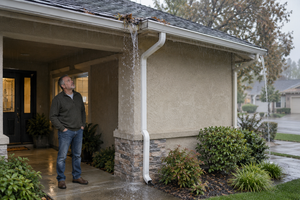
Depending on the location, a professional may look at surrounding conditions such as weather exposure, drainage or water intrusion, gaps around exterior components, plumbing-related moisture, or other sources relevant to the affected area.
The homeowner does not need to diagnose the cause.
Instead, the useful question is whether the proposed repair addresses both the damaged material and the condition that contributed to it.
If a provider cannot explain that connection, it is reasonable to ask for clarification before proceeding.
Repairing the affected material comes after the scope is understood
Once the damaged area and contributing conditions have been evaluated, the physical repair can move forward.
The exact work depends on where the deterioration is located, how much material is affected, what role that material serves, and what surrounding components must be accessed.
Some projects may involve a relatively contained section of exterior trim or another localized component. Others may require more extensive rebuilding because the affected material continues behind or alongside what was initially visible.
This is where homeowners benefit from separating two questions:
What looks damaged?
and
What actually needs to be repaired for the project to be complete?
Those answers are not always identical.
For work involving structural components, extensive deterioration, or conditions that are difficult to assess safely, evaluation by appropriately qualified professionals becomes especially important.
Rebuilding is only part of reaching completion
After affected materials have been addressed, the area usually needs to be put back together in a way that fits the surrounding property.
Depending on the project, this may involve reinstalling or replacing exterior or interior components, restoring adjacent finishes, sealing appropriate transitions, preparing surfaces, or completing painting and other finish work.
This stage can make the project look nearly finished, but appearance is only one part of completion.
A useful final review focuses on whether the agreed repair scope was completed, whether any approved changes were addressed, and whether the repaired area has been restored as expected.
Homeowners should also know whether any separate finishing work remains.
For example, a repair estimate may include rebuilding but handle painting or another finish as a separate part of the project. Clarifying those boundaries before work begins can prevent confusion near the end.
Why dry rot timelines can be difficult to predict precisely
A dry rot repair can sometimes be straightforward. Other projects become less predictable because more information becomes available only after damaged or covering materials are removed.
Timing may be influenced by factors such as:
- how accessible the affected area is
- whether deterioration extends beyond the initially visible section
- whether another moisture-related condition needs attention
- the amount of rebuilding required
- availability of matching or appropriate replacement materials
- whether separate trades or additional evaluation become necessary
- the amount of finish work included in the agreed scope
This is why homeowners may get more useful information from asking how a provider handles unexpected findings than from focusing only on a promised completion date.
A clear process for communicating changes can matter just as much as the original timeline.
Questions that can make an estimate easier to understand
Before approving a dry rot repair, a few focused questions can help clarify how the contractor expects the project to proceed:
- What damage can you confirm from the initial inspection?
- Is any part of the scope still concealed or uncertain?
- What appears to have contributed to the moisture exposure?
- Does the proposed work address that contributing condition?
- What happens if additional deterioration is discovered?
- How will changes in scope or price be explained before additional work proceeds?
- What rebuilding and finish work are included?
- Will anything remain for another contractor or service provider to complete?
The goal is not to predict every possible discovery before work starts. It is to understand how the provider will move from what is known now to what may become known later.
Good communication should continue throughout the repair
Dry rot projects can become frustrating when homeowners receive information only at the beginning and the end.
If conditions change during the project, useful communication should connect the new finding to the original scope.
A homeowner should be able to understand, in ordinary language, what was discovered and what that discovery means for the work.
Be cautious when significant additions are presented without a clear explanation, when the provider cannot distinguish confirmed damage from suspected damage, or when you are pressured to approve substantially different work without enough information to understand why it changed.
The presence of an unexpected condition is not necessarily the concern.
The quality of the explanation is.
From diagnosis to completion, the scope becomes clearer in stages
Dry rot repair usually makes the most sense when viewed as a process rather than a single replacement task.
The initial inspection establishes what can be seen. Access to the affected area can reveal what was hidden. The moisture source or contributing condition helps explain why the damage developed. The repair addresses the affected material, and the rebuilding and finishing stages restore the area afterward.
For Sacramento-area homeowners comparing local pros, one of the most useful things to look for is a provider who can explain that progression clearly—including what is known, what remains uncertain, and how unexpected findings will be handled.
You do not need to know every technical detail yourself. You simply need enough information to understand what the contractor believes is happening, what the proposed repair includes, and how the project will move toward completion.