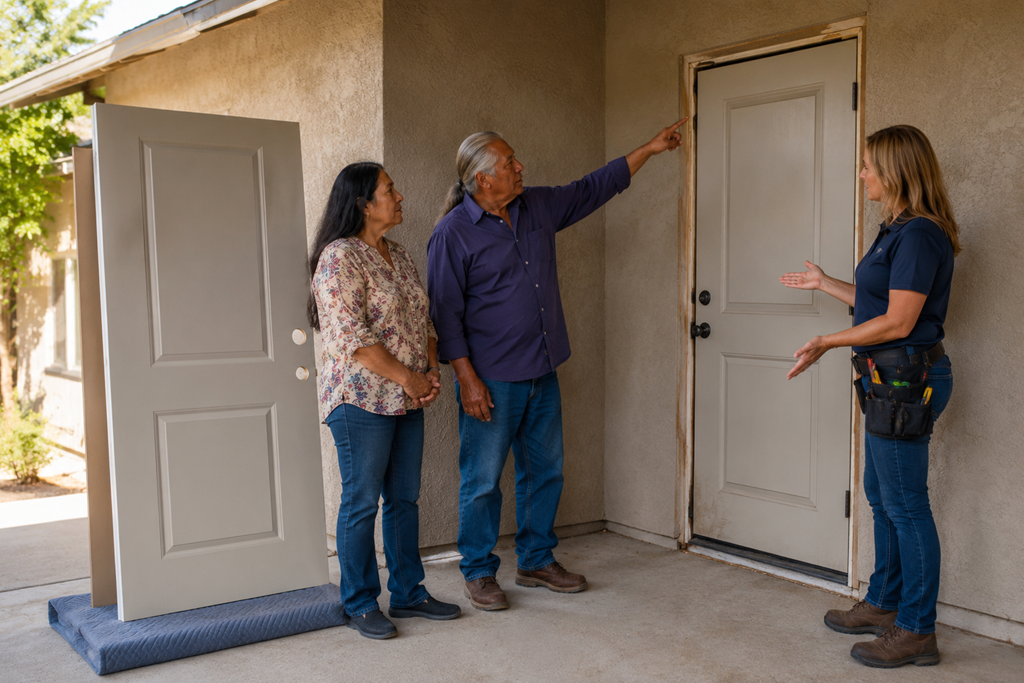
A door can look solid and still perform poorly when the frame around it is out of square, weakened, shifted, or poorly sealed. The frame controls how the door hangs, closes, locks, and keeps out outside air and moisture, so replacing only the door slab may not solve the problem when the surrounding structure is part of the issue.
Homeowners often focus on the visible door because that is the part they open, close, paint, and notice every day. The frame tends to fade into the background until the door begins rubbing, sticking, rattling, leaking air, or requiring extra pressure to lock.
Understanding the relationship between the door and its frame can make it easier to evaluate replacement recommendations and compare estimates from Sacramento-area door professionals.
The Door Does Not Operate Independently
The main door panel is sometimes called the door slab. It depends on the surrounding frame to hold it in the correct position.
The hinges attach the door to one side of the frame. The latch and deadbolt must line up with openings on the opposite side. Weatherstripping must meet the door consistently, and the threshold beneath the door must support a reasonably even seal.
When the frame is square, secure, and properly aligned, these parts can work together. When it is not, a door may appear to have several separate problems even though those problems share the same underlying cause.
For example, a homeowner may notice that the deadbolt will only turn when the door is pushed inward. There may also be a narrow gap above one corner or a section of weatherstripping that does not make contact. Replacing the lock may address the symptom temporarily, but it will not necessarily correct the alignment of the opening.
Frame Problems Can Look Like Door Problems
A door that sticks is not automatically warped. A loose-feeling lock is not always defective. A draft does not always mean the door panel lacks insulation.
These problems can also develop when the frame has shifted, loosened, deteriorated, or been installed out of alignment.
Common signs that the frame may deserve closer attention include:
- Gaps that are wider on one side of the door than the other
- A latch or deadbolt that no longer enters its opening smoothly
- A door that swings open or closed without being pushed
- Rubbing near one corner while the opposite corner has extra space
- Cracked, softened, separated, or visibly damaged frame material
- Weatherstripping that contacts the door in some areas but not others
One sign by itself does not prove that the entire frame needs replacement. It simply means the complete opening should be evaluated rather than assuming the door slab is the only concern.
A New Door Cannot Correct Every Existing Condition
Replacing a door slab within an existing frame can be a reasonable option when the frame is sound, square, secure, and compatible with the new door. This approach may preserve surrounding trim and reduce the amount of work involved.
However, a new slab must still be fitted to the existing opening. When that opening is uneven or damaged, the new door may inherit many of the same operational problems.
It may still rub. The hardware may still sit slightly above or below its matching openings. The weatherstripping may remain compressed on one side and loose on the other. The finished door may look new without performing like a properly coordinated system.
This is why a lower-cost slab-only quote should not automatically be treated as equivalent to an estimate that includes frame correction or a complete prehung door unit. The two estimates may address different scopes of work.
Not Every Imperfection Requires a Full Replacement
The importance of the frame does not mean every door concern requires removing it.
Some problems may come from loose hinges, worn weatherstripping, an isolated damaged section, a shifted strike plate, or another replaceable component. In other situations, adjustment or limited repair may restore acceptable operation.
The useful question is not simply, “Is there something wrong with the frame?”
A better question is, “Is the frame stable and aligned enough to support the proposed door and allow the complete opening to work properly?”
A qualified door professional should be able to explain whether the existing frame can remain, whether part of it needs attention, or whether replacing the complete assembly would provide a more appropriate result.
The Condition Around the Frame Matters Too
The visible frame is only part of the installation area.
A door opening also connects with the surrounding wall, exterior trim, interior casing, threshold, weather-resistant materials, and nearby flooring. Damage or movement in these areas can affect what the project involves.
For example, staining near the lower corner of a frame may justify a closer look at how water has been moving around the entry. Separation between trim and the wall may indicate that sealing or attachment details should be reviewed. An uneven threshold may affect the lower door seal even when the vertical sides appear straight.
Sacramento-area homes can have entry doors exposed to strong sun, dry heat, seasonal rain, and ordinary building movement. These conditions do not automatically mean a frame has failed, but they provide useful context when a professional evaluates wear, sealing, and alignment.
Appearance Alone Does Not Reveal the Full Scope
A freshly painted frame can still be misaligned. An older frame can still be solid and serviceable.
This makes visual appearance an incomplete way to decide between slab replacement, frame repair, or a complete door unit.
A useful evaluation should consider how the door operates, how the gaps compare around the perimeter, whether the hardware aligns, whether the frame feels secure, and whether there are signs of deterioration or moisture exposure.
The goal is not to find a reason to expand the project. It is to make sure the estimate addresses the condition that is actually causing the problem.
Questions That Can Make an Estimate Easier to Understand
Before comparing door replacement quotes, consider asking:
- Is the existing frame square, secure, and suitable for reuse?
- Are the operating problems coming from the door, the frame, the hardware, or a combination?
- Does the estimate cover a slab only or a complete prehung door and frame?
- How will existing gaps, lock misalignment, or threshold concerns be addressed?
- Could hidden damage change the scope once the existing materials are removed?
- What interior and exterior trim work is included?
The answers can reveal why two estimates differ even when both appear to describe a door replacement.
A provider who recommends keeping the existing frame should be able to explain why it is suitable. A provider who recommends replacing it should also be able to point to the conditions supporting that recommendation.
The Best Scope Treats the Door as a Complete Opening
The door slab is the most visible part of an entry, but it cannot provide reliable operation by itself. Its fit, movement, locking, and sealing all depend on the frame and surrounding installation.
Before choosing a replacement scope, look beyond the appearance of the door. Ask how the frame was evaluated, what conditions were found, and how the proposed work will address the entire opening.
That understanding can help Sacramento-area homeowners compare recommendations more fairly and avoid paying for a new door that leaves an old alignment problem unresolved.