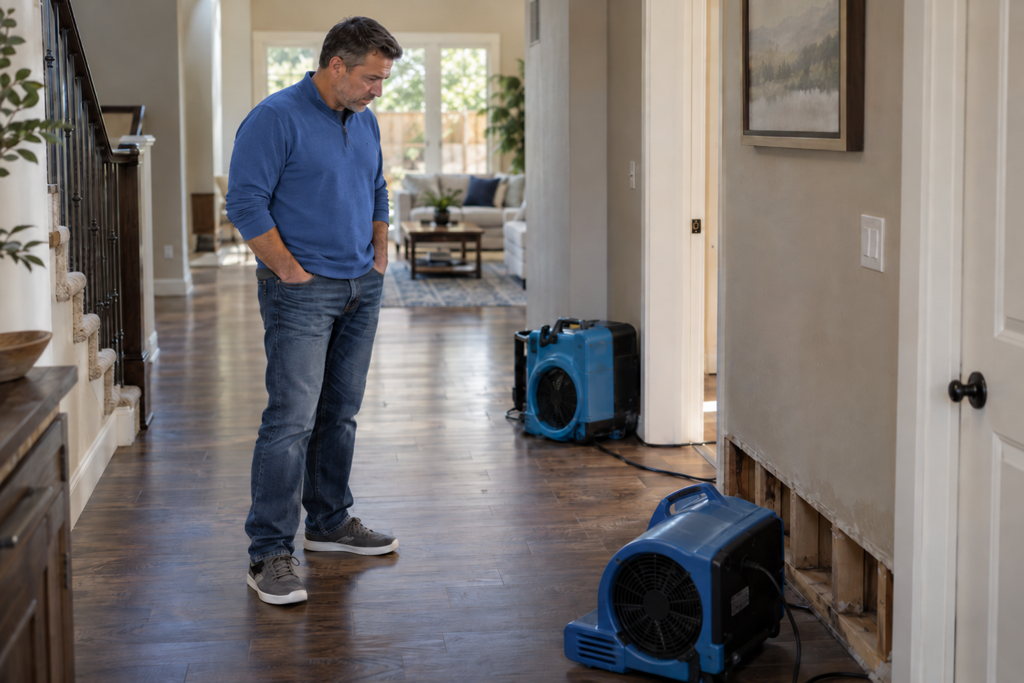
After water damage, removing visible water does not always mean a room or building material is fully dry. Moisture can remain inside carpet padding, drywall, wood, insulation, cabinets, and other materials even when surfaces look much better. Drying equipment may be used to help move moisture out of affected materials and control the drying environment while the area is being evaluated.
That distinction can be easy to miss. A homeowner may see that the standing water is gone, the floor no longer looks wet, and the room appears mostly normal again. Then a restoration professional may recommend leaving drying equipment in place. At first, that can feel unnecessary. Understanding what the equipment is meant to accomplish can make the recommendation easier to evaluate.
Visible Water And Remaining Moisture Are Not The Same Thing
Water damage often has two different parts: the water you can see and the moisture that may have moved into materials around it.
A puddle on a floor is obvious. Moisture that has entered flooring layers, drywall, baseboards, cabinetry, or other porous materials may be much harder to recognize just by looking at the room.
That is one reason drying equipment may still be recommended after the obvious water has been removed.
The goal is not simply to make the surface appear dry. A restoration provider may also be trying to reduce moisture that remains within affected materials and create conditions that support continued drying.
For Sacramento-area homeowners, this is an important distinction when reviewing a restoration plan. A room that looks much better may still be in the drying stage.
Why A Room Can Look Dry Before Materials Are Dry
Many building materials can absorb or hold moisture.
Depending on what was exposed and how the water moved through the space, moisture may remain in places that are not easily visible from the surface. A floor may feel dry underfoot while moisture remains below the finished surface. A wall may look normal while the lower portion still contains elevated moisture.
This does not mean every water-damage situation requires the same equipment or the same drying approach.
It does mean appearance alone may not tell the whole story.
A qualified restoration professional may evaluate which materials were affected, how far the moisture traveled, and whether those materials appear to be drying as expected before determining what equipment is appropriate.
Drying Equipment Helps Create A Controlled Drying Environment
Restoration drying equipment can serve different purposes.
Air-moving equipment may be used to support evaporation from affected surfaces and materials. Dehumidification equipment may be used to remove moisture from the surrounding air as drying takes place.
These pieces of equipment are often used together because drying is not just about one wet spot. The conditions in the surrounding space can influence how moisture leaves affected materials.
The important consumer question is not simply, “Why is this machine here?”
A more useful question is, “What moisture condition is this equipment intended to address?”
A restoration provider should be able to explain that connection in understandable terms.
More Equipment Does Not Automatically Mean Better Drying
It can be tempting to assume that more machines automatically mean a more thorough restoration.
That is not necessarily the right way to look at it.
The appropriate amount and type of drying equipment can depend on the size of the affected area, the materials involved, the amount of moisture present, the layout of the space, and how the area responds during drying.
This is one reason Sacramento homeowners do not need to judge a restoration plan simply by counting machines.
What matters more is whether the provider can explain why the equipment is being used, what it is expected to accomplish, and how the drying process will be evaluated.
A Household Fan Is Not Always The Same As A Drying Plan
Another common misunderstanding is assuming that placing an ordinary fan in the room should accomplish the same thing.
Moving air may be part of professional drying, but a restoration plan can involve more than simply creating airflow.
Professionals may be considering moisture in multiple materials, humidity in the space, how water traveled, and whether conditions are changing over time.
That does not mean homeowners need to understand the technical details themselves. It means that comparing a professional drying recommendation to simply pointing a household fan at a wet area can oversimplify what is being addressed.
The practical issue is whether the drying approach matches the actual condition of the property.
The Length Of Time Equipment Stays In Place Can Vary
Homeowners sometimes expect drying equipment to remain for a fixed number of hours or days.
Water damage does not always fit neatly into a universal schedule.
Different materials release moisture differently, and two rooms that experienced similar-looking water exposure may not dry at the same rate.
Rather than focusing only on a promised number of days, it can be more useful to ask how the provider will determine when drying equipment is no longer needed.
That shifts the conversation from an arbitrary timeline to the condition of the affected materials and space.
Monitoring Can Be As Important As The Initial Equipment Setup
Drying equipment may be placed at the beginning of the restoration process, but that initial setup is not necessarily the entire story.
A restoration provider may return to evaluate how conditions are changing and determine whether the drying plan should continue or be adjusted.
For the homeowner, this provides an important point of comparison when speaking with local restoration companies.
A clear provider should be able to explain how progress will be evaluated rather than presenting equipment placement as something that happens without follow-up or explanation.
If the process feels unclear, asking how the provider decides whether drying is progressing appropriately can make the plan easier to understand.
Not Every Wet Material Can Necessarily Be Dried In Place
Drying equipment is useful because some affected materials may be able to dry successfully under appropriate conditions.
But equipment does not automatically make every water-damaged material suitable to remain.
The type of material, its condition, the extent of exposure, and other site-specific factors can affect whether drying or removal is being considered.
This is another reason a restoration estimate should be more specific than simply listing equipment.
If some materials are being dried while others are being removed or replaced, the provider should be able to explain the reasoning behind the different approaches without relying on vague language.
Questions That Can Make The Drying Plan Easier To Understand
You do not need to become a restoration expert to ask useful questions.
Before approving or continuing a drying plan, you might ask:
- Which materials are you trying to dry?
- What indicates that moisture is still present?
- What is each type of drying equipment intended to accomplish?
- How will you evaluate whether the area is drying as expected?
- How will you decide when the equipment can be removed?
- Are any affected materials unlikely to be dried in place?
- Will the drying conditions be checked again during the process?
The answers should help connect the equipment you see in the room with the actual condition being addressed.
The Main Question Is Whether The Equipment Has A Clear Purpose
Drying equipment after water damage can seem unnecessary once the obvious water is gone. But visible dryness and complete drying are not always the same thing.
For Sacramento-area property owners, the most useful approach is to look beyond the presence of the machines themselves. Ask what remains wet, what the equipment is intended to do, how drying progress will be evaluated, and how the provider will determine when the equipment is no longer needed.
A clear explanation can help you understand whether the proposed drying plan fits the actual condition of the property before you commit to the next stage of restoration.