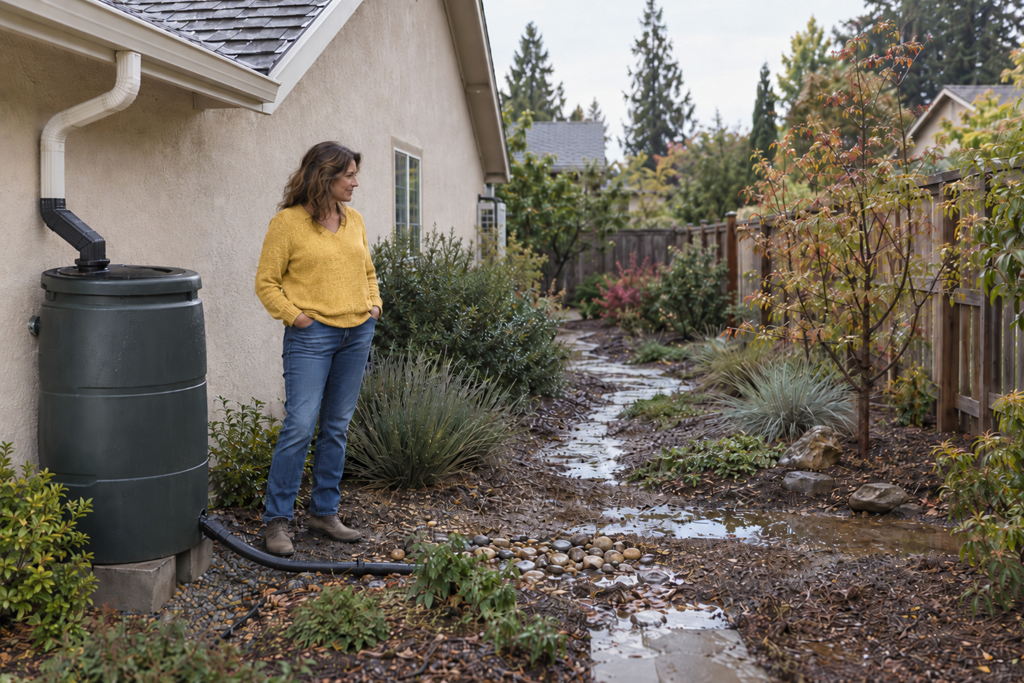
Rainwater collection works best when it is planned as part of the property’s overall drainage picture, not as a separate add-on. Collecting water from a roof changes where that water is stored, redirected, and eventually released, so the overflow path and surrounding drainage still matter when deciding where a system should go and how it should fit the site.
For many Sacramento-area homeowners, the first thought is understandably the storage itself: where a barrel or larger tank could fit, how much space it would take up, or how the collected water might be used. What is easier to overlook is what happens when the system reaches capacity or when water needs to move beyond the collection point.
That is where drainage becomes part of the same planning conversation.
Collecting Water Does Not Eliminate The Need For Drainage
A rainwater collection system intercepts water that would otherwise continue through a roof drainage path. That can change how water moves around the property, but it does not mean every drop of rainfall remains contained indefinitely.
A collection system can fill. Water may need somewhere to go once storage capacity has been reached. Water may also eventually be released for its intended use.
That means the practical question is not simply, “Where should the tank go?”
It is also, “How does this location fit into the way water already moves across the property?”
That broader view can help a homeowner avoid treating the collection system and the drainage system as two unrelated projects.
The Overflow Path Deserves Attention Before Placement Is Finalized
It can be easy to picture a rain barrel or storage tank during ordinary dry weather and choose a location based mostly on convenience, appearance, or proximity to a downspout.
Seasonal rain can reveal a different side of the property.
If stored water reaches capacity, the remaining flow still needs to be accounted for. Where that excess water moves can matter just as much as where the storage container sits.
A location that looks convenient may be less appealing if overflow would be directed toward an area where water already tends to collect, toward a frequently used walkway, or toward another part of the property where drainage is already unclear.
This does not mean a homeowner needs to diagnose drainage conditions alone. It means drainage is worth discussing while placement options are still flexible.
Existing Drainage Patterns Can Change The Conversation
Most properties already have a water-management pattern, whether it was carefully planned or simply developed over time.
Roof downspouts, paved surfaces, landscaping, soil elevations, patios, walkways, and other property features can all influence where rainwater travels.
A rainwater collection system becomes another part of that existing relationship.
For example, moving roof runoff into storage may reduce the immediate amount of water reaching one location during part of a storm. But once storage is full, the water still has to transition somewhere else.
Understanding that relationship can make a provider conversation much more useful. Instead of discussing only the container, fittings, or storage capacity, the homeowner can ask how the proposed system works with the site's existing water movement.
A Bigger Storage Tank Does Not Automatically Solve The Drainage Question
One common assumption is that greater storage capacity removes the need to think much about overflow.
Capacity certainly affects how much water can be held, but storage is still finite.
The more useful question is whether the proposed system has been considered as part of a complete water path: from the roof, into collection, and then through whatever happens when storage capacity is reached.
That distinction matters because a storage decision and a drainage decision solve different parts of the same problem.
A homeowner comparing system options may therefore want to look beyond tank size alone. Two proposals with similar storage capacity may differ in how clearly each provider has considered placement, overflow, existing drainage, and the surrounding property.
Placement Is About More Than Finding An Open Space
A rainwater collection system may need to fit into an area that already serves several purposes.
There may be walking paths, gates, planting areas, patios, utility access, side-yard circulation, or other everyday uses nearby. The best-looking open space is not automatically the best location if it complicates how water moves or how the area functions.
This is one reason it can help to consider the surrounding space rather than viewing the collection equipment in isolation.
A useful planning conversation may include how the location interacts with roof drainage, what happens when the system is full, whether nearby surfaces already receive runoff, and whether the installation would affect ordinary access around the property.
The goal is not to turn a simple project into an overly complicated one. It is to catch important site relationships before the system is placed.
Dry Weather Can Hide The Questions That Matter During Rain
Rainwater collection projects are often considered when the yard is dry and easy to inspect.
That is convenient, but it can also make drainage patterns less obvious.
Sacramento-area properties can look very different during seasonal rain than they do during dry conditions. Low areas, runoff paths, and places where water lingers may be much easier to notice when rain is actually moving through the site.
Homeowners do not need to wait for a storm to begin thinking about these issues. Even remembering where water has collected in the past can give a provider useful context during an estimate or consultation.
Photos from previous rainy periods may also help explain conditions that are not visible on the day of the visit.
Separate Project Scopes Can Still Affect Each Other
Sometimes rainwater collection and drainage are discussed as different service needs.
That may be appropriate, but the physical systems can still interact.
A rainwater collection provider may focus primarily on capturing and storing roof runoff. A drainage professional may look more broadly at how water moves across the property. Depending on the site and the scope of the project, one provider may recommend that another issue be evaluated separately.
That is not necessarily a sign that the project is becoming unnecessarily complicated. It may simply mean the property has more than one water-management consideration.
What matters is whether the boundaries of the proposed work are clear.
If a quote addresses collection but says very little about where overflow will go, that is a reasonable point to ask about before moving forward.
Questions That Can Make The Estimate More Useful
A homeowner does not need technical expertise to ask useful planning questions.
Consider asking:
- What happens to roof runoff when the collection system reaches capacity?
- How does the proposed location relate to the property's existing drainage?
- Are there nearby areas where overflow could create an unwanted concentration of water?
- Does the project scope include overflow planning, or would that require separate drainage work?
- Is there anything about the current property layout that should be evaluated before final placement?
The value of these questions is not in getting one universal answer. It is in making sure the proposed system is being considered in the context of the actual property.
A Collection System Should Fit The Whole Water Path
Rainwater collection can be easier to evaluate when the system is viewed as one stop along a larger water path rather than the final destination for every drop of rain.
The roof collects water. The collection system stores some of it. The property still needs a sensible way to handle water that cannot remain in storage.
Thinking about those pieces together can make provider conversations more specific and help Sacramento-area homeowners better understand what a proposed installation does—and what may fall outside its scope.
Before choosing a location or comparing quotes, it is worth asking how rainwater collection and drainage fit together on the property. That one question can provide a clearer picture of the project before installation begins.