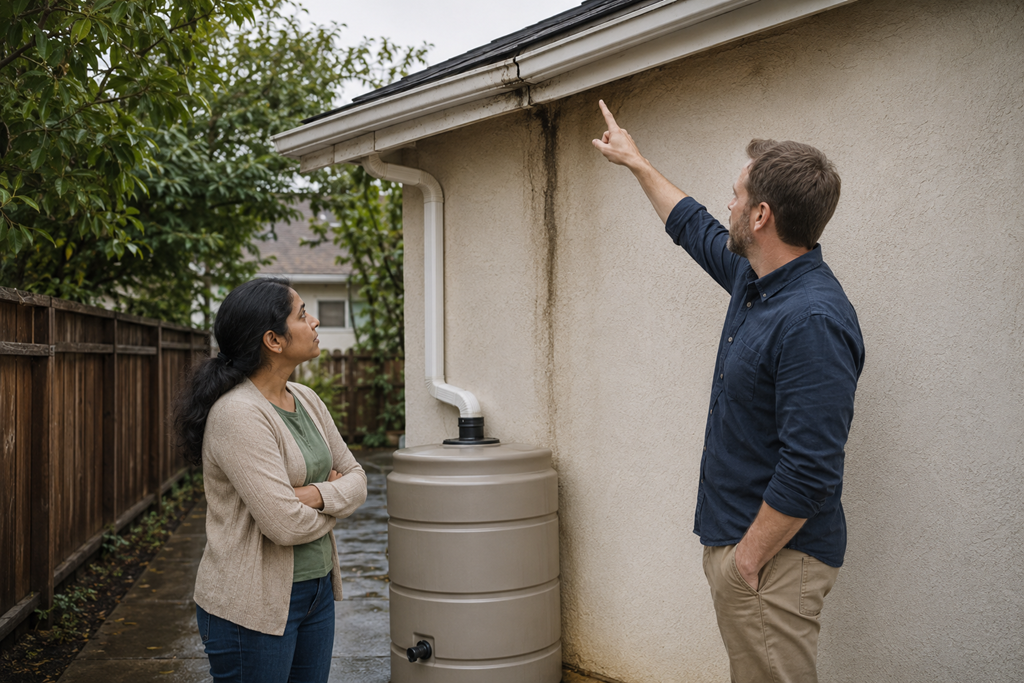
Collecting rainwater does not begin with the storage tank. It begins with the roof surface, the gutters that move water, and the drainage paths that handle overflow. If any of those areas are damaged, clogged, poorly directed, or already creating moisture problems, adding a collection system may simply carry those problems into a new part of the property.
This is easy to overlook because storage tanks, barrels, filters, and connecting hardware are the most visible parts of a rainwater collection project. A Sacramento-area homeowner may naturally begin by asking how much water a tank can hold or where it can fit. Those questions matter, but they come after a more basic one: Is the property ready to collect and manage roof runoff properly?
The Storage Tank Is Only One Part of the Water’s Path
A rainwater collection system depends on a connected path.
Rain falls on the roof, moves toward the roof edge, enters the gutters, passes through downspouts or collection piping, and eventually reaches storage. Once the storage container is full, excess water still needs somewhere appropriate to go.
A weakness anywhere along that path can affect the rest of the system. A sound tank cannot correct a leaking gutter, an unsuitable roof surface, a poorly positioned downspout, or an overflow route that sends water toward the house.
This is why a useful project discussion should look beyond the storage equipment. The surrounding roof and drainage conditions help determine whether the proposed system can work predictably without creating a different property concern.
Roof Condition Can Affect What Enters the System
The roof is the collection surface, so its condition deserves attention before runoff is redirected into storage.
A roof may have accumulated leaves, dust, animal debris, loose surface material, or residue from nearby trees. Older roofing materials may also shed particles or have areas that need repair. Roof penetrations, valleys, patched sections, and areas beneath overhanging branches can affect how water and debris move.
This does not automatically mean the property is unsuitable for rainwater collection. It means the roof should be considered as part of the system rather than treated as an unrelated structure above it.
The intended use of the collected water also matters. Water intended for landscape use may raise different questions than water being considered for another purpose. A qualified professional can help explain how the roof material, roof condition, filtration plan, and intended use relate to one another.
Gutters Determine Whether Water Arrives Reliably
Gutters may appear functional during dry weather while still having problems that become obvious when rain arrives.
Common concerns can include loose connections, sagging sections, clogged outlets, leaking seams, accumulated debris, or downspouts that discharge in inconvenient locations. Water may spill over an edge, run behind the gutter, or bypass the intended collection route.
These conditions can reduce how much water reaches the storage system. They can also create staining, erosion, or moisture near walls and foundations.
A homeowner may assume that connecting a tank to an existing downspout is a simple equipment decision. In reality, the condition and alignment of the gutter system can affect whether the connection performs as expected.
Before comparing tank sizes or accessories, it is reasonable to ask whether the existing gutters can move runoff toward the proposed collection point consistently.
Collecting Water Does Not Eliminate the Need for Drainage
Even a well-planned collection system will not capture an unlimited amount of water.
Storage can fill. A connection can be temporarily bypassed. Debris can restrict flow. A homeowner may also choose not to collect water during certain maintenance periods. In each of these situations, roof runoff still needs a safe drainage path.
That makes overflow planning a central part of the project rather than an optional detail.
An overflow outlet that ends beside the foundation, near an air-conditioning unit, across a walkway, or in a low section of the yard may create puddling or erosion. A tank placed in a narrow side yard may also affect gate access, trash-bin movement, or existing drainage channels.
The important question is not only, “Where will the tank go?” It is also, “Where will the water go when the tank cannot accept more?”
Existing Moisture Problems Should Be Identified First
A rainwater collection project should not be used to cover up an existing roof or drainage problem.
Signs such as soil erosion beneath a gutter, standing water near the house, dark staining below a roof edge, damp siding, washed-out landscaping, or repeated puddling around a downspout deserve attention before the runoff route is changed.
Redirecting water may reduce one visible symptom while moving the moisture somewhere else. It may also make the original cause harder to recognize later.
In some cases, a rainwater collection professional may recommend that a roofer, gutter specialist, or drainage professional evaluate part of the property first. That is not necessarily an unnecessary complication. It may be a sign that the provider is looking at how the full water path affects the home.
Similar-Looking Quotes May Cover Different Work
Roof, gutter, and drainage conditions can also explain why rainwater collection estimates differ.
One quote may focus mainly on the tank and basic connection. Another may include gutter adjustments, downspout changes, filtration components, overflow routing, a prepared base, or drainage improvements around the installation area.
The higher quote is not automatically the better one, and the lower quote is not automatically incomplete. The important issue is whether each provider has clearly explained what is included and what property conditions are being assumed.
A quote that depends on existing gutters being in good condition should say so. A proposal that includes correcting an overflow problem should identify that work separately. Clear scope makes it easier to compare the actual plans rather than comparing only the final totals.
Questions That Can Make the Consultation More Useful
A few focused questions can reveal whether the provider has considered the complete collection path:
- Are there roof or gutter conditions that should be addressed before installation?
- How will water reach the tank from the existing downspout layout?
- Where will overflow go when the storage container is full?
- Could the proposed placement interfere with drainage, access, or nearby equipment?
- Which gutter, drainage, base-preparation, and overflow changes are included in the estimate?
- Does the intended use of the water affect the recommended setup?
The provider should be able to explain the reasoning in understandable terms. Answers should connect the equipment recommendation to the actual conditions around the home.
A Stronger Project Starts Before the Tank Is Chosen
Choosing a rainwater collection system is not only a question of capacity, appearance, or available yard space. It is a property-wide water-management decision involving the surface that catches the rain, the gutters that carry it, and the drainage route that handles what cannot be stored.
For Sacramento-area homeowners, evaluating those conditions early can make provider conversations more useful and estimates easier to understand. It can also help separate a thoughtful collection plan from a proposal that simply adds equipment without addressing how water already moves around the property.
Before committing to a system, look at the full path from the roof to the final overflow location. That broader view can help you ask better questions and choose a plan that fits both your collection goals and the existing conditions of your home.