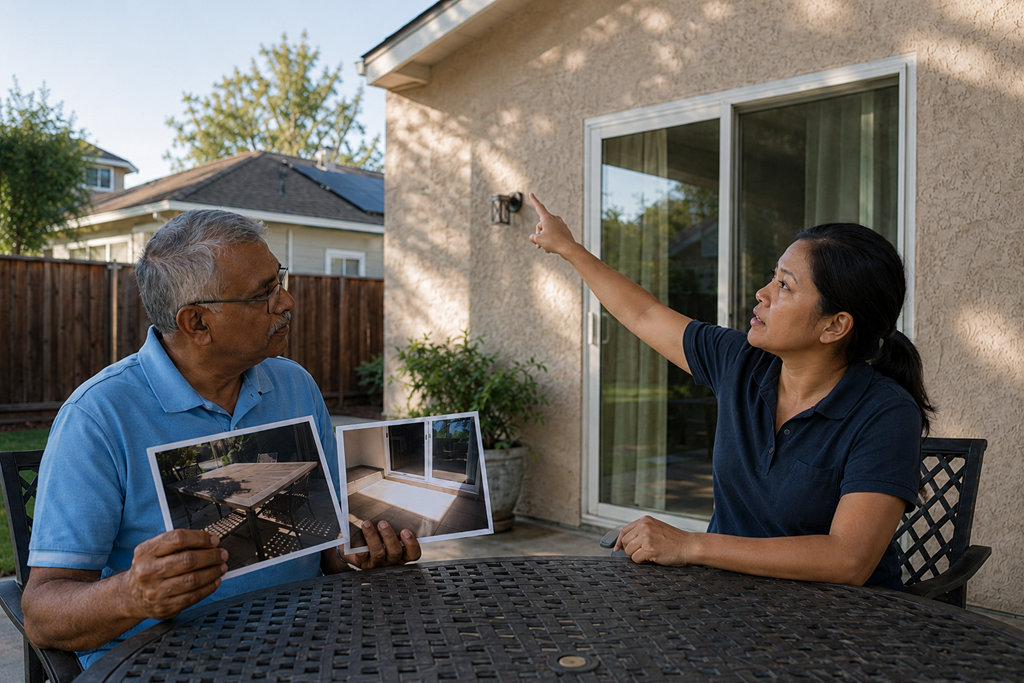
Shade planning matters before awning installation because an awning can be installed correctly and still fail to shade the place you actually use. The wall, window, or door may suggest one location, but the useful shade must reach the seating, walkway, dining area, or interior opening at the times when sun exposure is most disruptive.
This is an easy detail to overlook. A homeowner may picture a neat awning centered above a patio door, only to discover that the afternoon shade falls beside the table instead of over it. The installation may look balanced from the yard, yet the chairs, play area, or room inside may remain exposed.
Planning the shade first helps connect the awning’s placement and size to the problem it is supposed to solve.
An Awning Shades a Moving Target
Shade does not remain in one fixed rectangle throughout the day. Its position and reach change as the sun moves.
An awning that shades a window well during part of the morning may cast a shorter or differently angled shadow later. An installation that covers a chair near the wall may not protect a dining table several feet away when the space is used most often.
This matters for Sacramento-area homeowners because the goal is usually not to create shade somewhere on the property. The goal is to create useful shade in a particular place during a meaningful part of the day.
Before discussing colors, fabric patterns, or operating features, it helps to define where the shade needs to fall.
The Most Balanced Location May Not Be the Most Useful
A wall often encourages people to think in terms of symmetry. Centering an awning above a door, window, or patio can look like the obvious choice.
The activities below it may not be centered, however.
A patio sofa may sit to one side because of a walkway. A dining table may be positioned away from the wall so people can move around it. A children’s play area may occupy the sunniest part of the patio. A grill, planter, gate, or pool access route may affect where people actually spend time.
In those situations, a visually centered awning could produce shade that looks orderly but serves an underused section of the space.
This does not mean appearance is unimportant. It means appearance and function should be considered together rather than assuming that the most symmetrical position will automatically be the most effective one.
Start With What the Shade Is Supposed to Improve
“More shade” can describe several different goals. Identifying the main goal makes the installation conversation more useful.
Making an Outdoor Seating Area More Comfortable
When the priority is a sofa, dining table, lounge chair, or play area, the important question is whether the awning’s shadow will reach that activity zone when it is normally occupied.
The furniture arrangement may be more important than the centerline of the wall.
Reducing Sun Through a Window or Door
Some homeowners are less concerned about sitting beneath the awning and more concerned about direct sunlight entering the home.
In that case, the discussion may focus on the opening being protected, the direction of exposure, and when glare or solar heat is most noticeable inside. The best placement for protecting an interior room may differ from the best placement for shading a large outdoor table.
Protecting a Frequently Used Transition Area
A shaded doorway, entry, or path between indoor and outdoor spaces can also be the priority.
The awning may need to serve people entering and leaving the home rather than cover the entire patio. Planning around this narrower goal can prevent the project from becoming larger or more complicated than necessary.
The important point is that the awning should be evaluated according to its intended job, not according to a general idea that any added shade will be helpful.
Projection and Sun Direction Affect Usable Shade
Awning width is easy to notice because it follows the wall horizontally. Projection—the distance the awning extends outward—is sometimes harder to visualize before installation.
A wide awning may cover a large section of wall while casting less shade over the outer portion of a patio than the homeowner expected. Depending on the direction of the sun, part of the shadow may also shift sideways rather than extending straight outward.
This is one reason a photograph, rough patio measurement, or conversation about how the space is used can be valuable during an estimate. The goal is not for the homeowner to perform technical calculations. It is to give the installer enough context to explain what the proposed placement is expected to shade.
A qualified awning professional should be able to discuss how the wall location, expected projection, orientation, and surrounding conditions relate to the desired coverage.
The Time of the Estimate Can Be Misleading
A consultation provides only a snapshot of the property.
If an installer visits in the morning, a patio may already be shaded by the home. That does not necessarily show what happens later when the homeowner wants to eat outside. An afternoon visit may reveal a different problem but say little about morning glare through a kitchen window.
The current shadow should therefore be treated as one piece of information rather than the full shade plan.
Homeowners can make the conversation more productive by explaining when the problem is most noticeable. A simple observation such as “the table becomes uncomfortable later in the day” may be more useful than saying only that the patio needs shade.
Photos taken at different times can also help communicate the pattern, provided they are used to support the professional evaluation rather than replace it.
Better Shade Planning Makes Quotes Easier to Compare
Two awning proposals may not be designed to accomplish the same result.
One provider may recommend an awning centered over the opening. Another may shift the placement, increase the projection, divide the coverage, or suggest that the desired shaded area is larger than the original idea would serve.
Those differences can affect the proposed size, mounting location, operating style, project scope, and overall estimate.
A lower quote may reflect a smaller or simpler awning, but that proposal may also create less usable shade. A higher quote may include additional coverage that the homeowner does not actually need. Without a clearly stated shade goal, it can be difficult to tell whether the proposals are comparable.
Instead of comparing dimensions and prices alone, compare what each proposed installation is expected to shade.
Questions Worth Asking During an Awning Consultation
A few focused questions can help reveal whether the shade plan and the installation proposal are aligned:
- Where is the shadow expected to fall when this area is normally used?
- Is the proposed location based mainly on the wall opening or on the activity area below it?
- Will the projected shade reach the outer seating or dining area?
- How might the shade shift during the part of the day that concerns us?
- Are there placement limitations that could affect the intended coverage?
- What tradeoffs would come with changing the width, projection, or location?
The answers do not need to include guarantees about an exact shadow at every moment. They should demonstrate that the provider understands what the homeowner wants the awning to accomplish.
Common Assumptions Can Lead to Disappointing Results
One common assumption is that a larger awning automatically creates better shade. Size can help, but only when the additional coverage is directed toward the area that matters.
Another is that the installation should follow the visual center of the building. That may produce the best appearance in some settings, but it should not be accepted without considering the furniture, traffic pattern, and sun direction.
It is also easy to assume that shade observed during the estimate represents typical conditions. Sun exposure changes, and the most important conditions may occur at a different time.
Finally, homeowners sometimes try to solve several different problems with one awning without deciding which result matters most. Shading a window, covering a dining area, protecting a doorway, and cooling an entire patio are not necessarily the same project.
A clearer priority helps the homeowner and installer recognize reasonable tradeoffs before the work begins.
Plan the Result Before Choosing the Awning
Shade planning does not require turning a homeowner into a sun-angle expert. It means beginning with a practical description of the result:
Where should the shade fall, what should it cover, and when is that coverage most important?
Once those questions are understood, awning placement, size, projection, appearance, and operating options can be discussed in relation to a real purpose. This also gives Sacramento-area homeowners a stronger basis for reviewing estimates and noticing when a proposed installation does not appear to address the original concern.
The best-looking location and the most useful location may be the same. Shade planning helps confirm that before the awning is installed rather than after the shadow begins falling in the wrong place.