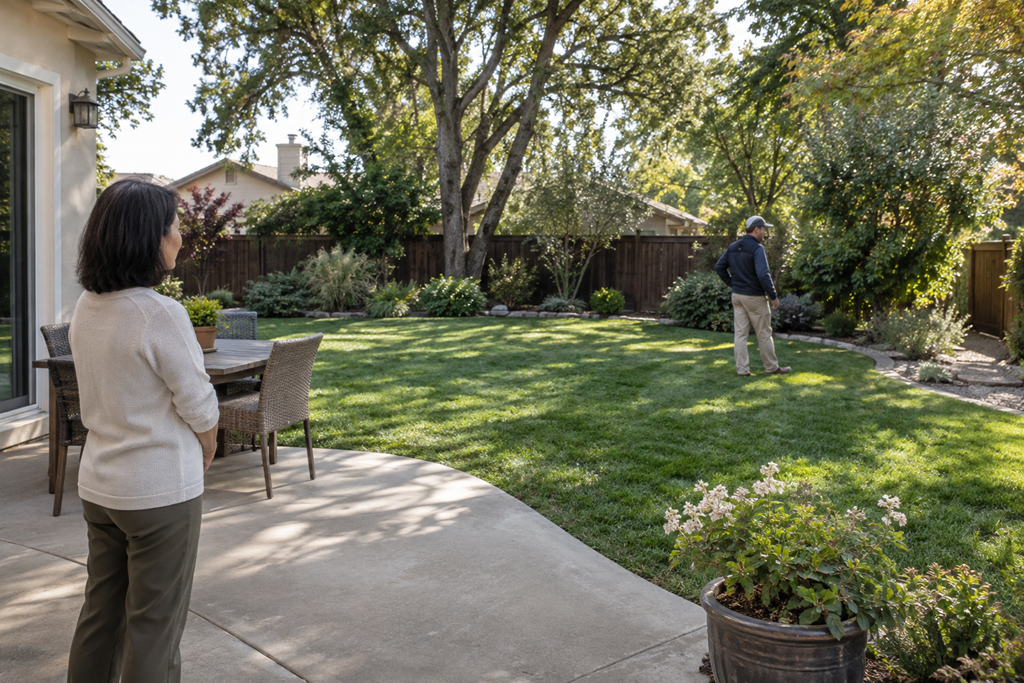
Evaluating a landscaping provider before hiring one is less about finding the person with the most polished pitch and more about noticing how well they understand your property, priorities, and expectations before proposing work. A strong conversation should leave you with a clearer picture of the scope, what is included, what may still be uncertain, and how the provider plans to communicate if conditions or priorities change. For Sacramento-area homeowners, that can make comparing providers much easier than judging on price or first impressions alone.
Landscaping projects can look straightforward from a distance. You may want a cleaner yard, new planting areas, a refreshed lawn, better use of an outdoor space, or ongoing maintenance. But once you start talking with providers, you may realize that two companies can look at the same property and describe very different approaches.
That does not automatically mean one is right and the other is wrong. It does mean you need enough information to understand what each provider is actually proposing.
A Good Evaluation Starts Before You Compare Prices
Price matters, but it is difficult to judge a landscaping quote without understanding what sits behind the number.
Before focusing on the total, pay attention to how the provider approaches the property. Do they take time to understand what you want to change? Do they ask about areas you want to preserve? Do they consider how different parts of the yard relate to one another?
A provider who immediately jumps to a solution may still be capable, but you have less information about whether the recommendation reflects your actual priorities.
The goal is not to test the provider or expect a lengthy consultation. It is simply to notice whether enough discovery happens before recommendations are made.
Notice Whether the Provider Looks at the Whole Situation
A landscape is rarely just one isolated feature.
A planting bed may sit beside a walkway. A lawn may connect to a patio. Trees may create shaded areas while other parts of the yard receive much more sun. Side-yard access may affect how materials or equipment can reach the work area. Existing irrigation, drainage, fencing, hardscape, or established plants may also be relevant depending on the project.
You do not need to diagnose these conditions yourself.
Instead, notice whether the provider seems interested in understanding the property beyond the single feature you initially mentioned.
That can be especially useful when comparing providers. One may concentrate narrowly on the requested change, while another may explain how that change relates to the surrounding yard. Understanding that difference can help you decide which proposed scope better matches what you actually want.
The Questions a Provider Asks Can Tell You a Lot
You can learn something about a landscaping provider by listening to what they want to know before recommending work.
Useful questions may involve how you use the space, what you like or dislike about the current yard, which areas matter most to you, whether you want lower or higher ongoing maintenance, and whether there are features you definitely want to keep.
For example, a homeowner asking for a backyard refresh may primarily care about creating a more usable gathering area. Another homeowner may be more concerned about simplifying regular upkeep.
Those goals can lead to very different conversations even if the properties look similar.
A provider does not need to ask every possible question. What matters is whether the conversation gives you confidence that the recommendation is connected to your priorities rather than being a standard solution applied to every property.
Make Sure You Understand What the Proposed Scope Actually Covers
One of the easiest ways for landscaping comparisons to become confusing is to assume that similar-looking quotes cover similar work.
They may not.
A proposal might focus on one section of the property while another includes preparation, removal, planting, cleanup, or additional areas. Materials or plant selections may differ. Some decisions may still be open rather than finalized.
Instead of asking only, “Which quote is cheaper?” try to understand what each provider believes the project includes.
This can also reveal misunderstandings early. You may discover that something you considered an obvious part of the project was not included in the provider's expectations at all.
Finding that out before hiring is much easier than discovering it after work has begun.
Clear Explanations Matter More Than a Perfectly Polished Presentation
A landscaping provider does not need an elaborate presentation to communicate well.
What matters is whether you can follow the explanation.
If a provider recommends a certain approach, you should be able to ask why. If part of the project is uncertain until the site is evaluated more closely, that uncertainty should be understandable. If there are decisions you will need to make later, you should know that too.
Be cautious about confusing confidence with clarity.
Someone can sound very certain while still leaving important details vague. Another provider may openly identify something that cannot yet be confirmed.
Acknowledging uncertainty is not necessarily a weakness. In some situations, it can give you a more realistic picture of what has been evaluated and what remains to be determined.
Think About the Yard After the Project Is Finished
It is easy to concentrate on how the property will look immediately after landscaping work is completed.
It is also useful to discuss what happens afterward.
Different landscaping choices can involve different levels of routine care, watering considerations, trimming, cleanup, or future maintenance. The exact questions will depend on the work being considered, but the broader issue is simple: make sure the provider understands how much ongoing involvement you realistically want.
A visually appealing recommendation may be a poor fit if it creates more upkeep than you expected.
That does not make the recommendation bad. It simply means fit matters.
Communication Before Hiring Can Preview the Working Relationship
The period before hiring gives you a small sample of what communicating with the provider may feel like later.
Notice whether questions are answered directly. Pay attention to whether changes in the discussion are acknowledged. See whether the provider distinguishes between what is included, what is optional, and what still needs to be decided.
You are not looking for perfection or instant responses to every question.
You are looking for a communication style that makes it reasonably easy to understand what is happening.
Landscaping projects can involve many small decisions. If basic expectations already feel difficult to clarify before hiring, it is reasonable to explore those concerns before committing.
A Few Questions Can Make Provider Comparisons Easier
You do not need a long interview. A handful of focused questions can reveal a great deal:
- What do you see as the main scope of this project?
- Is anything I mentioned not included in what you are proposing?
- Are there parts of the property that could affect the approach?
- Which decisions would I need to make before work begins?
- What ongoing maintenance should I expect from the landscaping being discussed?
- How would changes or unexpected conditions be communicated?
- What should I understand when comparing your proposal with another provider's?
- What credentials, insurance, or other qualifications are relevant to this type of work?
The purpose of these questions is not to force every provider to give identical answers. It is to make the differences between providers easier to understand.
Be Careful When the Decision Starts Feeling Rushed
A rushed decision can make ordinary uncertainties easier to overlook.
You may feel pressure simply because you are tired of comparing options and want the project settled. A confident recommendation, attractive design idea, or appealing price can make it tempting to move forward before you fully understand the scope.
Taking additional time does not mean you are being difficult.
It can simply mean you want to understand what you are agreeing to.
Before hiring, consider whether you can explain in your own words what the provider is proposing, what is included, what decisions remain, and how the project matches your priorities.
If you cannot, another conversation may be worthwhile.
The Best Fit Is the Provider You Can Understand
Evaluating a landscaping provider is not about finding someone who says all the right things or promises a flawless project.
It is about gathering enough information to decide whether the provider appears to understand your property, listens to your priorities, explains the proposed scope clearly, and communicates in a way that works for you.
For Sacramento-area homeowners comparing landscaping providers, that broader view can be more useful than focusing on a single quote, design idea, or first impression.
Before hiring, give yourself enough room to understand not only what a provider wants to do, but why the proposed approach seems appropriate for your property and expectations. That makes the final decision easier to base on meaningful differences rather than guesswork.