Gutters do more than keep rainwater from spilling over the edge of a house. They help move roof runoff away from the roofline in a controlled path. When gutters are clogged, damaged, poorly aligned, or pulling away from the home, water can collect or overflow near roofing edges, fascia, and other areas that were not meant to stay wet for long.
For Sacramento-area homeowners, gutters can be easy to think about only when rain is actively falling. During long dry stretches, they may fade into the background. Then seasonal rain arrives, and a small drainage problem can suddenly become much easier to notice.
Understanding the relationship between gutters and the roof can help you ask better questions when something around the roofline does not look right.
Gutters Are Part of the Roof's Water-Management System
A roof is designed to shed water. Gutters receive much of that runoff and direct it toward downspouts so it can continue away from the roof edge.
That means the roof and gutters are separate components, but they do not function independently.
When the drainage path is working properly, water moves off the roofing surface, into the gutter, and away from the edge of the structure. If something interrupts that path, water may spill over, remain in the gutter, or repeatedly wet nearby surfaces.
The problem is not simply that a gutter looks messy. The more important question is whether water is still moving where it is supposed to go.
Problems Often Become Visible Around the Roof Edge
Gutter-related concerns frequently show up near the transition between the roof and the exterior wall.
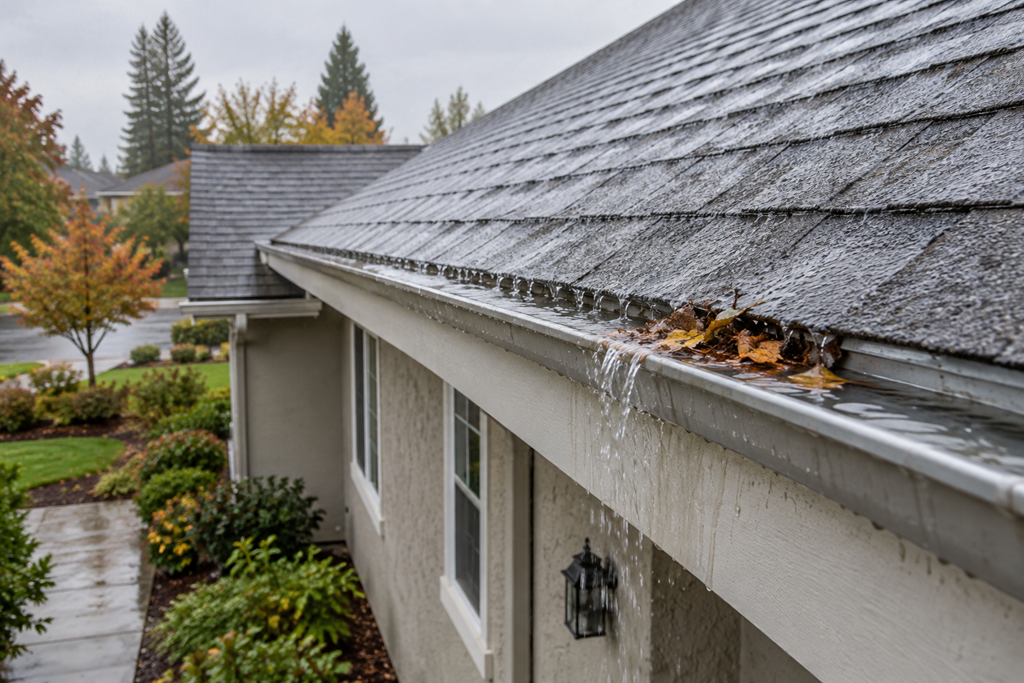
A gutter filled with leaves or other debris may not have enough room to carry runoff normally. A gutter that has shifted or pulled away may not catch water as effectively as intended. Sections that no longer drain properly may also hold water instead of directing it toward a downspout.
Depending on the situation, a homeowner might notice water spilling over one section during rain, staining around the roof edge, damp areas beneath the gutter, peeling finishes around fascia, or a gutter that visibly sits differently from neighboring sections.
These signs do not automatically mean the roof itself has been seriously damaged. They are reasons to look more closely at how water is moving around the roofline.
A Gutter Problem Does Not Automatically Mean a Roofing Problem
One of the easiest misunderstandings is assuming that any gutter issue means the roof needs repair or replacement.
That is not necessarily the case.
Sometimes the concern is primarily with the gutter system. In other situations, repeated water exposure around the roof edge may have affected nearby materials as well. And occasionally, what appears to be a gutter problem may actually involve another part of the roof drainage system.
This is why identifying the source matters more than jumping immediately to the largest possible repair.
If you are requesting an evaluation, it can be useful to ask the professional to explain which component appears to be causing the problem and whether nearby roofing or fascia materials show any signs that deserve additional attention.
Overflow Can Be More Informative Than It Looks
Water coming over the front edge of a gutter may seem like a simple nuisance, especially if it only happens during rain.
But the location and pattern of that overflow can provide useful information.
If water repeatedly spills from one particular area, the question is not only how much water is present. It is also why that part of the drainage path is not handling runoff as expected.
A localized obstruction, drainage issue, gutter alignment problem, or another condition may be involved.
For homeowners, the useful takeaway is not to diagnose the cause from the ground. It is to recognize that repeated overflow is worth describing clearly when speaking with a roofing or gutter professional.
The Condition of the Fascia Can Matter Too
The fascia is positioned along the roof edge where gutters are commonly attached. Because of that location, gutter problems and fascia concerns can sometimes appear together.
Repeated moisture near this area may affect finishes or materials over time, particularly when water consistently reaches places it normally would not.
From a homeowner's perspective, this is another reason to avoid treating the gutter as an isolated accessory.
If a gutter is loose, sagging, pulling away, or repeatedly overflowing, asking whether the attachment area and surrounding roof edge are still in good condition can help clarify the scope of the issue.
That does not mean assuming damage exists. It means making sure the evaluation considers the relationship between the components rather than focusing on only the most visible symptom.
Dry Weather Can Make the Issue Easy to Forget
Sacramento's dry periods can create a simple timing problem: a drainage concern may be noticeable during rain and nearly invisible afterward.
Once the weather clears, the overflowing water is gone. What remains may be nothing more obvious than debris, a slight change in gutter position, a faint discoloration, or a damp area that quickly dries.
That can make it tempting to forget the issue until the next rainfall.
A more useful approach is simply to remember what you observed. Where did the water appear? Was it one section or several? Did it flow over the front of the gutter, appear behind it, or collect near the roof edge?
Those observations can make a later conversation with a professional more specific without requiring you to determine the technical cause yourself.
Ask What Is Actually Included in an Evaluation
If you contact a roofing company, gutter company, or another qualified home-service professional, it helps to know what they are evaluating.
A few practical questions may include:
- Is the concern limited to the gutter system, or should the roof edge and fascia also be evaluated?
- What appears to be interrupting normal water flow?
- Are any gutter sections loose, misaligned, or no longer draining as intended?
- Is there visible evidence that nearby materials have been repeatedly exposed to water?
- If work is recommended, which problem is the work intended to correct?
Clear answers can make it easier to understand whether you are dealing with routine gutter maintenance, a gutter repair, or a concern that deserves a broader roofing evaluation.
The Goal Is to Understand the Water Path
Gutters may look like a relatively small exterior feature, but their job connects directly to how the roof manages rainwater.
The most useful way to think about them is not simply as channels attached beneath the roof. They are part of the path water takes after it leaves the roofing surface.
When that path is interrupted, the important question is where the water is going instead.
For Sacramento-area homeowners, noticing repeated overflow, unusual gutter positioning, or changes around the roof edge does not require assuming the worst. It simply gives you useful information to bring into a conversation with a qualified professional.
Understanding that connection can help you discuss the problem more clearly, compare recommendations more carefully, and make a better-informed decision about what actually needs attention.