A well-planned fence project starts by deciding what the fence needs to do in each part of the property—not by choosing a material or copying the same design around the entire yard. For many Sacramento-area homeowners, the real decision is how to balance privacy from nearby windows, safe gates and stable boundaries, and a level of upkeep that fits the way the yard is actually used. Those goals can overlap, but they do not always point to the same solution.
A homeowner may want a taller fence near a patio, better visibility near a driveway, a secure gate for children or pets, and easier access to plants or irrigation lines. Treating all of those needs as one general request can lead to a fence that looks consistent but does not work equally well in every location.
The project becomes easier to evaluate when privacy, safety, and maintenance are considered as separate priorities before they are combined into one plan.
Start With What the Fence Needs to Do
Homeowners often begin by thinking about fence materials, colors, or styles. Those choices matter, but they make more sense after the fence’s everyday purpose has been defined.
Privacy may be most important around a patio, bedroom window, pool area, or frequently used part of the yard. Safety may matter more near a gate, driveway, walkway, play area, or property edge. Maintenance may become the deciding factor along planting beds, irrigation zones, shaded areas, or narrow side yards where access is limited.
The same fence line can therefore have several jobs.
A solid section may reduce unwanted sightlines near outdoor seating. A gate area may need a clear path and dependable operation. A section near shrubs may need enough access for future trimming and inspection. A long side-yard fence may need to withstand regular exposure without becoming difficult to maintain.
Defining those jobs early helps a homeowner explain the project more clearly when requesting an evaluation or comparing estimates.
Privacy Depends on Sightlines, Not Just Fence Height
Privacy concerns often begin with a simple observation: a neighboring window, raised patio, walkway, or outdoor seating area is visible from a part of the property where the homeowner wants more separation.
It is easy to assume that the answer is simply a taller fence. However, the location of the unwanted sightline may matter as much as the overall height.
A privacy concern that affects one seating area may not require the same solution along the entire property line. In some yards, changing one section, adjusting the placement of an outdoor activity area, or discussing another form of screening may address the practical concern without turning the whole fence into a larger project.
Homeowners should also think about what they want to see from inside their own yard. A completely solid barrier may improve separation in one direction while reducing light, airflow, or visibility in another.
The useful question is not merely, “How high should the fence be?”
It is, “Where is privacy actually needed, and from which viewing angles?”
A fence professional can help evaluate those sightlines and explain how different layouts may affect the appearance and function of the property. Any changes involving height, placement, or shared boundaries should also be discussed carefully before work begins.
Safety Includes More Than Whether the Fence Is Standing
A fence can appear generally upright while still creating concerns in the way people move through the property.
A gate that drags, a latch that is difficult to operate, a narrowing walkway, a loose section beside a play area, or a fence that blocks visibility near a driveway can affect daily use even when the fence has not visibly failed.
Safety planning should focus on the people, pets, and activities that regularly use the space.
A household with a dog may care about gaps, gate reliability, and places where digging or pushing occurs. A family with young children may be more concerned about accessible latches or unstable boards. An older homeowner may place greater importance on clear walkways and gates that open without excessive effort.
There can also be a tradeoff between privacy and visibility. A solid fence near a patio may be useful, while the same degree of screening close to a driveway or narrow exit could make it harder to see approaching people, bicycles, or vehicles.
These details are easier to address while the project is being planned than after the fence has been installed.
Maintenance Is Part of the Design Decision
Every fence requires some level of attention over time. The amount and type of maintenance depend on the material, exposure, landscaping, construction quality, and how easily the fence can be reached.
Sacramento-area properties may include sections exposed to strong sun, dry soil, seasonal rain, irrigation overspray, dense shrubs, or mature trees. Different parts of one fence line can therefore age at different rates.
A fence beside an open driveway may remain easy to inspect. A similar section behind vines, storage items, or closely planted shrubs may be difficult to reach until a problem becomes noticeable.
Planning for maintenance means considering what will be around the fence after the project is complete. Homeowners may benefit from discussing:
- Whether plants will touch or grow through the fence
- Whether irrigation regularly reaches the boards or posts
- Whether both sides can be accessed when maintenance is needed
- How gates, hardware, and finishes are expected to age
- Which areas receive the strongest sun or remain shaded and damp
- What routine care the proposed material is likely to require
A product described as low-maintenance is not necessarily maintenance-free. Gates may need adjustment, vegetation may need management, finishes can weather, and hardware can wear even when the main fence material remains sound.
One Design Does Not Have to Solve Every Problem
A common planning mistake is assuming that every section must be identical.
Visual consistency may be important, especially along a prominent property edge. However, consistency does not always require every section to have the same height, openness, or function.
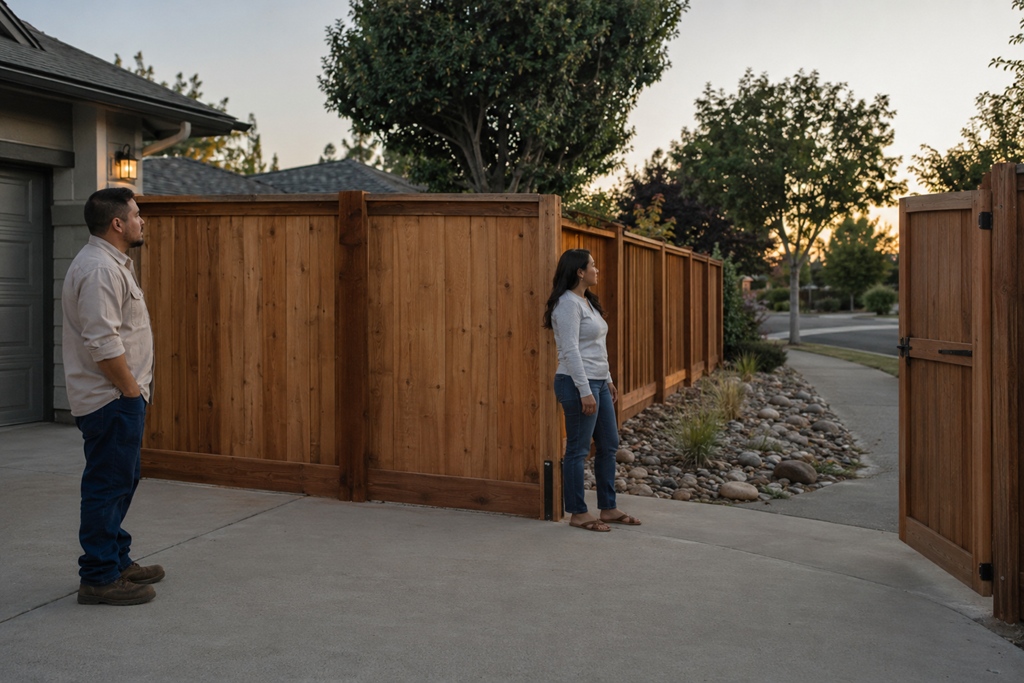
A homeowner might need greater privacy near a patio but better visibility near a driveway. One side yard may require a secure gate, while another needs easier access for waste bins, gardening equipment, or maintenance. A fence beside mature landscaping may need different planning than a fence beside open concrete.
This does not mean the finished project should look disconnected. It means the design should respond to the property rather than forcing the property to fit one repeated solution.
When speaking with a fence professional, homeowners can ask how different functional needs might be handled while preserving a cohesive overall appearance.
Daily Use Often Reveals Priorities That Plans Miss
A property can look very different on a sketch than it feels during an ordinary day.
Before settling on a project scope, it helps to notice how people actually move through the space. Consider where outdoor furniture is placed, which gates are used most often, where pets wait, how waste bins are moved, which paths become crowded, and where landscaping equipment must pass.
A gate that appears wide enough on paper may still feel inconvenient when carrying groceries or moving a lawn mower. A privacy section may work from the patio but leave an unwanted sightline from a kitchen window. A fence placed close to shrubs may look neat at installation but become difficult to inspect later.
These are not unusual planning failures. They happen because fence projects are often discussed as property boundaries rather than as parts of a working outdoor space.
The more clearly a homeowner can describe daily use, the easier it becomes for a professional to understand the intended result.
Repairing One Section May Not Address the Larger Goal
Some fence projects begin with a visible defect, such as a broken board, leaning panel, loose gate, or deteriorated post. Repairing that defect may be appropriate, but it is useful to consider whether the repair also supports the homeowner’s broader goals.
For example, replacing damaged boards may restore the appearance of a section without improving an existing privacy concern. Adjusting a gate may help it close but may not resolve a walkway conflict. Replacing one unstable post may make sense when the neighboring fence remains sound, but repeated movement across several sections may call for a broader evaluation.
This does not mean every repair should become a full replacement project. It means the immediate problem and the long-term purpose should be discussed separately.
A homeowner can ask which work is necessary to correct the current condition and which changes would be optional improvements related to privacy, safety, appearance, or maintenance.
That distinction makes estimates easier to understand and helps prevent optional preferences from being confused with essential repairs.
Shared Fence Lines Deserve an Early Conversation
Fence projects can become more complicated when the fence sits near a shared property line or affects a neighbor’s view, landscaping, access, or outdoor use.
Even when a homeowner is primarily concerned with their own side of the yard, the project may involve questions about alignment, ownership, removal, access, or the appearance of the opposite side.
Those questions are better raised before demolition, material delivery, or final scheduling.
A fence professional can explain what is included in the proposed work, but homeowners should avoid assuming that the existing fence location automatically answers every boundary question. When placement is unclear, the alignment changes unexpectedly, or a tree and landscaping obscure the line, additional verification may be appropriate before work begins.
Pausing to understand the situation can prevent a straightforward fence project from becoming a disagreement about something that was never clearly discussed.
Questions That Can Improve a Fence Consultation
A productive consultation does not require the homeowner to know construction terminology. Clear questions about function and expectations are usually more useful.
Consider asking:
- Which sections of the property need the most privacy?
- Are there areas where a solid fence could reduce useful visibility?
- Which gates or walkways will receive the most daily use?
- How will nearby trees, shrubs, soil, or irrigation affect the project?
- What maintenance is normally expected for the proposed material?
- Can damaged sections be repaired without replacing stable sections?
- Which parts of the estimate address necessary work, and which are optional upgrades?
- How will access, cleanup, and the opposite side of the fence be handled?
The answers should help the homeowner understand why a particular layout or scope is being recommended.
If an estimate lists materials and total cost without connecting them to the homeowner’s privacy, safety, and maintenance concerns, it may be difficult to tell whether the proposal actually solves the intended problem.
The Best Plan Reflects the Property’s Real Priorities
A fence does not need to maximize privacy, safety, durability, appearance, and convenience equally in every location. It needs to balance those goals in a way that fits the property and the people using it.
For Sacramento-area homeowners, that may mean stronger privacy around one outdoor area, clearer visibility near another, dependable gate access, and enough room to maintain landscaping and inspect the fence over time.
Before comparing quotes, it helps to rank the goals of the project and identify where each one matters most. That gives local fence professionals a clearer problem to evaluate and gives the homeowner a better basis for comparing proposed solutions.
A thoughtful fence plan is not simply a choice of boards, posts, and gates. It is a decision about how the property should feel, function, and remain manageable after the work is complete.