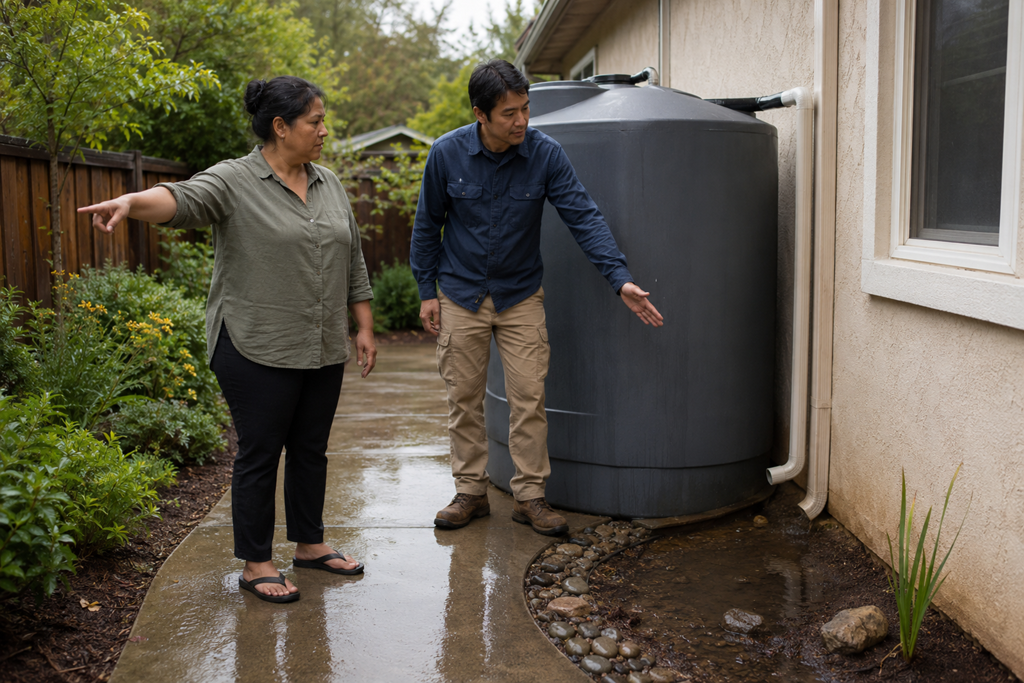
The most useful way to plan rainwater collection is to begin with the part of the yard you genuinely want the system to support, not with the largest tank that will fit. For many Sacramento-area homeowners, that means identifying a few priority plants, beds, or containers and then judging whether the collection, storage, and delivery setup makes sense for those specific needs.
Rainwater collection can initially feel like an equipment decision. Homeowners may start comparing tank capacities, barrel shapes, filters, or accessories before deciding what they actually expect the collected water to accomplish.
That order can make the project harder to evaluate. A tank may fit beside the house and collect water successfully, yet still be inconveniently located, difficult to maintain, or poorly matched to the part of the yard that matters most.
A more practical starting point is the intended use.
Begin With the Part of the Yard You Most Want to Support
A homeowner does not necessarily need to collect enough rainwater for the entire property to make the system worthwhile.
The goal might be to help water:
- Two young fruit trees
- A group of patio containers
- Several raised vegetable beds
- A narrow planting strip
- A small collection of drought-sensitive plants
- New landscaping that needs more attention while becoming established
This narrower focus can make the project easier to understand. Instead of asking whether rainwater can handle every watering need, the homeowner can ask whether it can provide useful supplemental water to a clearly defined priority area.
That distinction matters because total yard size does not always reflect actual watering priorities. A property may include a broad lawn, mature shade trees, ornamental beds, vegetable containers, and newly planted shrubs, but the homeowner may care most about supporting only one or two of those areas with stored rainwater.
A Bigger Yard Does Not Automatically Require a Bigger System
It is easy to assume that a large property calls for the largest available tank. In practice, the better question is how much of the property the homeowner realistically intends to serve.
A modest storage system located near raised beds may be more useful than a larger tank placed far from the plants it is supposed to support. Likewise, a homeowner who mainly wants water for containers near the patio may not benefit from planning around the demands of the entire landscape.
The yard’s individual conditions matter as well.
Plants in full sun may dry out differently from plants in shade. Containers may need attention more often than established landscaping. Young trees may have different needs from mature plants. Soil conditions, exposure, plant type, and the homeowner’s normal watering habits can all affect how useful stored rainwater will be.
The purpose is not to calculate every future gallon perfectly. It is to define a realistic job for the system before choosing the equipment.
Storage Capacity Is Only One Part of the Decision
A rainwater tank can hold an impressive amount of water and still be poorly suited to the yard.
Homeowners should also think about how the water will move from the storage location to the priority plants. A short, unobstructed route to nearby beds may be easy to work with. A route that crosses a driveway, climbs a slope, passes through a gate, or stretches around the house may require more planning.
Expected water flow also deserves discussion. Homeowners sometimes picture stored rainwater working exactly like a typical outdoor faucet. The actual experience may depend on the tank location, the intended watering method, elevation differences, and the equipment included in the system.
These are good subjects to raise with a qualified rainwater collection professional before settling on tank size or placement.
The professional should be able to explain how the proposed arrangement connects the roof collection point, storage tank, watering area, overflow route, and maintenance access.
The Most Convenient Tank Location May Not Be the Most Useful One
The space directly beneath a downspout may seem like the obvious location for a tank. Sometimes it is. Other times, that position creates a new problem.
The tank could interfere with a gate, trash-bin route, side-yard walkway, air-conditioning service area, garden access, or driveway clearance. It may also be too far from the plants the homeowner hopes to water.
A location should be judged by more than whether the tank physically fits.
Homeowners can consider whether they will be able to:
- Reach the tank for routine inspection or cleaning
- Connect and manage the intended watering equipment
- Move comfortably through the surrounding area
- Open nearby gates or access utility equipment
- Direct overflow away from sensitive areas
- Reach the priority plants without creating an awkward hose route
This does not mean every tank must sit beside the garden. It means the collection point and the use area should be considered together rather than treated as separate decisions.
Plan Around Seasonal Use Rather Than a Single Rainy Day
Rainwater collection is naturally tied to changing weather. A tank may fill when rain is available and gradually empty as the stored water is used.
The plants that need the most help, however, may need it during a longer dry period. That does not automatically make rainwater collection impractical, but it does affect expectations.
For many homeowners, stored rainwater works best as one part of a broader watering approach rather than as a guaranteed replacement for every other water source.
A homeowner might use collected water for priority plants when it is available and return to the regular irrigation or watering routine when storage runs low. That can still be valuable if the system has been planned around a realistic, limited purpose.
Trouble often begins when a homeowner expects a single tank to support the entire landscape indefinitely without first discussing roof collection potential, storage limits, seasonal patterns, and actual yard demand.
Overflow Should Support the Yard Plan, Not Create a New Drainage Problem
Planning should also include what happens when the tank becomes full.
Once storage capacity has been reached, additional water needs somewhere appropriate to go. The overflow route should not be treated as a minor accessory added after the tank location has already been chosen.
A proposed overflow path may affect nearby soil, walkways, fences, foundations, neighboring areas, or low spots in the yard. In some properties, overflow may be directed toward a suitable landscaped area. In others, drainage conditions may require a different approach.
The important point is that a tank does not eliminate runoff. It temporarily stores part of the roof water and changes where excess water may travel.
A qualified professional should evaluate the proposed overflow direction as part of the same conversation about yard use, tank placement, and site conditions.
Homeowners Often Get Sidetracked by Equipment Too Early
One common pattern is comparing tank capacities before deciding which plants will receive the water.
Another is trying to justify the system by assigning it responsibility for the entire yard. This can make a potentially useful small project seem inadequate before it has been considered on its own terms.
Homeowners may also focus heavily on how much water can be collected while giving less attention to how often they will use it, how they will reach the tank, and whether the watering route will be convenient enough to maintain.
A rainwater collection system is more likely to feel useful when it fits the homeowner’s normal yard routine. If using the water requires moving heavy equipment, navigating obstacles, or repeatedly setting up an inconvenient hose route, the system may be used less often than expected.
Realistic planning includes the human side of the project: how the homeowner moves through the yard, which plants receive regular attention, and how much maintenance the homeowner is comfortable managing.
Questions to Discuss Before Comparing Proposals
A few focused questions can make a consultation or estimate easier to evaluate:
- Which part of the yard is this proposed system intended to support?
- How will the stored water reach that area?
- What watering method is the system being designed around?
- What happens when the tank is empty?
- Where will overflow travel when the tank is full?
- Will the tank interfere with access, gates, walkways, or utility equipment?
- What routine maintenance will the homeowner need to perform?
- Could a smaller, better-positioned system serve the priority area more effectively?
Clear answers can help homeowners compare proposals based on usefulness rather than capacity alone.
A Useful System Starts With a Specific Purpose
Rainwater collection does not have to serve every plant or replace an entire irrigation system to have a meaningful role in a Sacramento-area yard.
The strongest starting point is usually a specific, realistic purpose: supporting selected fruit trees, raised beds, containers, or another priority planting area.
Once that purpose is defined, tank capacity, placement, delivery, overflow, access, and maintenance become easier to evaluate. Homeowners can then compare local professionals and proposed systems based on how well each option fits the way the yard is actually used.