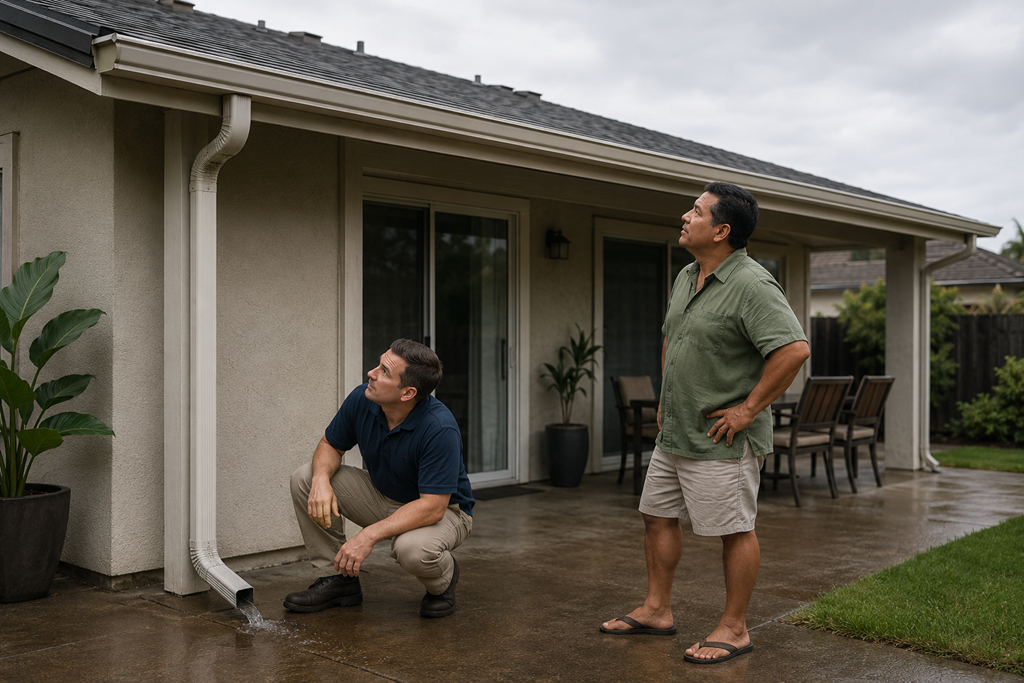
Gutter guards can reduce maintenance stress by limiting how quickly leaves, needles, and other debris collect inside a gutter, but they do not make the system maintenance-free. For Sacramento-area homeowners, the real benefit is often a more manageable routine: fewer heavy cleanouts, easier inspections, and less uncertainty about what may be building up overhead.
That distinction matters because gutter maintenance can be easy to postpone. The gutters are above eye level, debris accumulation is not always visible from the ground, and a system may appear fine until water begins spilling over an edge or collecting where it should not.
Gutter guards can make that responsibility feel less demanding, but only when the system matches the home and the homeowner understands what upkeep will still be needed.
Less Maintenance Is Different From No Maintenance
The purpose of a gutter guard is to reduce the amount of material entering the gutter channel. Depending on the guard design, leaves and other debris may remain on top of the guard, wash away, dry out, or collect near certain roof sections.
The gutter beneath the guard may stay cleaner for longer, but several areas can still require attention:
- Debris resting on the guard surface
- Material collecting near roof valleys
- Pine needles or small seeds lodging in openings
- Dust and roof granules settling inside the gutter
- Buildup near downspout outlets
- Loose, shifted, or damaged guard sections
This does not mean gutter guards have failed. It means the maintenance pattern has changed.
Instead of removing large amounts of material from an open gutter several times, the homeowner may be dealing with lighter surface cleaning, occasional inspections, and targeted attention where debris tends to concentrate.
The Most Useful Benefit Is a More Predictable Routine
Maintenance stress often comes from uncertainty rather than the work itself.
A homeowner may wonder whether the gutters are already full, whether the next rain will cause overflow, or whether another difficult cleanout needs to be scheduled. When gutters are hard to reach, surrounded by landscaping, or positioned above sloped ground, even a routine task can become inconvenient.
A well-matched gutter guard system can make upkeep more predictable. The homeowner may be able to focus on a few known collection points rather than treating every section of gutter as an equal concern.
Predictability can also make it easier to plan professional maintenance. Instead of waiting until there is an obvious problem, the homeowner can ask a provider to inspect the areas most affected by tree coverage, roof valleys, windblown debris, or downspout congestion.
The goal is not to forget about the gutters. It is to replace a recurring unknown with a simpler maintenance expectation.
What Reaches the Roof Matters More Than the Guard’s Appearance
A gutter guard that looks sturdy in a product display may not be the best match for every property.
The debris reaching a Sacramento-area roof can vary significantly from one home to another. One property may receive broad leaves that are relatively easy to block. Another may collect thin needles, small seed pods, dust, roof granules, or a mixture of materials.
Roof shape also affects what happens after debris lands. A roof valley can direct water and leaves toward one short section of gutter, creating a concentrated maintenance point even when the rest of the system stays relatively clear.
Nearby branches, prevailing wind, roof pitch, gutter size, and downspout placement can also influence how much material reaches each section.
This is why homeowners should be cautious about choosing a system based only on a general claim that it keeps debris out. A more useful question is whether the guard can reduce the specific kind of maintenance the property currently creates.
Surface Buildup Can Still Affect Water Flow
Some homeowners expect debris to slide off a gutter guard immediately. In practice, leaves and other material may remain on the surface for a period of time.
Dry leaves may eventually blow away. Wet leaves can temporarily cling to a screen. Thin needles may bridge across openings. Small particles may settle into fine mesh. Debris can also gather at corners where water flow changes direction.
The important issue is not whether the guard always looks perfectly clean. It is whether water can continue entering the gutter and moving toward the downspouts without regularly spilling over the edge.
A small amount of visible debris may have little effect on one section and create a noticeable restriction in another. That is another reason property-specific evaluation matters more than broad maintenance-free promises.
Guards Do Not Correct Existing Gutter Problems
Installing guards over a gutter system does not automatically resolve issues already present.
A gutter may have poor alignment, loose attachments, leaking seams, damaged sections, or a downspout restriction. Water may also be moving toward an area where drainage at ground level is already inadequate.
Covering the gutter without evaluating those conditions can make future problems harder to recognize. It may also leave the homeowner believing the guard is responsible for an issue that began elsewhere in the system.
Before installation, a qualified professional should be able to explain whether the gutters and downspouts appear ready for guards or whether cleaning, adjustment, repair, or replacement should be discussed first.
The evaluation should focus on the complete water path—from the roof edge to the gutter, through the downspout, and away from the home—not only on the guard material.
Tree Coverage Can Create Different Needs on the Same Home
A single property may not have one uniform debris problem.
One roof section may sit beneath leafy branches. Another may receive thin needles from a nearby conifer. A third may remain open to the sky and collect only light dust or roof granules.
These differences can affect where maintenance is still needed after guards are installed. The shaded section beneath branches may require more frequent observation, while an open section may need very little attention.
A provider who evaluates the roof as one identical perimeter may miss these differences. A more useful assessment identifies where debris enters, where water concentrates, and which sections are likely to remain the most demanding.
This can help the homeowner form realistic expectations before comparing products or installation proposals.
Access Should Be Part of the Maintenance Conversation
Reducing gutter maintenance is especially valuable when the gutters are difficult or unsafe for the homeowner to reach.
Roof height, sloped ground, narrow side yards, patio covers, landscaping, and utility equipment can all complicate access. A guard may reduce how often those areas require attention, but it does not remove the need to inspect them.
Homeowners should avoid assuming that future maintenance will be simple just because guards are being installed. During an estimate, it is reasonable to ask how the system can be inspected, how debris is removed from problem areas, and whether guard sections can be opened or removed when the gutter beneath them needs service.
A system that reduces debris but makes future access unusually difficult may create a different kind of maintenance frustration.
Where Homeowner Expectations Commonly Go Wrong
Several misunderstandings can make gutter guards feel disappointing even when they are performing reasonably well.
One is expecting all debris to disappear on its own. Guards block or redirect material, but they cannot control every leaf, needle, seed, or particle that lands on the roof.
Another is assuming every part of the gutter will require the same level of attention. Roof valleys, corners, shaded sections, and areas beneath branches often behave differently from open straight runs.
Homeowners may also assume that guards eliminate the need to check downspouts. Although guards can reduce the amount of large debris entering the gutter, smaller material can still reach an outlet or settle inside the system.
The final misunderstanding is treating lower maintenance as zero maintenance. A realistic expectation is that the work becomes less frequent, less extensive, or easier to plan—not that the drainage system can be ignored permanently.
Questions That Keep the Estimate Focused on Maintenance Relief
Before choosing a system, Sacramento homeowners can ask a gutter guard professional:
- What types of debris are reaching each part of this roof?
- Where is buildup most likely to remain after guards are installed?
- What maintenance will the guard surface still require?
- How can the gutter and downspout be inspected after installation?
- Will the existing gutters need cleaning or repair first?
- What happens if a section of the guard needs to be removed for service?
- Are different guard approaches worth considering for different roof sections?
The answers should be specific to the property. Explanations that rely only on broad claims such as “never clean your gutters again” do not provide enough information to understand the real maintenance commitment.
The Goal Is Manageable Upkeep, Not a Forgotten System
Gutter guards can be worthwhile when they reduce the amount of debris entering the system and make maintenance easier to anticipate. Their value is not measured by whether a homeowner can completely forget the gutters.
A better measure is whether the system reduces difficult cleanouts, keeps water moving more consistently, and makes the remaining maintenance simpler to understand.
Before hiring a local gutter guard installer, Sacramento-area homeowners should ask how the proposed system will perform with their actual roof design, tree coverage, debris patterns, downspouts, and access conditions. That conversation can help turn gutter guards from a vague maintenance promise into a practical home-care decision.