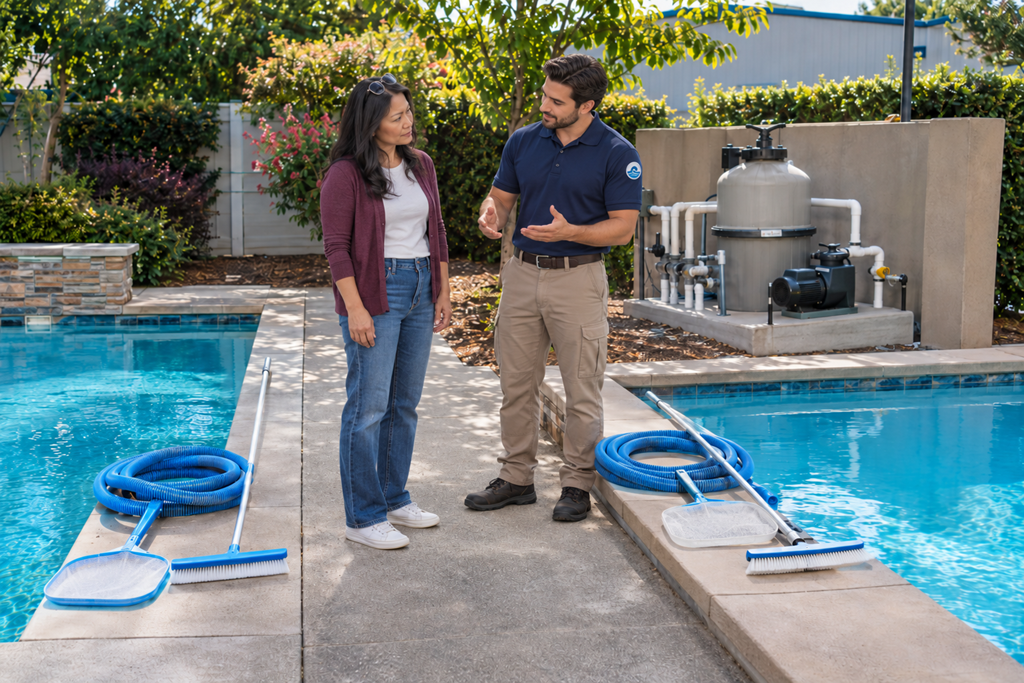
Choosing a pool maintenance plan is not simply a matter of deciding how often someone should clean your pool. Sacramento-area homeowners may find that two companies offering weekly pool service provide very different levels of care, particularly when it comes to chemical treatment, equipment checks, filter maintenance, and handling problems between visits. Understanding the difference between routine maintenance and more comprehensive service plans can help you compare what you are actually paying for, identify responsibilities that remain yours, and choose a level of service that fits your pool's condition, usage, and maintenance needs.
A lower-priced plan may cover the regular tasks needed to keep a pool looking presentable, while a more comprehensive plan may include additional equipment attention, maintenance tasks, or service support. However, these descriptions are not standardized. One provider's routine plan may include services that another company reserves for a higher-priced package.
The goal is not automatically to purchase the most comprehensive option. It is to understand which services your pool actually needs, what each provider will deliver, and which costs or responsibilities may fall outside the advertised plan.
What routine pool maintenance usually covers
Routine pool maintenance generally focuses on recurring cleaning, water testing, chemical adjustments, and basic observations that help maintain normal pool conditions.
Depending on the company and agreement, a routine visit may include:
- Skimming leaves, insects, and floating debris from the water.
- Brushing selected pool surfaces, steps, or accessible areas.
- Vacuuming the pool or performing another agreed-upon debris-removal service.
- Emptying accessible skimmer and pump baskets when appropriate.
- Testing selected water chemistry measurements.
- Adding or adjusting treatment chemicals according to the service agreement.
- Checking visible circulation conditions.
- Observing equipment for obvious signs of leaks, unusual operation, or other concerns.
These activities provide a recurring maintenance foundation, but homeowners should not assume every company performs every task during every visit.
For example, one provider may vacuum the entire pool when necessary, while another may include limited vacuuming or charge separately for substantial debris removal.
Similarly, a company that advertises chemical service might include treatment chemicals in its monthly fee, charge separately for certain products, or offer a chemicals-only package that excludes physical cleaning.
Routine maintenance is not the same as comprehensive pool care
An important distinction is the difference between maintaining everyday water conditions and attending to the pool's broader equipment and maintenance needs.
A technician performing routine cleaning may notice reduced water flow or an unusual equipment sound. That observation does not necessarily mean the service includes diagnosing the cause, performing repairs, or completing additional maintenance.
A routine service agreement may also exclude certain periodic tasks, such as deeper filter cleaning, specialized water treatment, or servicing equipment components.
This is why the phrase weekly pool service tells you relatively little about the complete service arrangement.
Before comparing prices, determine exactly what the provider considers a standard visit.
What more comprehensive pool service plans may include
More comprehensive pool service plans generally build on routine maintenance by adding selected periodic tasks, broader equipment attention, or additional support.
The actual inclusions vary considerably among providers.
More extensive cleaning and preventive maintenance
A comprehensive plan might provide additional attention to:
- Periodic filter cleaning or servicing.
- More thorough brushing and debris removal.
- Additional cleaning of difficult-to-maintain areas.
- Inspection of selected pool components.
- Maintenance of certain accessible equipment.
- Monitoring recurring water-condition concerns.
The distinction is not always how often the technician visits. Two plans may both include weekly appointments, but one may cover a broader range of work during those visits or include certain periodic services throughout the year.
Some maintenance activities are scheduled based on equipment condition, manufacturer guidance, or observed operating conditions rather than being performed during every visit.
Broader equipment monitoring
Certain comprehensive plans include more detailed observation of the pool's circulation, filtration, or automated equipment.
This might involve checking visible equipment operation, reviewing operating indications, or identifying conditions that may warrant further evaluation.
However, equipment monitoring should not be confused with equipment repair.
A provider may inspect a pump, identify that something appears abnormal, and recommend a separate diagnostic appointment. Actual repair work may require additional authorization and charges.
Homeowners should clarify whether the plan includes observation, diagnosis, routine servicing, or repairs. These are different levels of responsibility.
Additional service support
Some providers include services such as follow-up visits, enhanced communication, seasonal maintenance adjustments, or limited assistance when routine conditions change.
Others may advertise a comprehensive plan primarily because it includes chemicals and filter care.
Neither approach is inherently better. What matters is whether the added services address needs that would otherwise require separate appointments or charges.
A plan should be evaluated according to its written inclusions rather than the attractiveness of its package name.
Routine maintenance versus comprehensive service: a practical comparison
The following table illustrates common differences worth investigating. It does not represent universal industry standards or guarantees about what providers include.
Service consideration | Routine maintenance plan | More comprehensive plan |
|---|---|---|
Regular debris removal | Often includes basic cleaning | May include broader cleaning coverage |
Water testing | Usually includes selected routine testing | May include additional monitoring or follow-up |
Treatment chemicals | May be included, limited, or billed separately | May offer broader chemical coverage, depending on terms |
Filter maintenance | May involve observation or separate charges | May include selected periodic filter services |
Equipment attention | Often limited to visible operational observations | May include more detailed monitoring or certain maintenance |
Unusual water conditions | Additional treatment may cost extra | Some additional treatment may be included |
Problem diagnosis | Commonly separate from routine visits | May include limited assessment, but not necessarily repairs |
Extra visits | Often separately arranged | May include selected follow-up services |
Repairs and replacement parts | Generally outside ordinary maintenance | Often still excluded or separately authorized |
The table highlights why homeowners should compare service tasks individually.
A comprehensive plan that includes frequent additional services may offer greater value for one pool, while a basic plan with separately scheduled maintenance may work well for another.
It is also possible for two providers to deliver nearly identical services under different plan names.
Match the maintenance plan to your pool's actual needs
The right service level depends partly on how demanding the pool is to maintain.
A pool that remains relatively stable throughout normal use may not require the same arrangement as one that regularly collects debris or needs additional attention.
Pool use and household activity
A pool used frequently by family members or guests may experience changing water-treatment demands and additional debris.
A lightly used pool may have a different maintenance pattern.
However, infrequent swimming does not eliminate the need for appropriate water care or equipment maintenance.
When discussing service plans, explain how the pool is normally used rather than relying only on its dimensions or appearance.
Ask whether the provider recommends additional services because of actual observed conditions or simply because they are part of a higher-tier package.
Surrounding trees, landscaping, and debris
For Sacramento-area properties, nearby trees, landscaping, windblown debris, and seasonal changes can influence routine cleaning demands.
A pool surrounded by vegetation may need more frequent debris removal than a similarly sized pool in an open yard.
The relevant question is not simply whether the pool is large or small. It is how much work is routinely required to maintain it.
Homeowners should ask whether ordinary leaf accumulation is included and how unusually heavy debris is handled.
A plan that appears sufficient during a relatively clean period might require additional service when landscaping conditions change.
Equipment age and condition
An older or frequently troublesome pool system may benefit from more regular professional attention.
That does not necessarily mean paying for the most comprehensive maintenance package will solve equipment problems.
If a pump, filter, heater, or other component has an unresolved issue, a qualified professional may need to evaluate it separately.
Maintenance plans are designed around recurring care. They should not be treated as substitutes for necessary diagnosis or repair.
When comparing plans, disclose known equipment problems and ask which services are appropriate for the current condition of the system.
Pool features and complexity
Pools with attached spas, water features, specialized sanitation systems, automation, or additional circulation equipment may involve more complicated service requirements.
Some companies include selected features within their standard plans. Others charge more or exclude certain systems.
For example, maintaining a pool and attached spa may involve different work than servicing a simple pool without additional features.
Before requesting estimates, identify all major features so each provider can quote the same property conditions.
Homeowner involvement
Another important factor is how much responsibility you want to retain.
Some homeowners are comfortable handling ordinary debris between professional visits and arranging periodic maintenance separately.
Others prefer a provider to manage a broader collection of recurring tasks.
Neither choice is automatically more economical or appropriate.
The issue is whether your preferred level of involvement matches the responsibilities described in the service agreement.
Why a comprehensive plan may cost more without always providing more value
A higher monthly fee can reflect additional labor, included treatment materials, periodic maintenance, service frequency, or broader responsibilities.
But a higher price does not prove that the package is better suited to your pool.
To understand the difference, examine what you would otherwise pay for separately.
Compare total expected service costs, not just monthly fees
Suppose two companies offer different maintenance packages.
One provides routine visits with additional charges for periodic filter cleaning. Another includes certain filter services within a higher monthly fee.
The second package may reduce separate billing for those tasks, but it is not necessarily less expensive overall.
The appropriate comparison depends on how often the additional services are likely to be required and whether the first provider would actually perform them during the same period.
Ask both companies to explain the tasks and circumstances that could generate charges beyond the monthly fee.
This helps prevent a misleading comparison between an inexpensive base package and an apparently all-inclusive alternative.
Understand chemical pricing
Chemical costs can create confusion because companies use different pricing models.
Possible arrangements include:
- A recurring fee that includes specified treatment chemicals.
- A service fee with chemicals billed separately.
- Included routine chemicals with additional charges for specialized treatments.
- A limited chemical allowance or other stated coverage conditions.
Do not assume that a plan described as full service includes unlimited chemical treatment.
Ask how ordinary chemical adjustments are billed and what happens if unusual water conditions require additional products or appointments.
The provider should be able to describe the billing approach without promising that every possible water problem is covered.
Distinguish included maintenance from optional upgrades
A comprehensive plan might bundle tasks that your pool does not require as frequently as the package assumes.
For example, additional cleaning services may be useful for a pool exposed to substantial debris but provide limited added value for a property with different conditions.
Conversely, a basic package may require so many separately purchased services that its initial price advantage becomes less meaningful.
The most useful question is:
Which included services would I realistically need, and what would happen if I did not purchase them as part of the plan?
A provider should be able to explain the practical purpose of an upgrade rather than treating a premium package as universally necessary.
Filter maintenance deserves special attention
Filter service is one of the most important areas to clarify when comparing routine and comprehensive plans.
The filter helps remove particles from circulating pool water. Different filter designs have different maintenance requirements, and the appropriate servicing approach depends on the equipment and its condition.
A weekly maintenance visit does not automatically include the full range of filter-maintenance tasks.
Some providers may check relevant operating indications during routine visits while billing separately for more involved servicing.
Other plans may include specified periodic filter care.
Questions to clarify about filter service
Ask the provider:
- What type of filter does my pool have, and does your plan cover it?
- What filter-related tasks are included during ordinary visits?
- What periodic filter services are included in the recurring fee?
- How do you determine when additional filter maintenance is needed?
- Are any filter materials, replacement components, or specialized cleaning services billed separately?
These questions help distinguish basic monitoring from actual maintenance.
A plan that includes filter service may provide meaningful convenience, particularly if the homeowner otherwise needs to arrange it separately.
But the value depends on what service is performed, when it is needed, and which equipment is covered.
Avoid comparing packages using only the phrase filter cleaning included. Ask what that phrase specifically means.
What happens when routine conditions become unusual?
Pool maintenance plans are often easiest to compare when everything is operating normally.
Differences become more important when a pool develops an unexpected condition.
Examples might include cloudy water, recurring debris accumulation, unusual equipment operation, or a change in circulation performance.
These conditions do not necessarily mean a provider has failed to maintain the pool. They can arise for different reasons, and some require evaluation beyond routine care.
How the provider responds matters
Ask each company to explain how it handles a concern discovered during a scheduled visit.
A clear process might involve documenting the observation, notifying the homeowner, identifying whether additional evaluation is necessary, and obtaining approval before performing separately billable work.
The agreement should distinguish routine correction from services outside the plan.
For example, adjusting ordinary water chemistry during a scheduled visit may be included, while investigating a persistent water-quality problem could involve additional work.
A comprehensive package might cover some additional attention, but it should not be assumed to include unlimited troubleshooting.
Understand the limits of additional visits
If a provider advertises extra visits or enhanced support, clarify the terms.
Does the plan include a certain number of follow-up visits? Are they restricted to specified circumstances? Do additional treatment materials cost extra?
Also ask how the company communicates when an issue cannot reasonably be resolved during an ordinary appointment.
Clear boundaries are preferable to broad promises that the provider will take care of everything.
Do not assume maintenance coverage guarantees swimming conditions
Even regular professional maintenance cannot guarantee that a pool will always be ready for swimming.
Unexpected water conditions, equipment failures, contamination, or other problems may require additional assessment.
If a pool's safety or water quality is uncertain, avoid using it until the concern has been appropriately evaluated and addressed.
The maintenance agreement should make it clear how the provider reports such concerns and what action falls outside the normal plan.
How to compare two service proposals fairly
Once you understand the available service levels, the next step is to compare actual proposals for your particular pool.
A fair comparison requires consistent information.
If one provider has inspected your pool and another has quoted based on a brief description, their estimates may reflect different assumptions.
Start with the same pool information
Before requesting quotes, prepare a short description of:
- The approximate pool size and whether an attached spa is present.
- Major equipment and special features.
- Current pool condition and known recurring issues.
- Typical swimming activity.
- Nearby trees or landscaping that contribute debris.
- Your preferred service frequency.
- Any maintenance tasks you already handle yourself.
You do not need to diagnose the pool or supply technical performance measurements.
A straightforward description helps providers determine whether a standard package is appropriate or whether an initial evaluation is needed.
Compare the written scope task by task
Use the following comparison worksheet when reviewing estimates.
What to compare | Provider A | Provider B |
|---|---|---|
Scheduled visit frequency | ||
Skimming, brushing, and vacuuming coverage | ||
Water testing and chemical treatment | ||
Chemical billing arrangements | ||
Filter maintenance included | ||
Equipment monitoring included | ||
Treatment of unusual water conditions | ||
Extra-visit arrangements | ||
Excluded equipment or pool features | ||
Separately billed services and materials | ||
Monthly fee and payment terms | ||
Cancellation or plan-change terms |
The purpose is not to select the company with the most boxes filled in.
It is to identify the services that matter to your pool and understand whether each proposal includes them.
A clear, narrower agreement may be more useful than a broad package with poorly defined responsibilities.
Consider communication and documentation
For recurring pool care, communication becomes part of the service experience.
Ask whether the company provides visit summaries, reports unusual conditions, and explains additional work before billing.
Some providers may use electronic reports, while others communicate through messages or direct conversations.
The format matters less than the reliability and usefulness of the information.
You should know when the pool was serviced, whether a problem was observed, and when your approval is needed.
Questions worth asking before choosing a plan
These questions focus on the differences that are most likely to affect ongoing value.
1. What exactly happens during a routine visit? Ask the provider to distinguish regular tasks from those performed only when needed.
2. What additional work does the comprehensive plan include? Request specific services rather than a general description of better or more complete care.
3. Which chemicals and filter services are included in the price? Clarify exclusions, limits, and circumstances that generate additional charges.
4. How do you determine whether my pool needs the higher service level? A recommendation should reflect relevant pool conditions and equipment, not solely the company's package structure.
5. What happens when you identify an equipment problem? Understand the boundary between observing, diagnosing, servicing, and repairing equipment.
6. What services might I need to purchase separately during normal ownership? Ask about foreseeable periodic expenses beyond the monthly plan.
7. How do service reports, additional approvals, and plan changes work? A recurring agreement should establish how responsibilities and decisions are communicated.
A provider does not need to offer every possible service to be a suitable choice.
What matters is whether the provider explains the arrangement clearly and can meet the needs you are actually hiring them to address.
Service-plan wording that deserves a closer look
Some descriptions may sound comprehensive without explaining the extent of coverage.
These are not automatically signs of an unreliable company, but they are reasons to request more detail.
"Full service" without a defined task list
A company may describe a package as full service while excluding periodic maintenance, specialized treatments, or equipment work.
Ask for a written list of inclusions and exclusions.
"All chemicals included" without stated boundaries
This wording should prompt a discussion about routine chemicals, specialty products, unusual treatments, and any applicable limitations.
Do not assume it covers every possible water condition.
"Equipment inspection included" without explaining the inspection
Determine whether this refers to basic visual observation, operational checks, specialized testing, or another defined service.
Also clarify what happens when a concern is found.
"Unlimited support" without describing the service process
Ask whether support refers to communication, scheduling, additional on-site appointments, or actual work.
These can involve substantially different levels of service.
Pressure to upgrade before the pool is evaluated
A higher-tier plan may be appropriate for some properties, but the provider should be able to explain why its additional coverage is relevant.
If the recommendation is difficult to understand or the provider dismisses reasonable questions, consider seeking another proposal.
When routine maintenance may be enough
A routine plan may be appropriate when the pool generally operates as expected, recurring cleaning demands are manageable, and the homeowner is comfortable arranging additional maintenance when necessary.
This can be a reasonable option when:
- The pool has no known unresolved equipment concerns.
- The homeowner understands the routine visit's coverage.
- Periodic maintenance is available separately.
- The provider clearly reports emerging concerns.
- The homeowner is willing to coordinate additional work when needed.
The important qualification is that routine service still needs to be appropriate for the actual pool.
A basic plan should not be selected solely because the current water looks clean.
Water appearance alone cannot establish whether water treatment, filtration, or equipment maintenance is adequate.
If the provider identifies needs outside the routine agreement, those should be considered separately rather than ignored.
When broader service coverage may be worthwhile
A more comprehensive plan may make sense when it includes tasks that the pool regularly needs and the homeowner would otherwise arrange separately.
Potential reasons include:
- Significant recurring debris or cleaning demands.
- Additional pool features that require more attention.
- A preference for bundled periodic filter maintenance.
- A desire to reduce the number of separate service appointments.
- More extensive monitoring needs supported by the pool's actual condition.
- Clear additional-service coverage that matches expected maintenance demands.
However, a comprehensive maintenance plan is not automatically the right answer for aging or malfunctioning equipment.
If the system requires diagnosis or repairs, those needs may remain outside even an extensive recurring service agreement.
Similarly, a package with more scheduled tasks is not necessarily better when those tasks provide little additional benefit.
The decision should be based on relevant service coverage rather than the perceived status of a premium plan.
Before signing, confirm the responsibilities and service boundaries
Once you have identified a suitable plan, review the agreement with particular attention to recurring responsibilities.
Check that it explains:
- The normal service schedule and visit expectations.
- Which cleaning and water-treatment tasks are included.
- Which chemicals, filter services, and equipment-related tasks are covered.
- Which situations may involve additional charges.
- How separately billable work is approved.
- How missed visits or schedule changes are handled.
- How the provider communicates maintenance concerns.
- How billing, cancellation, and plan changes work.
If the agreement does not match the verbal explanation, ask for clarification before committing.
Also determine what the provider expects from you, such as reasonable access to the pool and equipment, communication about unusual conditions, or responsibilities between visits.
A workable maintenance arrangement depends on both sides understanding their roles.
Choose the level of care your pool needs, not the package with the longest list
Comparing routine pool maintenance with a comprehensive service plan ultimately comes down to matching coverage with real maintenance needs.
A routine plan can be a sensible choice when its scope is sufficient and additional maintenance responsibilities are understood. A comprehensive plan may offer better value when its added services address recurring needs, reduce separately arranged work, or provide useful support.
Neither option should be judged by its name or monthly fee alone.
For Sacramento-area homeowners, the most useful approach is to compare actual tasks, chemical and filter coverage, equipment responsibilities, additional charges, and communication expectations before agreeing to ongoing service.
The better decision is the one that leaves you knowing what will be maintained, what may require separate attention, and what you can reasonably expect from your pool service provider.