Privacy should be considered room by room, not treated as a single feature that every window covering either provides or does not provide. The right choice depends on what can be seen from outside, when the room is used, how interior lighting changes visibility after dark, and how much natural light you still want during the day.
Many homeowners begin by asking whether a blind, shade, or shutter offers privacy. A more useful question is: What kind of privacy does this particular window need, and at what times?
A covering that feels private on a bright afternoon may behave differently after sunset. A material that blocks an unwanted view may also remove more daylight than expected. Thinking through these tradeoffs before choosing a product can help prevent a visually attractive treatment from becoming frustrating in everyday use.
Privacy Is More Than Covering the Glass
A fully closed window treatment can usually block a view, but complete closure is not always how people want to use their windows.
You may want daylight in a kitchen without exposing the room to a sidewalk. You may want a bedroom protected from neighboring windows while still seeing the sky. A home office may need glare control during working hours but stronger privacy once lamps and computer screens brighten the room.
This is why privacy is better understood as a combination of:
- The direction and distance of outside sightlines
- The brightness inside compared with outside
- The openness, weave, or angle of the covering
- The height and position of the window
- The activities that take place in the room
- The times when the room is normally occupied
Two windows in the same Sacramento-area home may require very different solutions even when they are similar in size.
Daytime Privacy Can Change After Dark
One of the easiest misunderstandings is assuming that a window looks the same from outside throughout the day.
During daylight hours, outdoor light can make it harder to see through some light-filtering materials into a darker interior. After dark, that balance may reverse. Lamps, ceiling fixtures, televisions, and computer screens can make the inside of the room brighter than the exterior.
A sheer or loosely woven treatment may continue to soften the view without fully concealing the room. Furniture, movement, and interior activity may become more noticeable from outside.
This does not mean light-filtering materials are unsuitable. It means their role should be understood. They may work well for softening daylight, reducing an exposed feeling, or providing limited daytime screening. They may need to be paired with another layer when stronger evening privacy matters.
Start With the Actual Sightline
Privacy concerns usually come from a specific viewing angle rather than from every direction around the window.
A ground-level window facing a public walkway presents a different issue from an upstairs window facing another home. A narrow bathroom window may only be visible from one corner of a neighboring yard. A bedroom may feel exposed because of a second-story window across the property rather than because of anyone standing directly outside.
Before choosing a treatment, consider where a person would actually be standing and what portion of the room could be seen from that position.
The most important sightline may come from:
- A sidewalk or front path
- A neighboring patio or balcony
- A driveway or shared side yard
- A nearby second-story window
- A backyard seating area
- A street that sits above or below the property
A window-treatment professional can discuss these angles during a consultation, but homeowners should also describe the moments when the room feels most exposed. That information may be more useful than simply saying that more privacy is needed.
Different Rooms Need Different Boundaries
Privacy is not equally important in every room.
A living room may only need visual separation from the street while preserving natural light. A bathroom may require a more dependable barrier even during the day. A bedroom may need both nighttime privacy and light control. A home office could require enough screening to protect documents, screens, or video calls without making the room feel closed in.
Room use also affects how much adjustment is practical.
A treatment that needs to be raised and lowered several times each day may be reasonable in one room but inconvenient across a row of frequently used windows. A permanently closed covering may provide privacy but leave a kitchen, hallway, or work area darker than the homeowner prefers.
The goal is not necessarily to maximize privacy everywhere. It is to match the level of privacy to what actually happens in each space.
Light Filtering and Privacy Are Not the Same Thing
Product descriptions can sometimes make different benefits sound interchangeable.
“Light filtering” generally describes how a material softens or reduces incoming light. It does not automatically mean that the material prevents visibility through the window in every lighting condition.
Similarly, an opaque material may provide stronger visual coverage but may also reduce the outside view and natural light when closed. Adjustable slats or louvers may redirect views, but their effectiveness depends on angle, spacing, window position, and where an observer is located.
When comparing options, ask what the material does when it is:
- Fully open
- Partially adjusted
- Completely closed
- Viewed during daylight
- Viewed from outside after interior lights are on
Seeing a sample against the actual window can be more informative than holding it in the center of the room.
Layers Can Separate Daytime and Evening Needs
Some rooms have competing goals that one material may not address by itself.
A homeowner may want softened daylight and a view during the day, followed by stronger coverage at night. In that situation, a layered arrangement may allow each treatment to perform a different role.
For example, one layer might remain in place during the day to reduce exposure while admitting light. A second, more opaque layer could be closed when greater privacy is needed.
Layering is not automatically necessary for every window. It can add visual weight, operating steps, and cost. The useful question is whether the room has two distinct privacy conditions that a single treatment would struggle to balance.
Privacy Should Be Tested From Both Sides
People naturally evaluate window coverings while standing inside the room. That only shows half of the situation.
When practical, look at the window from the exterior viewing areas that concern you. Observe it during the times when privacy matters, including after interior lights are turned on. You do not need to conduct an elaborate test. The purpose is simply to understand whether the treatment conceals the areas you expected it to conceal.
Pay attention to more than whether someone can see directly through the fabric. Notice whether room shapes, furniture, screens, or activity remain easily recognizable.
This outside perspective can reveal that a window needs more coverage, less coverage, or coverage only across a particular section.
Common Assumptions Can Lead to the Wrong Fit
Privacy problems often result from reasonable assumptions rather than careless decisions.
One assumption is that any fabric over a window creates dependable privacy. Another is that privacy requires blocking the entire window all day. Some homeowners also choose one matching treatment for every window even though the rooms face different directions and have different sightlines.
Another common pattern is focusing on the appearance of the material without discussing how it will be used. A treatment may coordinate beautifully with the room but require constant adjustment to provide the desired boundary.
These issues are easier to address before installation than after the household has begun living with the treatments.
Questions Worth Discussing Before Installation
A window-treatment consultation can be more productive when the privacy goal is described specifically. Useful questions include:
- How much can be seen through this material during the day and at night?
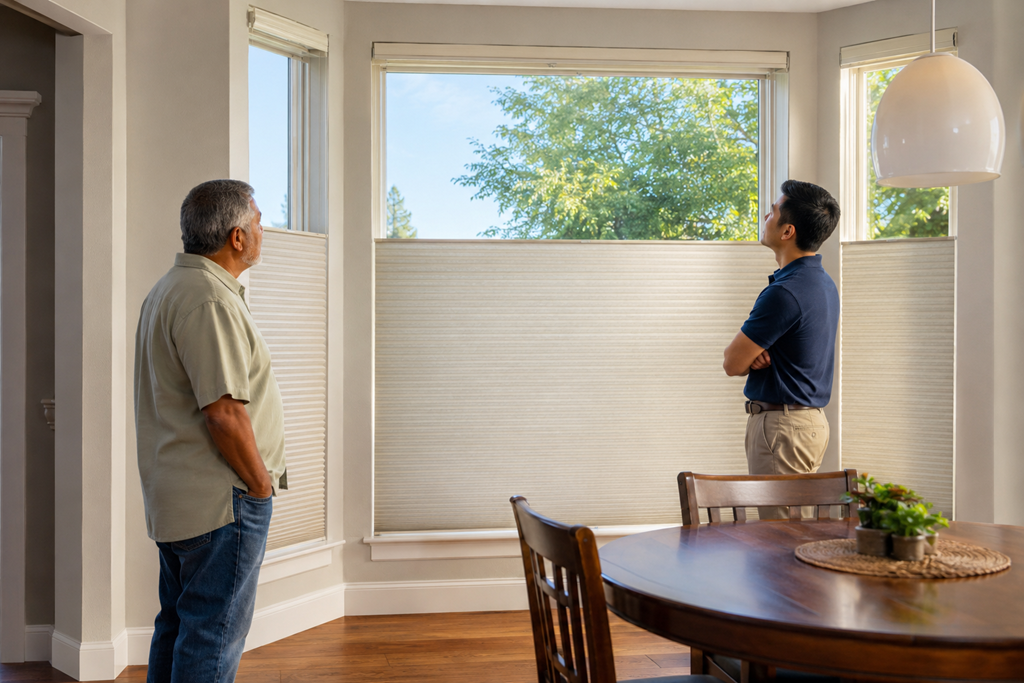
- Can the treatment protect the lower part of the room while preserving light above?
- Will the angle of the slats or louvers address the actual outside sightline?
- Would one treatment work throughout the day, or would two layers serve different purposes?
- Can a sample be viewed against the window rather than only under indoor showroom lighting?
Clear answers should explain both the benefits and the limitations of the proposed option.
Choose for the Moments That Matter
Privacy is not simply a product feature printed on a sample. It is the result of how the window, material, lighting, sightline, and room use work together.
Before choosing window treatments, identify where the exposed feeling comes from and when it occurs. Then compare options based on those real conditions rather than on appearance alone.
Sacramento-area homeowners who explain their daytime and nighttime needs clearly will be better prepared to evaluate recommendations, compare treatment options, and choose an installation that supports both privacy and natural light.