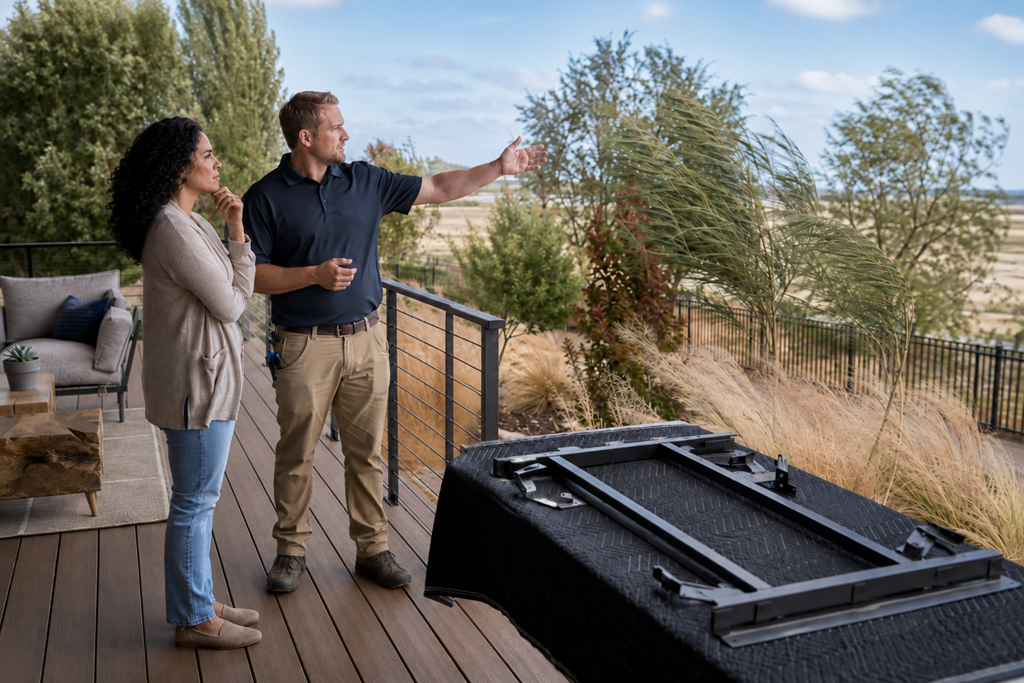
An awning is most likely to be right for your home when it solves a specific, repeated exposure problem—such as harsh afternoon sun over a patio, glare through a window, or light rain at an entry—without creating new concerns about placement, clearance, wind, operation, or attachment in practice. The decision is less about whether awnings are useful in general and more about whether one fits the way you actually use a particular part of your property.
Many homeowners begin considering an awning after noticing that an otherwise useful space becomes uncomfortable at certain times. A patio may be pleasant in the morning but difficult to use later in the day. Sunlight may heat a room through one exposed window. An entry may offer little protection when rain reaches the door.
Those situations can make an awning worth discussing, but the visible discomfort is only the beginning of the decision.
Start With the Exact Problem You Want to Solve
The clearest awning decisions begin with a defined problem rather than a general desire for more shade.
For example, you may want to:
- Make an outdoor dining table usable during the late afternoon
- Reduce direct sunlight reaching a particular window
- Create limited weather protection above an exterior door
- Shade a seating area without covering the entire patio
- Improve comfort near a west-facing side of the home
These are more useful starting points than saying the backyard is too hot. A broad problem can lead to an oversized or poorly placed solution. A specific goal gives an awning professional something concrete to evaluate.
It also helps you judge whether an awning is the most appropriate option. Depending on the location, another type of shade or weather-protection feature may fit the problem better.
Watch the Area Before Choosing the Coverage
Sacramento-area properties can receive intense sunlight, but the direction and timing of that exposure vary from one location to another.
Before comparing awning options, notice when the problem actually appears. A patio that feels exposed for one hour may need a different solution from a space that receives direct sun throughout most of the afternoon.
Pay attention to:
- The direction the sun enters the area
- How the shadow line changes during the day
- Which seats, windows, or doors are affected
- Whether the problem changes by season
- How often the area is actually used during those hours
This observation can prevent a common misunderstanding: assuming that the awning should cover the largest possible area.
The more useful question is whether it will place shade where people, furniture, doors, or windows need it at the times that matter.
The Awning’s Projection Is Only Part of the Decision
Homeowners sometimes focus mainly on the width of an awning. Width matters, but it does not fully determine how much useful shade the awning will create.
Projection, installation height, sun angle, orientation, and the location of the activity below it can all affect the result. A wide awning may still leave an important seating area exposed if the shade falls in the wrong place.
This is why a proposal should be connected to the intended use of the space.
During an estimate, point out the exact location of the table, doorway, window, grill, walkway, or seating arrangement you are trying to protect. Ask the provider to explain where the expected shade will fall rather than discussing dimensions in isolation.
That conversation does not guarantee a particular result, but it can reveal whether the proposed size is based on your property or simply on a standard product configuration.
The Attachment Area Needs Its Own Evaluation
An awning must relate properly to the surface and surrounding area where it will be installed.
The visible wall may contain windows, trim, lights, gutters, downspouts, vents, roof edges, utility equipment, or other features that affect placement. Door swing, walkway clearance, and the height of nearby furniture may also matter.
The condition and suitability of the attachment area should be evaluated by a qualified professional. A homeowner should not assume that a wall is appropriate merely because there appears to be enough open space.
Ask the provider to explain:
- Where the awning would be attached
- What nearby features affect its position
- Whether the planned height provides practical clearance
- How the proposed placement relates to doors and windows
- Whether another location or size should be considered
A clear explanation is more valuable than a quick assurance that the awning will fit.
Fixed and Retractable Awnings Support Different Habits
The choice between a fixed and retractable awning is not only about appearance. It is also about how you expect to use and manage the shade.
A fixed awning remains in place and may suit an area where ongoing coverage is the main goal. A retractable awning allows the coverage to change, which can be useful when you want shade at some times and open sunlight at others.
That flexibility comes with another consideration: operation.
A retractable awning only provides its intended benefit when someone is willing and able to extend and retract it appropriately. Think about who will operate it, how frequently adjustments may be needed, and whether manual or powered operation fits the household.
For a rental or managed property, the person approving the installation may not be the person using it each day. In that situation, operating expectations and responsibilities should be clarified before selecting a system.
Wind Exposure Can Change an Otherwise Good Idea
A location that needs shade may also be exposed to wind.
An open side yard, raised deck, uncovered corner, or area near a roofline may experience different conditions from a sheltered patio. An awning professional should consider the exposure of the proposed location and explain any operating or placement concerns that affect the recommendation.
Avoid relying on assumptions about wind performance or on broad product claims without context. Product specifications, installation details, property conditions, and operating practices can all affect how an awning should be evaluated.
Ask what the provider expects you to do when conditions change. The answer should be specific enough that you understand how the awning is intended to be used, without suggesting that it can remain deployed in every situation.
Think About the Space You Will Actually Use
An awning does not need to transform the entire exterior of a home to be worthwhile.
It may be valuable if it makes one frequently used area more comfortable. A modest awning over a breakfast patio may provide more practical benefit than a larger installation over a space the household rarely uses.
Consider what would change after installation.
Would you eat outside more often? Would a room receive less direct glare? Would people wait more comfortably at an entry? Would the shaded area be large enough for the furniture already there?
A useful awning decision is connected to a real household routine. Without that connection, the project can become an exterior upgrade that looks appealing but does not meaningfully improve daily use.
Do Not Let One Uncomfortable Afternoon Decide the Project
A particularly hot or bright day can make any shade option seem immediately necessary. That does not mean the underlying problem should be ignored, but it is worth observing the area more than once before committing.
Common rushed assumptions include:
- Believing the entire patio must be covered
- Choosing dimensions before identifying the needed shade zone
- Assuming every wall can support the preferred placement
- Treating fixed and retractable options as interchangeable
- Ignoring how doors, windows, lights, or gutters affect the layout
- Focusing on fabric appearance before understanding the installation scope
These patterns do not automatically make an awning a poor choice. They simply mean the decision has moved ahead of the evaluation.
Questions That Can Clarify an Awning Estimate
A useful estimate should help you understand why the proposed awning fits the location and goal.
Consider asking:
- What specific area is this awning expected to shade?
- How were the proposed width and projection selected?
- Where will the shade likely fall during the hours I described?
- What nearby property features affect the placement?
- How will the awning be operated and managed?
- What weather-related precautions should I understand?
- What is included in the installation scope?
- Are there parts of the property that require further evaluation?
Listen for explanations tied to your home rather than answers that could apply to any property.
It is reasonable to pause when a proposal does not clearly connect the product, placement, dimensions, and installation approach to the problem you originally described.
An Awning Is Right When the Goal and Location Agree
An awning may be a practical addition when the exposure is repeated, the intended shade area is clearly defined, the location can be properly evaluated, and the operating expectations fit the household.
It may be less suitable when the problem is temporary, the desired coverage cannot be achieved from the available placement, surrounding features create conflicts, or another form of shade would better match how the space is used.
Before hiring an awning professional, be ready to describe the problem in terms of location, timing, use, and expected coverage. That preparation makes it easier to compare proposals and recognize whether a recommendation responds to your home rather than simply offering an available product.