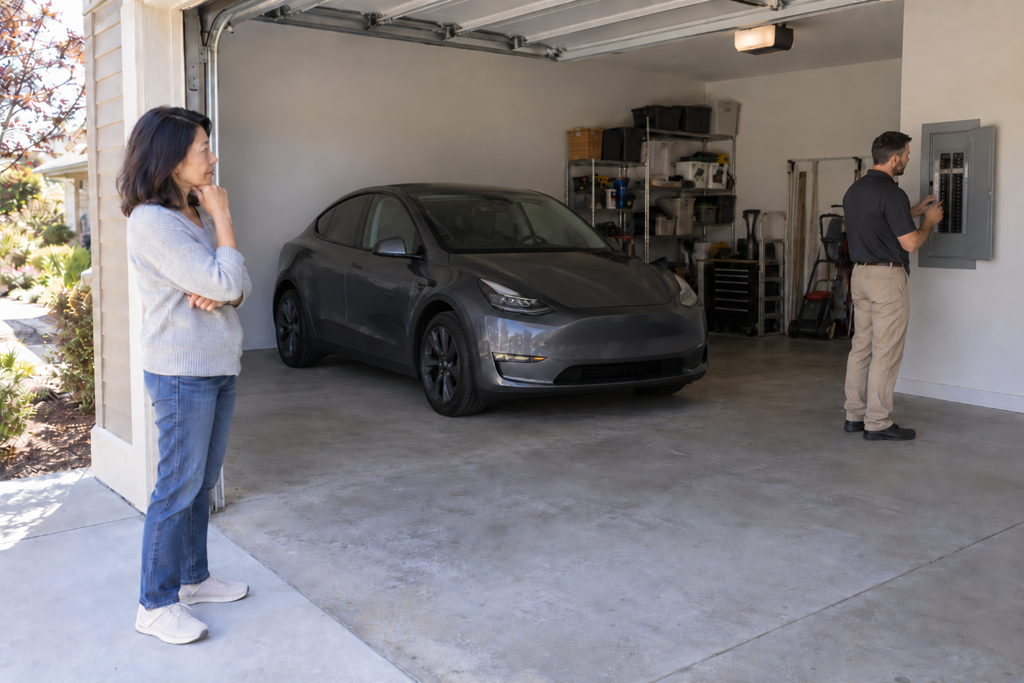
A good EV charging professional should make the project easier to understand before you hire them. That means asking enough questions to understand your vehicle, parking setup, charging goals, electrical situation, and the area where equipment may be installed, then explaining the proposed scope in plain language. You are not looking for the person who talks the fastest or gives the shortest estimate. You are looking for a professional whose questions, explanations, and proposal make it easier to see what is included, what may change, and what you are being asked to approve.
For Sacramento-area homeowners considering EV charging at home, it can be tempting to treat the decision as mainly a matter of finding someone who can install the equipment. But the quality of the conversation before hiring can tell you a great deal about how clearly the project may be handled.
You do not need to become an electrical expert to evaluate the professional. You can pay attention to whether the person is taking the time to understand your situation rather than jumping immediately to a recommendation.
A Good Evaluation Starts With the Questions They Ask
An EV charging project is connected to more than the charging unit itself. The professional may need to understand where you normally park, what vehicle you use, how you expect to charge it, where electrical equipment is located, and what parts of the property could affect the proposed work.
That makes the professional's questions useful information for you.
Someone who asks about the actual property and how you plan to use the charger is giving themselves a better opportunity to understand the project before describing a solution. Someone who seems ready to quote the job without learning much about your situation may leave important assumptions unexplained.
The goal is not to count how many questions the professional asks. It is to notice whether the questions seem connected to your real circumstances.
For example, a Sacramento homeowner who parks inside an attached garage may have a different project context than someone who parks outside, uses a detached garage, or has more than one vehicle competing for the same parking area.
A thoughtful professional should be trying to understand the project you actually have, not simply describing the installation they commonly perform.
Pay Attention to How Clearly the Scope Is Explained
A price by itself does not tell you very much about what you are buying.
Before hiring, you should be able to understand the basic scope of the proposed project: what the professional expects to provide, what work is included, what equipment or materials are part of the estimate, and what could result in a change.
You do not need every technical detail translated into everyday language, but the overall project should make sense.
If a professional uses technical terminology, it is reasonable to ask what it means for your property, your charging setup, or your estimate.
Clear explanations are especially helpful when you are comparing more than one provider. Two proposals that appear similar at first may not be describing exactly the same work.
That is why comparing only the bottom-line number can create confusion. The more useful comparison is whether you understand what each professional believes the project involves.
Notice Whether the Professional Looks at the Whole Situation
One of the easier mistakes to make is focusing only on the wall where the charger might eventually be located.
The professional should also be thinking about how the charging setup fits the way the property is actually used.
That may include the normal parking position, the relationship between the vehicle and proposed charger location, access to relevant electrical areas, the path the project may need to follow through the property, and any practical limitations the professional notices during the evaluation.
This does not mean you need to inspect these things yourself.
Instead, notice whether the professional appears interested in understanding them before committing to a recommendation.
A thorough evaluation should feel connected to the actual property rather than like a standard solution being applied automatically.
Good Communication Includes What Is Still Unknown
A professional does not necessarily need to have every answer immediately.
In fact, one useful sign can be a willingness to distinguish between what is already known and what still needs to be confirmed.
There may be details that cannot be finalized until the professional has seen the property, reviewed existing conditions, confirmed equipment information, or completed whatever evaluation is appropriate for the project.
That uncertainty does not automatically make a provider less qualified.
What matters is how they communicate it.
Statements such as "I need to confirm that before I include it in the scope" can be more useful than an immediate answer that later changes.
When something could affect cost, timing, equipment selection, or the amount of work involved, ask how and when that issue will be clarified.
The Proposal Should Match the Conversation
After speaking with the professional, the written proposal should generally reflect the project you discussed.
You should not have to reconstruct the entire conversation from memory to understand what you are agreeing to.
Look for consistency between what was explained and what appears in the proposal. If an important part of the conversation seems missing, ask about it before approving anything.
The same applies when comparing providers.
One proposal may include something another provider discussed separately. Another may leave a portion of the project dependent on further evaluation. Neither situation is automatically better or worse, but you should understand the difference before comparing prices.
A lower number is difficult to evaluate if you cannot tell whether the scope is comparable.
Equipment Recommendations Should Come With an Explanation
Homeowners sometimes begin the process already having a particular charging unit in mind. Others want the professional to recommend one.
Either approach can work, but the explanation matters.
If the professional recommends specific equipment, ask why it fits your situation. The answer should connect back to practical considerations such as your vehicle, charging expectations, installation setting, or other relevant project needs.
Likewise, if you have already purchased equipment, the professional should be able to explain whether there are any considerations they want to review before agreeing to install it.
You are not trying to determine the technical answer yourself. You are evaluating whether the professional can explain the reasoning behind the recommendation in a way that makes sense.
Ask What Could Change After You Say Yes
One of the most useful conversations can happen before you approve the proposal.
Ask what circumstances could cause the scope, cost, or schedule to change once the project moves forward.
The answer may be simple. It may also reveal portions of the project that are still assumptions.
Either way, you gain a clearer picture of what the current estimate represents.
This is also a good time to ask how changes are communicated and approved. A provider should be able to explain what happens if something different is discovered or if the original plan needs to be adjusted.
The objective is not to eliminate every possibility of change. It is to reduce surprises by understanding how changes would be handled.
A Few Questions Can Reveal a Lot
You do not need a lengthy interview. A small group of practical questions can help you understand how the professional approaches the project:
- What do you need to know about my vehicle, parking setup, and charging expectations before recommending an installation?
- What exactly is included in this proposal?
- Are there parts of the project that still need to be confirmed?
- What could cause the scope or price to change?
- Why are you recommending this charging setup or equipment for my situation?
- How will you communicate with me if something changes after the project begins?
- What should I expect between approving the proposal and completing the project?
- Are there approvals, coordination steps, or other project responsibilities I should understand before hiring you?
The value of these questions is not simply the answers themselves. Pay attention to whether the professional answers directly, explains unfamiliar details without pressure, and gives you enough information to make a considered decision.
Be Cautious When the Decision Feels Rushed or Vague
Not every concern appears as an obvious red flag.
Sometimes the problem is simply that you still do not understand what you are agreeing to.
You may want additional clarification if the professional avoids basic questions about the scope, provides explanations that keep changing, pressures you to commit before you understand the proposal, or dismisses reasonable questions about what is included.
The same is true when a quote appears unusually simple for a project that was described as having several variables.
That does not automatically mean something is wrong. It does mean you have a reason to ask for more explanation before moving forward.
Taking another day to understand a proposal is different from unnecessarily delaying a project. A hiring decision becomes easier when you can explain to yourself what the professional plans to do and why.
The Best Fit Is Usually Easier to Understand
Evaluating an EV charging professional does not require judging their technical work yourself.
Your role is to evaluate the parts of the hiring process that are visible to you: whether they learn about your property and goals, whether their recommendations have understandable reasons behind them, whether the proposal reflects the conversation, and whether they communicate uncertainties and possible changes clearly.
For Sacramento-area homeowners, that approach can make provider comparisons much more useful than simply collecting prices.
Before hiring, you should have a reasonable understanding of what is being proposed, why it fits your situation, what is included, and what could change. When a professional helps you reach that point without pressure or unnecessary confusion, you have much better information for deciding whether they are the right person for the project.