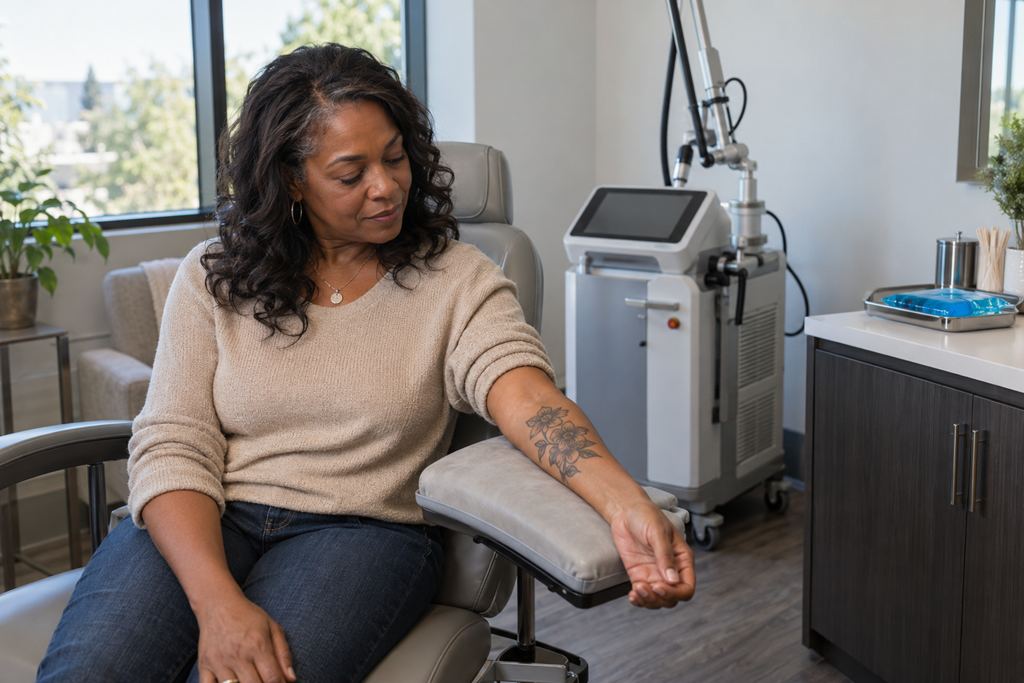
Concern about discomfort during tattoo removal is reasonable, and it is worth discussing before you schedule treatment. The sensation can vary from person to person and from one tattoo to another, so a useful consultation should help you understand what the appointment may feel like, what comfort measures the provider uses, and how they handle pauses or concerns during a session.
It is easy to approach tattoo removal with one simple question: “How much will this hurt?” The difficulty is that there usually is not one answer that applies to everyone. Descriptions of discomfort are subjective, and the experience can differ based on the tattoo, the area being treated, the removal method, and the individual receiving treatment.
For Sacramento-area residents comparing tattoo removal providers, the more useful goal is not getting a perfect prediction. It is understanding what to expect and whether the provider communicates clearly about comfort before you commit.
Discomfort Is Personal, Not A Test Of Toughness
People can experience and describe physical sensations very differently. Something one person considers manageable may feel much more uncomfortable to someone else.
That does not mean either person is overreacting.
Tattoo removal can involve brief but noticeable sensations during treatment, and a qualified provider should be able to explain how patients commonly describe the experience without promising exactly how it will feel for you.
The location and characteristics of the tattoo may also matter. The size of the treatment area, the method being used, individual sensitivity, and other personal factors can all affect the experience.
This is one reason another person's tattoo-removal story can be interesting without being a reliable prediction of your own experience.
“Does It Hurt?” May Not Be The Most Helpful Question
Asking whether tattoo removal hurts is understandable, but a simple yes-or-no answer does not tell you very much.
A more useful conversation explores what the treatment may feel like, how long the active portions of an appointment typically last for a tattoo like yours, how the provider approaches patient comfort, and what happens if you need to communicate a concern during treatment.
This changes the discussion from trying to obtain a pain guarantee to understanding the experience.
A provider does not need to promise that treatment will be painless to be reassuring. In fact, a straightforward explanation of what can and cannot be predicted may give you more useful information than an overly confident promise.
The Same Person May Not Experience Every Tattoo The Same Way
Even if you have had tattoo removal before, a different tattoo may not feel identical.
Tattoos can differ in size, placement, density, age, color, and other characteristics that may influence how a provider approaches treatment. Different body areas can also feel different to the same person.
That makes it useful to discuss the actual tattoo you are considering having treated rather than relying entirely on a previous experience or someone else's description.
A consultation gives the provider an opportunity to evaluate your situation and gives you an opportunity to ask what factors may affect your particular treatment experience.
Ask How The Provider Approaches Comfort Before Treatment Begins
Tattoo-removal practices may use different approaches to patient comfort depending on the treatment method, the individual, and the provider's protocols.
Rather than assuming that a particular comfort measure will or will not be available, ask.
A provider may discuss cooling techniques, topical options, pacing, positioning, breaks, or other measures when appropriate. Which options are suitable for you is something to discuss with a qualified provider rather than deciding on your own.
The important consumer question is not whether a clinic uses one particular method. It is whether the provider can clearly explain what they normally do, what options may be appropriate in your situation, and what those options can realistically accomplish.
Comfort measures should not be presented as a guarantee that you will feel nothing.
Know How You Can Communicate During A Session
Some people become more anxious about discomfort when they imagine having no control once a treatment session begins.
That is another useful subject to raise beforehand.
Ask how patients communicate when they need a pause or when something feels different from what was described. Understanding that process before treatment can remove some of the uncertainty surrounding the appointment.
Good communication works both ways. The provider should explain what sensations may normally occur with the treatment being used and how they want you to communicate concerns.
If you experience something unexpected or concerning during or after treatment, discuss it with the qualified provider handling your care rather than trying to determine on your own whether it is normal.
A Few Questions Can Make The Consultation More Useful
You do not need a long script. A few focused questions can tell you a great deal about both the expected experience and the provider's communication style:
- How do patients typically describe the sensation from the treatment you use?
- What factors about my tattoo could affect how the treatment feels?
- What comfort measures do you normally discuss with patients?
- If I need a pause during treatment, how is that handled?
- Is there anything about my situation that I should discuss with you before scheduling?
The goal is not to eliminate every unknown. It is to leave the conversation understanding the process better than when you arrived.
For personal questions about risks, candidacy, medications, skin conditions, pain control, recovery, or possible outcomes, speak directly with a qualified healthcare or tattoo-removal provider familiar with your situation.
Pay Attention To How Your Concern Is Handled
Your discomfort question can also tell you something about the provider before treatment begins.
There is a meaningful difference between a provider who explains that experiences vary and one who simply dismisses the concern. Likewise, promising that a procedure will be completely painless may not give you the realistic expectations you need.
Listen for clear explanations rather than absolute assurances.
A useful conversation should leave room for questions without making you feel pressured to schedule immediately. If the explanation is confusing, asking for clarification is reasonable.
You are not looking for a provider who can predict exactly what you will feel. You are looking for one who can explain the expected experience, discuss your individual concerns, and tell you how comfort and communication are handled.
Comfort Can Be Part Of Comparing Sacramento-Area Providers
When comparing tattoo removal services in the Sacramento area, price and scheduling may naturally get attention. The way a provider discusses the actual treatment experience deserves attention too.
Two providers can describe comfort, expectations, communication, and treatment pacing differently.
That does not automatically make one approach right and another wrong. It gives you information you can use when deciding which setting and provider feel like an appropriate fit for your needs.
A consultation is also an opportunity to find out whether you feel comfortable asking questions before making that decision.
You Do Not Need A Perfect Pain Prediction To Make A Better Decision
Concern about discomfort does not need to be resolved with a precise pain rating before you consider tattoo removal.
A more useful goal is to understand what sensations may be involved, what factors could make the experience different for you, what comfort approaches may be available, and how you can communicate with the provider during treatment.
That gives you something more practical than somebody else's pain story: clearer expectations for your own decision.
Before scheduling tattoo removal in the Sacramento area, discuss your personal concerns with a qualified provider who can evaluate your situation and explain the treatment approach being considered.