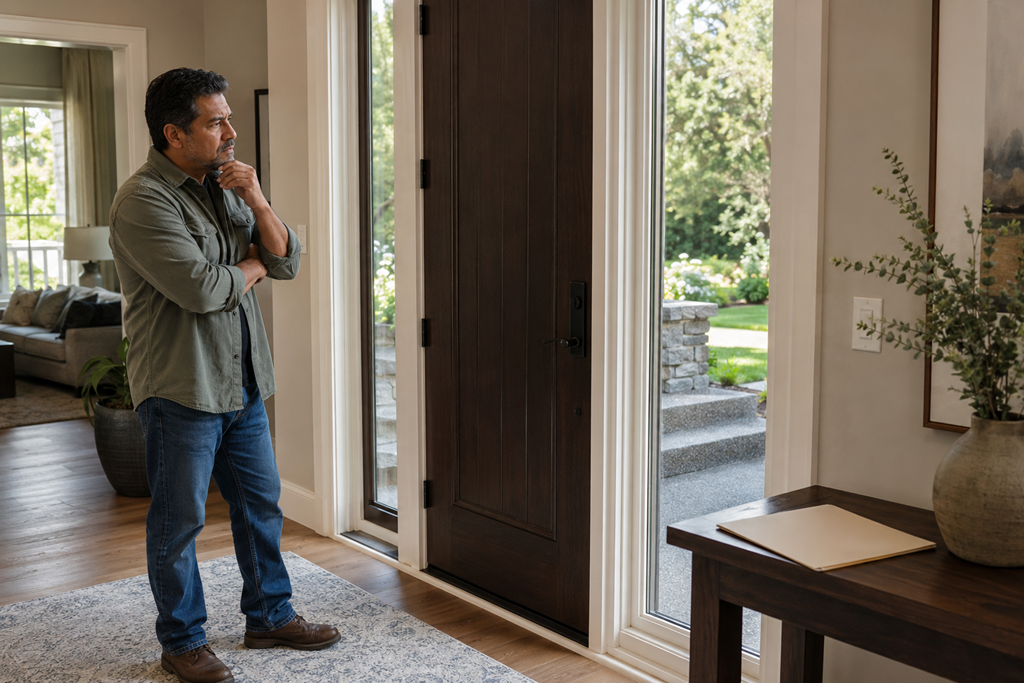
A door replacement estimate should tell you more than the total price. Before agreeing, look for enough detail to understand which door or opening is being addressed, what parts of the existing assembly are included, what new materials or components are being proposed, and what conditions could change the scope once the work begins.
That distinction matters because “replace the door” can sound much simpler than the actual project. One Sacramento-area homeowner may be replacing a straightforward side entry door, while another may have a front entry with sidelights, decorative trim, a larger frame, specialized hardware, or surrounding materials that need to be considered. Two estimates can therefore look similar at first glance while describing very different amounts of work.
The Total Price Does Not Tell You What the Estimate Actually Covers
It is natural to look first at the number at the bottom of an estimate. The problem is that the total alone does not explain what you are buying.
A useful estimate should give you enough information to understand the proposed scope. That does not mean it needs to read like a technical manual. It does mean you should be able to tell whether the provider is proposing to replace only the door itself, replace the door and frame as a unit, address trim or finishing around the opening, install new hardware, remove old materials, or handle other parts of the project.
If those details are unclear, you may not yet have enough information to compare the estimate with another quote or decide whether the proposal matches what you expected.
Make Sure the Estimate Matches the Actual Door Opening
Door replacement is not always a matter of counting how many doors a home has.
The physical opening can influence the project. A single standard entry, a wider front entrance, a door with sidelights, a double-door configuration, or an opening surrounded by detailed trim can present different considerations.
The surrounding area can matter too. Flooring transitions, exterior steps, wall finishes, existing trim, thresholds, and nearby features may affect what needs to be discussed before the work is approved.
This is why an estimate should feel connected to the specific opening in your home rather than like a generic price attached to the word “door.”
For Sacramento-area homeowners comparing estimates, this can be especially useful when two providers describe the same project differently. One proposal may simply include more of the surrounding work than another.
Pay Attention to What Is Included Around the Door
A common source of confusion is assuming that everything visually connected to the door is automatically included in the replacement price.
That may or may not be the case.
The door, frame, trim, hardware, threshold, finishing work, disposal of the existing materials, and other related items can be treated differently from one proposal to another. The important question is not whether every estimate uses the same format. It is whether you understand what your particular estimate includes.
If you expect existing trim to be replaced but the estimate assumes it will remain, that is worth clarifying before you agree. The same applies if you assume new hardware is included, expect certain finishing work, or believe the old door will be hauled away.
These are easier conversations to have before the project starts than after different assumptions have already formed.
A Lower Estimate May Simply Describe a Smaller Scope
When comparing door replacement quotes, a lower number is not automatically a better value or a warning sign.
It may simply represent a different scope.
For example, one estimate could include more materials, finishing, hardware, removal, or related work, while another addresses a narrower portion of the project. Without understanding those differences, comparing only the totals can create the impression that two providers are pricing the exact same job when they are not.
Instead of asking only, “Which estimate costs less?” it can be more useful to ask, “What is each provider actually proposing to do?”
That question makes the comparison much more meaningful.
Watch for Allowances, Options, and Details That Are Still Undecided
Some parts of a door replacement may not be finalized when the first estimate is prepared.
You might still be choosing the exact door style, finish, glass configuration, hardware, or another component. An estimate may also be based on assumptions that need to be confirmed before the project moves forward.
There is nothing automatically wrong with an estimate containing options or unresolved selections. The important part is recognizing them.
If something is still undecided, try to understand whether the quoted total assumes a particular selection and what happens if you choose something different. That helps prevent an estimate based on one set of assumptions from being mistaken for a fixed description of every possible choice.
Ask What Could Change After the Existing Door Is Removed
Not every condition around an existing doorway can be fully understood from what is visible during an estimate.
That does not mean you should expect a problem. It does mean it can be useful to ask how unexpected conditions would be handled if something relevant is discovered once the existing materials are removed.
You are not asking the provider to predict something they cannot see. You are trying to understand the process.
Would additional work be discussed with you first? How would a change in scope be documented? Would you receive an updated price before additional work proceeds?
A clear answer can tell you a great deal about how the provider communicates when a project does not follow the simplest possible path.
Do Not Overlook Access, Cleanup, and Finishing Expectations
The main door may be the most obvious part of the project, but the experience of having it replaced can also depend on practical details around the work.
For example, you may want to know how the provider expects to access the doorway, whether nearby belongings need to be moved beforehand, what happens to the old door and packaging, and what condition the surrounding area is expected to be in when the work is complete.
These details do not need to dominate the estimate. They simply should not remain mysterious if they matter to your expectations.
A project can feel much more straightforward when the homeowner and provider have the same picture of what “finished” means.
A Few Questions Can Reveal Whether the Estimate Is Clear Enough
Before agreeing to a door replacement estimate, consider asking:
- What exactly is being replaced and what is remaining?
- Are the frame, trim, threshold, and hardware included where applicable?
- Are removal and disposal of the existing materials part of the quoted scope?
- Are any product selections or allowances still undecided?
- What circumstances could change the quoted scope or price?
- How would additional work be discussed and approved if something unexpected is discovered?
You do not need a complicated interrogation. The goal is simply to remove assumptions that could otherwise become confusing later.
You Should Be Able to Picture What You Are Agreeing To
A well-explained estimate should leave you with a reasonably clear picture of the project.
You should understand which opening is involved, what major components are included, which choices are still yours to make, what the provider expects to do, and where there is still uncertainty.
If you cannot tell those things from the estimate or from the provider's explanation, it is reasonable to ask for clarification before committing.
Door replacement can involve more than the visible door itself. Taking a little time to understand the scope behind the price can make it easier to compare Sacramento-area providers on the work they are actually proposing rather than on a single number that may not tell the whole story.