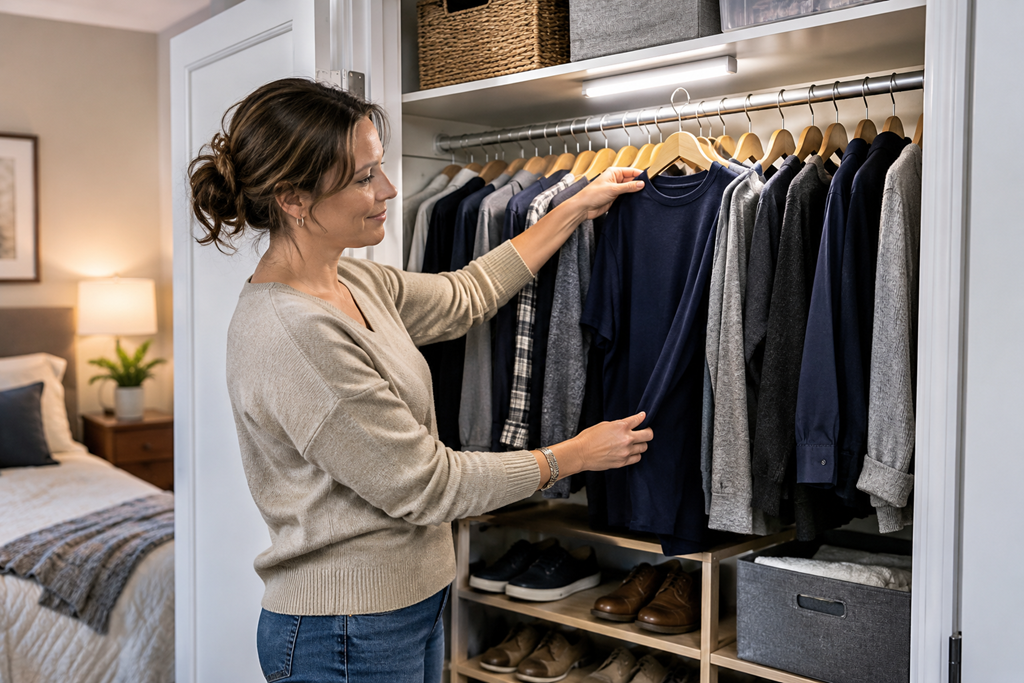
A closet can have a working light and still be difficult to use. Clothes may cast shadows over lower shelves, dark shoes may blend into the floor, and small items can disappear behind storage bins. Improving closet lighting starts with identifying where visibility is poor rather than adding light. Often, changing the way light reaches your belongings makes a bigger difference than increasing its intensity.
Whether you have a small bedroom closet, a hallway linen closet, or a larger walk-in closet, the goal is to make everyday belongings easier to identify, locate, and put away without unnecessary effort.
Find out which parts of your closet need more light
Before changing your existing lighting or purchasing anything new, spend a few minutes examining your closet under normal everyday conditions.
Stand where you usually stand when selecting clothes or retrieving belongings. Notice which areas are illuminated and which remain difficult to see.
Common problem areas include:
- Lower shelves beneath hanging clothing.
- Upper shelves containing storage containers.
- Shoes stored near the floor.
- Deep corners of walk-in closets.
- Drawers and shelving compartments.
- Areas behind closet doors.
- Spaces where your body blocks the existing light.
A ceiling light may adequately illuminate the center of a closet while leaving much of its storage space in shadow.
Identifying these individual areas helps you determine whether you need better overall illumination or additional light directed toward a particular storage location.
Remove unnecessary obstructions before adding lighting
Sometimes the contents of a closet contribute more to poor visibility than the light fixture itself.
Closely packed clothing, oversized storage containers, and crowded shelves can prevent light from reaching surrounding belongings.
Consider making a few adjustments:
- Space hanging clothes slightly farther apart where possible.
- Move infrequently used belongings into less frequently accessed storage areas.
- Avoid stacking containers in ways that block light from reaching nearby shelves.
- Keep frequently worn shoes and accessories in visible locations.
- Remove unnecessary items from the closet floor.
Light-colored or transparent storage containers may also make certain belongings easier to identify than dark, opaque containers.
Keep stored materials away from light fixtures and maintain the clearances required by the fixture manufacturer.
The objective is not to create a perfectly organized closet. It is to reduce the number of physical obstructions that interfere with visibility.
Improve the way light reaches your belongings
Closet lighting generally serves two different purposes: illuminating the overall space and making specific belongings easier to see.
Understanding this distinction can help you address the actual problem without making unnecessary changes.
General closet lighting
General lighting helps you see the closet as a whole.
A suitable overhead fixture may provide enough illumination for a small reach-in closet with limited shelving and relatively little obstruction.
If an existing fixture uses a replaceable bulb, check whether a compatible replacement with suitable brightness would improve visibility.
Always follow the fixture's bulb compatibility and maximum wattage requirements. Do not assume that every LED bulb is suitable for an enclosed fixture.
Targeted closet lighting
Targeted lighting directs illumination toward particular areas that remain difficult to see.
For example, a closet may have adequate overhead lighting but still contain a dark shoe rack beneath several rows of hanging clothes.
In that situation, additional light directed toward the shoe storage area may be more useful than increasing the brightness of the ceiling fixture.
Targeted lighting can be particularly useful for:
- Deep shelving compartments.
- Folded clothing storage.
- Shoe racks.
- Accessory organizers.
- Sections of a walk-in closet that remain in shadow.
The goal is to illuminate the belongings you need to see rather than simply making the entire closet brighter.
Choose lighting that makes colors and details easier to distinguish
Brightness is only one consideration when improving closet lighting.
The appearance and quality of the light can also influence how easily you distinguish between similar items.
Brightness
Light output is commonly measured in lumens. A higher lumen rating generally indicates greater light output, but it does not necessarily mean better visibility in every part of a closet.
Fixture location, light distribution, shelving depth, and surrounding materials all influence how useful that light becomes.
Excessive brightness can also create uncomfortable glare, particularly in smaller closets.
Color temperature
Color temperature describes whether light appears warmer, more neutral, or cooler.
Warmer lighting can create a comfortable appearance, while neutral white lighting may be useful for identifying clothing, shoes, and accessories.
A color temperature around 3000–4000 Kelvin can be a reasonable starting point for everyday closet use, depending on personal preference and the surrounding lighting.
Color accuracy
If you frequently have difficulty distinguishing between dark blue, black, brown, or gray clothing, consider the light's color rendering index, commonly called CRI.
Lighting with a higher CRI generally reproduces colors more faithfully. When color identification is particularly important, a CRI rating of 90 or higher may be worth considering.
You do not necessarily need specialized lighting throughout the closet. Focus on the areas where identifying colors and details matters most.
Consider lighting options that do not require electrical changes
Renters and homeowners who want to improve closet visibility without modifying existing wiring may benefit from supplemental lighting designed for the intended location.
Lighting type | Where it may be useful | Consideration |
|---|---|---|
Battery-operated LED light bars | Long shelves and hanging clothing areas | Batteries require periodic replacement. |
Rechargeable closet lights | Frequently accessed storage compartments | The lights need regular charging. |
Motion-activated closet lights | Closets without conveniently located switches | Sensor placement affects activation. |
Battery-operated puck lights | Small, isolated storage compartments | Light coverage may be relatively narrow. |
Closet-rated LED strip lighting | Longer storage areas and shelving sections | Product placement and installation requirements must be followed. |
These options can supplement existing lighting without necessarily requiring permanent electrical modifications.
Choose products specifically suitable for their intended closet or storage location. Follow manufacturer instructions concerning mounting, ventilation, charging, and clearance from combustible materials.
For renters, removable mounting options may be preferable when permanent modifications are restricted. However, removable adhesives can still affect painted or finished surfaces.
Make closet lighting convenient to use
A closet light provides limited everyday value if turning it on is inconvenient.
For example, you may have a rechargeable light inside a storage compartment but rarely use it because the switch is difficult to reach.
Think about how you normally access the closet.
Do you usually carry laundry into it? Do you open it early in the morning while someone else is sleeping? Do you frequently retrieve belongings with only one hand available?
Motion-activated lighting may reduce some of this inconvenience, provided the sensor can detect normal movement and the light remains illuminated long enough for the task.
Manually operated lighting may be more suitable for storage locations that you access occasionally or where nearby movement could trigger a sensor unnecessarily.
The appropriate choice depends on how the closet functions during ordinary household routines.
Know when the existing light fixture needs professional attention
Many closet visibility problems can be addressed through organization, compatible replacement bulbs, or supplemental lighting.
However, some conditions go beyond ordinary household adjustments.
Qualified electrical evaluation may be appropriate when:
- An existing light repeatedly flickers.
- A fixture shows visible damage or discoloration.
- You notice an unusual burning smell or buzzing sound.
- A light repeatedly stops working despite compatible bulb replacements.
- You want to relocate a permanently wired fixture.
- The existing fixture appears unsuitable for its proximity to stored clothing or other combustible materials.
- New wiring or electrical connections would be necessary.
Stop using a fixture that shows signs of overheating or electrical damage until it has been evaluated.
Closets present particular lighting considerations because fixtures may be positioned near clothing, cardboard, and other stored materials. Do not assume that a light suitable for an open room is automatically appropriate for an enclosed storage space.
Renters should report concerns involving permanent electrical fixtures to their property owner or property manager.
Make better visibility part of your closet organization
Once you have improved the lighting, revisit the way your belongings are arranged.
Keep frequently used items where they receive adequate illumination. Avoid placing new storage containers where they block supplemental lights, and periodically check whether changes to your closet arrangement have created new shadowed areas.
If additional lighting would help you put these ideas into practice, you can explore the Home Lighting And Everyday Convenience category at the Sacramento Local Pros Store for household lighting options that may support better visibility and everyday convenience.
Disclosure: Sacramento Local Pros may earn a commission from qualifying purchases made through links on the Sacramento Local Pros Store.
A more functional closet does not necessarily require a complete lighting redesign or expensive storage system. Start by identifying where visibility breaks down, reduce unnecessary obstructions, and direct appropriate lighting toward the belongings you use most often.