Clogged gutters can create problems well beyond the edge of the roof because trapped water does not simply stay in one place. It may spill over the front, back up beneath roofing materials, run down fascia or siding, collect near walkways and landscaping, or drain too close to the foundation. The visible clog is often only the starting point; the more useful question is where the displaced water is going.
For many Sacramento-area homeowners, the first sign is not a pile of leaves visible from the ground. It may be a dark streak on the siding, washed-out mulch below a roof corner, water dripping near an entry, or a section of soil that stays wetter than the surrounding area after rain.
Understanding this wider drainage path is important before cleaning the gutters, repairing them, or installing gutter guards.
A Full Gutter Changes the Direction of the Water
A gutter is designed to collect water from the roof and direct it toward a downspout. When leaves, pine needles, seed pods, roof granules, or other material block that path, the water must find another route.
Sometimes it spills over the outer edge, making the problem easy to see. In other cases, water collects behind the gutter or moves toward the fascia. A blockage near a downspout can also cause water to build up along an otherwise clean-looking gutter run.
This is why the location of the debris does not always match the location of the visible symptom. A homeowner may notice water near a patio or wall even though the main blockage sits several feet away.
The issue is not simply that the gutter contains debris. The issue is that the debris has changed how water moves across the property.
The First Visible Signs May Appear on the House
Overflowing water can repeatedly contact parts of the home that were not intended to handle concentrated roof runoff.
Depending on the gutter position and the direction of the overflow, a homeowner may notice staining, peeling paint, damp fascia, discoloration beneath the roof edge, or splash marks on the siding. Water may also drip behind the gutter instead of flowing over the front, making the problem less obvious from the yard.
One wet mark does not automatically prove that the gutter is the only cause. Roof edges, flashing, joints, gutter seams, and other drainage components may also need to be evaluated.
Still, when a mark appears directly below a gutter corner, roof valley, seam, or outlet, the gutter system is a reasonable place for a qualified professional to examine.
Ground-Level Evidence Can Reveal the Water’s New Path
Problems caused by a clog frequently become more noticeable at ground level.
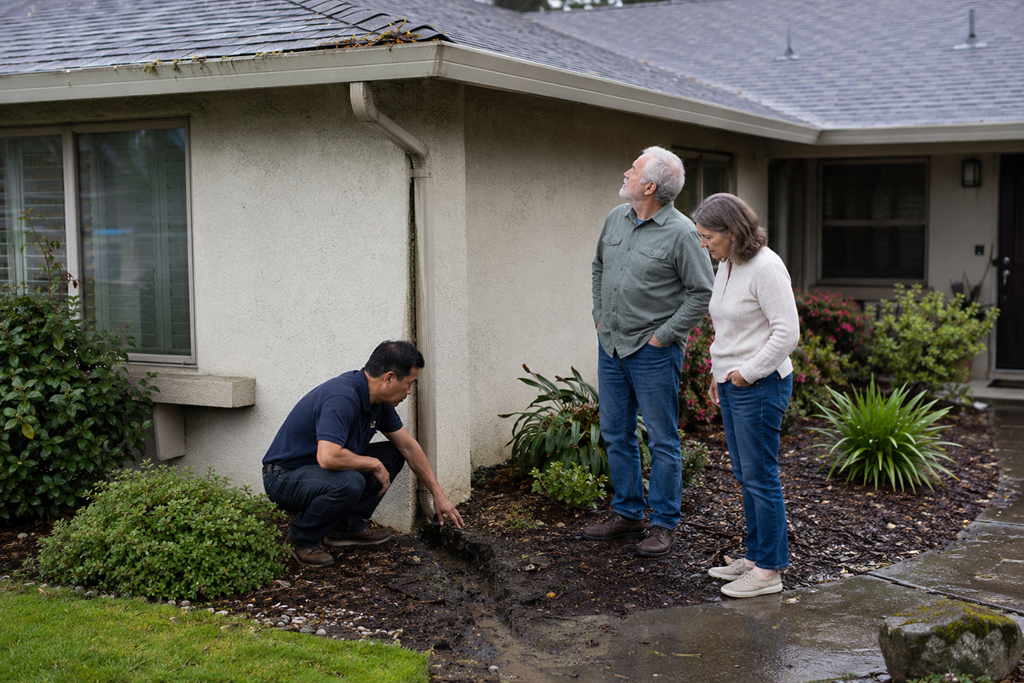
Water spilling from a roof edge can flatten plants, wash mulch away from one section of a bed, create a narrow channel in loose soil, or form a puddle near a walkway. Repeated runoff may also leave dirt or splash patterns on the lower portion of an exterior wall.
These clues are easy to dismiss because they can look like ordinary landscaping or drainage issues. However, their position may tell a useful story. A washed-out area directly beneath a clogged gutter corner is different from general yard saturation after rain.
Sacramento’s long dry periods can allow leaves, needles, dust, and seed material to collect before seasonal rain begins moving water through the system again. A gutter that appeared uneventful during dry weather may behave very differently once runoff reaches the blockage.
Roof Valleys Can Concentrate the Problem
Not every section of gutter receives the same amount of water or debris.
A straight roof edge beneath open sky may remain relatively clear, while a nearby valley directs leaves, needles, roof granules, and a larger volume of water toward one short section. That concentrated flow can overwhelm a partially blocked outlet even when the rest of the gutter looks clean.
This helps explain why one corner may overflow while other portions of the home appear to drain normally.
It also means that a quick glance at the most visible gutter section may not reveal the actual problem. The areas receiving concentrated runoff deserve particular attention during an evaluation.
An Overflow Does Not Always Mean the Same Repair Is Needed
Clogged gutters can produce similar symptoms for different reasons.
One system may simply contain loose debris that needs to be removed. Another may have a blocked downspout, an outlet that is too restricted, a loose gutter section, an improper slope, separated seams, or damage hidden beneath accumulated material.
Cleaning the visible leaves may improve the flow without resolving the entire issue.
A useful evaluation should consider the complete route:
- where water leaves the roof
- where debris tends to collect
- how water moves through the gutter
- whether the outlet and downspout are open
- where the water is discharged at ground level
This wider view helps distinguish a temporary blockage from a drainage problem that may require repair or adjustment.
Gutter Guards Should Not Cover an Unresolved Problem
Gutter guards can help reduce the amount and type of debris entering a gutter, but they are not a substitute for correcting an existing blockage, leak, drainage defect, or damaged section.
Installing guards over trapped debris can hide material that should have been removed. Adding them to a gutter with poor drainage may leave the homeowner with the same overflow problem beneath a newly covered system.
The existing gutters should therefore be evaluated before installation. The discussion may include cleaning, downspout flow, attachment points, visible damage, roof-valley runoff, and the type of debris common around the property.
The proposed guard should also match the conditions around the home. Broad leaves behave differently from thin needles, seed pods, roof granules, or fine organic material. A provider should be able to explain how the recommended system is expected to handle the property’s actual debris patterns.
Guards Reduce Certain Problems but Do Not Eliminate Maintenance
One common misunderstanding is that gutter guards make the entire drainage system maintenance-free.
Guards may reduce how often larger material enters the gutter, but debris can still collect on top of a screen, settle near roof valleys, gather at corners, or pass through openings. The roof, gutter, guard surface, outlets, and downspouts still need periodic observation.
Maintenance needs may depend on nearby trees, roof shape, wind exposure, the type of guard, and where debris naturally gathers.
A realistic provider should explain what homeowners may still need to watch for after installation rather than describing the system as something that will never require attention again.
Heavy Rain Often Reveals a Problem That Already Existed
Homeowners sometimes assume an overflowing gutter is simply the result of unusually strong rain.
A high volume of water can certainly expose the limits of a gutter system. However, rainfall may also reveal debris, a restricted outlet, a low section, or another condition that was already present.
When overflow repeatedly occurs in the same location, it is worth examining why that section is behaving differently from the rest of the system.
A professional evaluation does not need to begin with the assumption that the entire gutter system must be replaced. The goal is to identify the path of the water and determine what is interrupting it.
Useful Questions Before Installing Gutter Guards
A gutter guard consultation should address the condition of the existing drainage system, not only the product being installed.
Helpful questions include:
- Will the gutters and downspouts be inspected and cleared before installation?
- Is there evidence that water has been spilling behind or over the gutter?
- Are any sections loose, damaged, leaking, or holding standing water?
- Where does roof runoff become concentrated around the home?
- How will the proposed guard handle the property’s leaves, needles, seeds, and roof granules?
- What inspection or cleaning may still be needed after installation?
Clear answers can help a homeowner compare providers based on the completeness of the evaluation rather than the appearance of the guard alone.
Look Beyond the Roof Edge
A clogged gutter is not only a roofline issue. It is a water-routing issue that can affect fascia, siding, landscaping, walkways, soil, and other areas below the gutter.
Before installing gutter guards, Sacramento-area homeowners can benefit from tracing the entire path of the runoff: from the roof surface, into the gutter, through the outlet and downspout, and finally away from the home.
A provider who examines that full path is better positioned to explain whether the immediate need is cleaning, repair, adjustment, guard installation, or some combination of those services. That understanding helps homeowners make a better-informed decision instead of covering a problem that has not yet been identified.