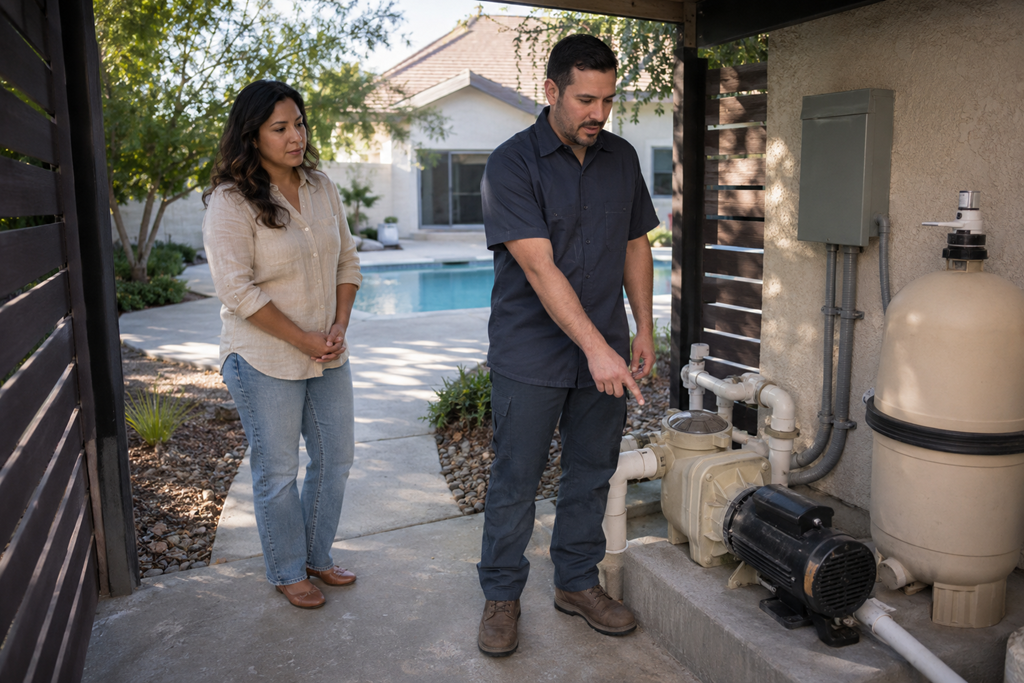
Early pool equipment problems often show up as small changes before anything stops working completely. A pump may sound slightly different, water movement may feel weaker, air bubbles may appear at the return jets, or dampness may develop near the equipment pad. Noticing these changes early does not tell you exactly what is wrong, but it gives you a useful reason to pause, document what you are seeing, and ask a qualified pool professional to evaluate the system before the issue becomes harder to explain.
The First Warning Is Often a Change, Not a Shutdown
Pool equipment does not always move directly from working normally to complete failure. In many cases, the first sign is simply that something no longer looks, sounds, or behaves the way it usually does.
That distinction matters because homeowners sometimes dismiss a change when the pool still appears usable. The water may remain clear, the pump may still run, and the cleaner may continue moving. However, a noticeable difference in the system’s normal pattern can still be useful information.
The goal is not to diagnose the equipment yourself. It is to recognize when the system has developed a new pattern that may be worth discussing with a qualified pool service professional.
A New Sound Can Be an Early Clue
Pool pumps and other equipment naturally make some noise while operating. What deserves attention is a sound that is new, louder than usual, inconsistent, or present during a different part of the operating cycle.
Examples may include:
- A new rattling or vibrating sound
- Grinding, scraping, or high-pitched noise
- A motor that hums without appearing to operate normally
- Repeated starting and stopping
- A sound that appears only after the equipment has been running for a while
A brief startup sound may not mean anything is wrong. The more useful question is whether the noise represents a clear change from the equipment’s normal operation.
Sound alone usually cannot identify the cause. A new noise might relate to debris, vibration, wear, restricted water movement, a motor issue, or another condition that requires inspection. Recording when the sound occurs can be more useful than trying to name the problem yourself.
Water Movement May Look Different Before the Pool Looks Unhealthy
Changes in circulation can be subtle. A Sacramento-area homeowner may first notice that the return jets feel weaker, the surface is not moving as evenly, or debris remains in a corner that normally clears.
Other changes may include:
- A pool cleaner moving more slowly than usual
- A spa spillway producing a thinner or uneven stream
- One section of the pool appearing calmer than the rest
- Leaves or floating debris lingering near the skimmer
- Water features losing some of their normal force
These observations do not automatically mean the pump needs to be replaced. Water level, debris, filter condition, valves, plumbing, equipment settings, and component wear can all affect circulation.
The important point is that a new circulation pattern gives a provider something specific to evaluate.
Persistent Air Bubbles Are Worth Noticing
A few bubbles may appear temporarily after maintenance or when equipment restarts. Repeated bubbles coming from the return jets are different, especially when they appear alongside weaker water movement or unusual pump behavior.
You may also be able to observe air moving beneath a transparent pump lid without opening or touching the equipment. A large air pocket that repeatedly returns can be useful information for a service professional.
Avoid removing lids, opening pressurized components, or attempting to adjust unfamiliar valves while the system is operating. Simply note where the bubbles appear, how long they last, and whether they are becoming more frequent.
Dampness Around the Equipment Pad Can Reveal a Developing Problem
A single splash or temporary wet spot is not the same as moisture that repeatedly appears in the same place.
Early evidence may include:
- A slow drip beneath a fitting
- A narrow wet trail on the equipment pad
- White or chalky mineral residue around a connection
- Damp soil beside an otherwise dry pad
- Moisture that returns after the surrounding area has dried
In Sacramento’s generally dry conditions, unexplained moisture around outdoor equipment can sometimes be easier to notice. Irrigation, rain, recent cleaning, and pool splashing should still be considered before assuming the equipment is leaking.
Rather than tightening fittings or opening equipment yourself, photograph the area from a safe distance and see whether the moisture returns in the same location.
Irregular Operation Can Matter Even When the Equipment Restarts
Equipment that works only some of the time can be more difficult to evaluate than equipment that has stopped completely.
A pump may start later than expected, stop before completing its normal cycle, or operate normally on one occasion and poorly on another. A cleaner may move well at first and then become unusually slow. A water feature may alternate between normal and reduced flow.
An isolated change could relate to settings, water level, a temporary obstruction, or another routine condition. A repeated pattern deserves closer attention because intermittent behavior may not be visible when a technician first arrives.
Writing down when the problem occurs can help the provider understand what to investigate.
Heat and Electrical Clues Require Additional Caution
Repeated breaker trips, a burning odor, visible discoloration, unusual heat, smoke, sparks, or equipment that repeatedly shuts itself off should not be treated as ordinary maintenance clues.
Do not open electrical panels, touch overheated equipment, reset a repeatedly tripping breaker, or continue testing a system that appears unsafe. Keep people away from the equipment and ask a qualified professional whether the system should remain off until it can be evaluated.
A provider should be able to explain whether the concern requires a pool equipment technician, electrician, or another qualified specialist.
Several Small Clues Can Tell a Clearer Story
One symptom rarely identifies the entire problem.
Weak water movement by itself may have several possible explanations. However, weaker movement combined with persistent bubbles, a new pump sound, and moisture around the equipment pad gives a professional a more complete picture.
This is why paying attention to patterns is more useful than focusing on a single dramatic sign. Consider whether the change:
- Happens every time the system runs
- Appears only after extended operation
- Affects the entire pool or one area
- Started after cleaning, maintenance, or a water-level change
- Is gradually becoming more noticeable
You are not trying to prove what caused the problem. You are collecting observations that can make a professional evaluation more focused.
A Few Details Can Make a Service Call More Productive
Before contacting a Sacramento pool service provider, gather a small amount of practical information.
Note what changed, when you first noticed it, and whether it happens constantly or intermittently. Photos of moisture, bubbles, or uneven water movement may help. A brief recording of a new sound can also be useful when captured from a safe distance.
Tell the provider about any recent maintenance, filter cleaning, water-level changes, power interruptions, or adjustments made before the symptom appeared.
Avoid taking equipment apart for the sake of providing more information. A clear description of the visible symptoms is usually more valuable than an attempted repair that changes the original condition.
Questions to Ask Before Approving a Repair
A useful evaluation should help you understand the evidence behind the recommendation, not just the name of the proposed repair.
Consider asking:
- What observations or tests point to the suspected cause?
- Does the problem appear isolated to one component?
- Is additional inspection needed before choosing between repair and replacement?
- Is it safe to operate the equipment while deciding what to do?
- Will the estimate separate diagnostic work, repairs, parts, and replacement options?
A qualified provider may not be able to diagnose an intermittent problem over the phone. That is not necessarily a warning sign. What matters is whether the provider clearly explains what can be determined during an inspection and how the available options will be compared.
Early Attention Supports a Better Repair Decision
Not every unusual sound, bubble, damp spot, or circulation change signals a major equipment failure. The value of noticing these signs is that they give you time to observe the pattern and seek an informed evaluation before making a repair or replacement decision.
Knowing what changed, when it happens, and whether several symptoms appear together can help a pool professional investigate the concern more efficiently. It can also help you ask better questions and understand why a particular recommendation is being made.
For Sacramento-area pool owners, the most useful early warning sign is often not a stopped pump or an unusable pool. It is a small but repeatable change from the way the system normally operates.