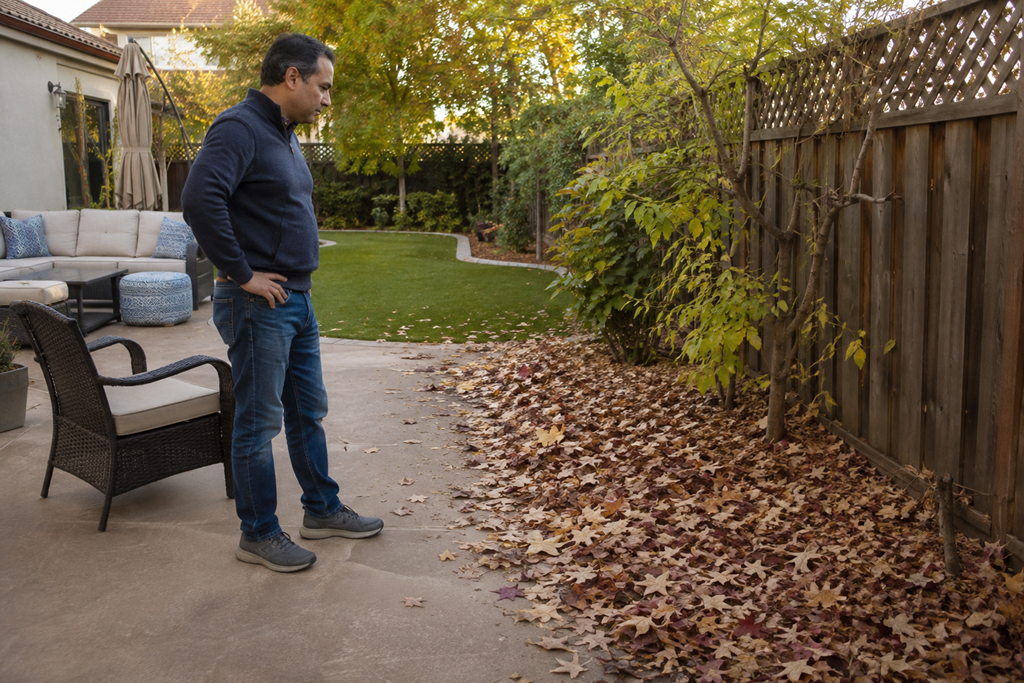
Preparing your yard for seasonal cleanup is less about gathering more tools and more about deciding what actually needs attention before the work begins. A little sorting, clearing, and planning can keep leaves, trimmings, outdoor belongings, and half-finished projects from turning one cleanup session into a larger clutter problem.
Seasonal yard work can feel deceptively simple at first. You may expect to rake, trim, sweep, or clear a few areas, only to discover garden supplies in several locations, outdoor furniture in the way, old plant containers that were never discarded, and materials left over from earlier projects.
The goal is not to make the yard perfectly organized before cleanup starts. It is to create enough order that the cleanup itself does not spread belongings, debris, and temporary piles across the property.
Decide what the cleanup actually needs to accomplish
Before moving anything, take a broad look at the yard and define the work that actually needs attention.
A seasonal cleanup might involve fallen leaves, small branches, plant trimmings, weeds, accumulated debris around hardscape, or outdoor belongings that have gradually migrated away from where they belong. Other areas may already be fine and do not need to become part of the project.
This distinction matters because homeowners sometimes turn a focused yard cleanup into a much larger organization project. A patio that only needs sweeping can suddenly become a reason to empty every outdoor cabinet. A small leaf problem can lead to pulling every garden item out of storage.
Keep the scope tied to what you can actually see needs attention.
For Sacramento-area homeowners, this can also make conversations with a landscaping service more useful. If you know which parts of the yard are creating the problem, you can describe the situation more clearly instead of treating the entire outdoor area as one undefined cleanup job.
Separate debris from belongings before you start moving things
One of the easiest ways to create more clutter is to mix cleanup debris with items you intend to keep.
Leaves, dead plant material, empty pots, usable garden accessories, children's outdoor items, hoses, furniture, and leftover project materials may all occupy the same general area, but they do not belong in the same decision pile.
Instead, think in simple categories:
- Material that is clearly part of the cleanup
- Belongings that already have a regular place
- Belongings that need to be returned somewhere
- Items you are unsure whether to keep
- Materials connected to another unfinished project
You do not need a complicated sorting system. The important part is preventing everything from becoming one temporary heap that has to be sorted again later.
A pile is not necessarily progress if it simply moves the decision from one part of the yard to another.
Clear the areas that actually need access
Seasonal cleanup usually goes more smoothly when the spaces being worked on are accessible.
That may mean moving a lightweight chair away from a leaf-covered corner, returning children's outdoor items to their usual location, or relocating a few portable objects that block access along a fence, planting bed, patio edge, or side yard.
Avoid clearing more space than the job requires.
If a professional landscaping crew will be handling the cleanup, ask whether there are particular areas they want accessible before the appointment and whether there are belongings they prefer homeowners to move in advance. Preparation requirements can vary by provider and by the work being performed.
This helps separate useful preparation from unnecessary rearranging.
Use existing storage before creating another storage problem
Seasonal cleanup often exposes small organization problems that were easy to ignore during the rest of the year.
A hand tool may have been left near a planter because its normal storage space became crowded. Several outdoor items may have collected beside the house because no one decided where they should return after use. Empty containers may remain outside simply because they have not been dealt with yet.
Before adding another container, rack, organizer, or storage area, look at what you already have.
Ask whether existing storage is actually full or simply disorganized. Check whether items have migrated away from their assigned locations. Notice whether something is taking up outdoor space even though it is rarely used.
Sometimes the most useful improvement is returning a few things to places that already exist.
Give temporary mess a boundary
Some temporary disorder is normal during yard cleanup. The problem begins when temporary piles have no defined boundary.
If leaves are being gathered, plant material is being consolidated, or outdoor belongings are being moved briefly, keep the temporary activity contained to a deliberate area whenever practical.
This makes it easier to see what has already been addressed and what still needs attention.
It also reduces the familiar situation where a cleanup ends with several unrelated piles scattered around the yard. Those piles can linger because each one represents another unresolved decision.
The cleaner the distinction between the active cleanup area and the rest of the yard, the easier it is to finish the work without creating a second project.
Be cautious about buying your way into preparation
A seasonal cleanup can make almost any additional yard item seem useful.
You may notice that a container is crowded, a cleanup tool is inconvenient, or an outdoor storage area could work better. Those observations can be helpful, but they do not automatically mean something new needs to be purchased before the cleanup can proceed.
First identify the actual gap.
For example, the problem may be that something has no storage location, that frequently used items are difficult to reach, or that debris repeatedly collects in a particular area. Those are different problems and may call for different responses.
Understanding the problem first helps prevent new supplies from becoming part of the clutter you were trying to reduce.
Notice what keeps reappearing
Seasonal cleanup can reveal patterns that are harder to see during ordinary weekly yard care.
Perhaps the same corner repeatedly fills with miscellaneous outdoor items. Maybe one storage area becomes difficult to access every few months. Perhaps leftover landscaping materials remain because no one has decided whether they will actually be used again.
These recurring trouble spots are often more informative than the temporary mess itself.
Instead of asking only, "How do I clean this up?" ask, "Why does this area keep ending up this way?"
That question can help distinguish a one-time seasonal task from an organization issue that may be worth addressing separately.
Know what a landscaping service will handle
If you are planning to hire a local landscaping service for seasonal cleanup, it can help to clarify the boundary between homeowner preparation and the provider's work.
You might ask:
- Which areas should be cleared before the visit?
- What types of yard debris are included in the planned work?
- Should lightweight outdoor belongings be moved beforehand?
- Will the crew need access through a side yard, gate, driveway, or patio area?
- Are there materials or belongings they do not move or remove?
These questions are not about directing the technical work. They simply help you prepare the property in a way that supports the service you have scheduled.
They can also prevent unnecessary work, such as moving belongings that the provider did not need moved at all.
A prepared yard does not have to look empty
It is easy to assume that preparing for seasonal cleanup means stripping the yard down until almost nothing remains.
Usually, that is unnecessary.
A well-prepared yard can still contain furniture, garden features, children's outdoor belongings, hoses, planters, and other ordinary items. The difference is that the areas requiring cleanup are accessible and unrelated clutter is not competing for attention.
That is a more practical standard than trying to create a perfectly cleared outdoor space.
The goal is to make the cleanup easier to understand and complete—not to create an entirely separate organization project.
Related resource: If your preparation reveals gaps in the setup you already have, see How to Choose Yard-Care Storage And Cleanup Tools For Seasonal Maintenance for practical product-selection considerations.
A little preparation can keep seasonal yard work focused on the areas that genuinely need attention. By separating debris from belongings, using existing storage where it still works, containing temporary piles, and identifying recurring trouble spots, you can finish the cleanup with less chance of simply moving clutter somewhere else.