A yard can look unhealthy even when the grass, shrubs, and soil are capable of doing well. Uneven sprinkler coverage, clogged or misdirected heads, small leaks, pressure changes, and poorly matched watering zones can create brown patches, soggy areas, weak-looking edges, or stressed plants that make the entire landscape seem worse than it really is.
This can be frustrating for Sacramento-area homeowners because the visible symptoms may suggest that the lawn needs to be replaced, the soil has failed, or the plants are no longer suitable for the property. In some cases, however, the larger issue is simply that water is not reaching the landscape evenly.
Patchy Color Does Not Always Mean the Yard Is Failing
When several brown or thin areas appear, it is natural to focus on the condition of the grass or plants. The more useful question may be whether those areas are receiving the same amount of water as the healthier parts of the yard.
An irrigation problem can create sharply different conditions within a relatively small space. One section may receive enough moisture, another may be missed almost completely, and a third may be receiving more water than it can use.
The result can include:
- A green circle surrounded by dry grass
- A brown strip along a fence or walkway
- Soggy soil close to a sprinkler head
- Wilted plants next to plants that appear healthy
- Water running onto pavement while nearby soil remains dry
These patterns can make a generally viable landscape look as though it has several unrelated problems.
The Shape of the Damage May Reveal the Real Issue
The color of a struggling area receives most of the attention, but its shape and location may be more informative.
A curved dry area may correspond with the edge of a sprinkler’s reach. Repeating brown spots may follow the spacing between sprinkler heads. A narrow dry strip may sit just beyond the watering pattern, while a wet patch may develop around a leak or low point.
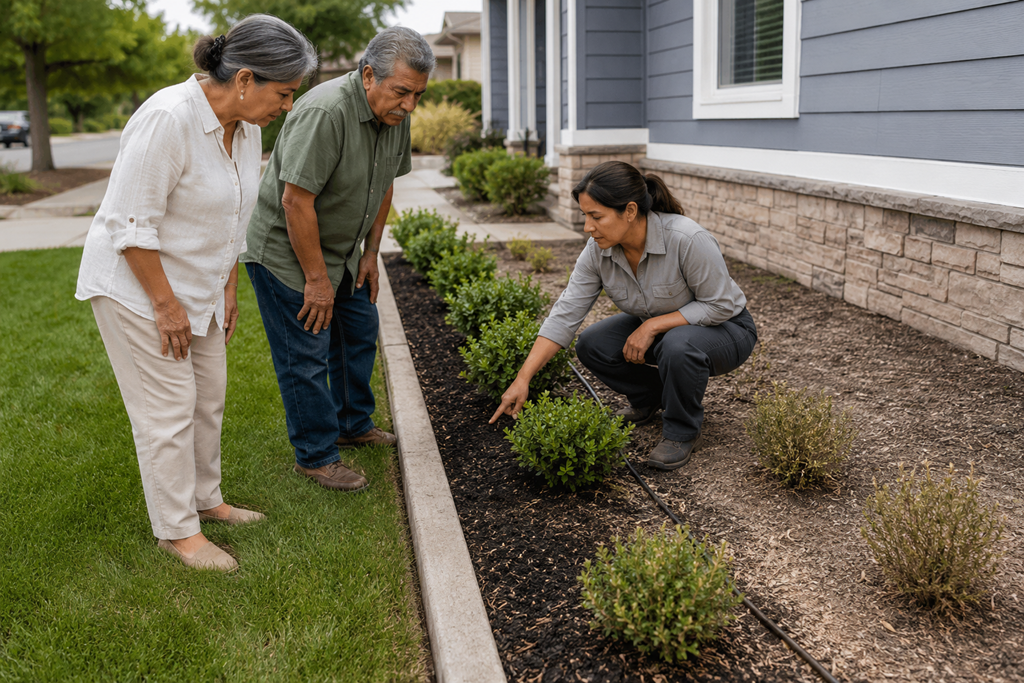
Plants can also struggle when a drip line is disconnected, obstructed, damaged, or positioned where the water does not reach the intended root area.
These visual patterns do not confirm a particular irrigation failure on their own. They can, however, provide a qualified landscaping or irrigation professional with useful clues during an evaluation.
More Water Is Not Always the Best Response
One common reaction to a brown area is to increase watering throughout the entire yard. That may improve the driest section temporarily, but it can also create new problems in areas that were already receiving enough water.
The healthy portions of the yard may become overly wet while the original dry area remains underserved. Water may begin pooling, running onto hard surfaces, or reaching plants that have different moisture needs.
This is why the total amount of watering is only part of the picture. Distribution matters as well.
A system can run for a long time and still fail to water the landscape evenly. Before assuming the yard needs substantially more water, it may be helpful to determine whether the existing water is reaching the right places.
Different Parts of a Yard May Need Different Treatment
A lawn, hedge, flowering bed, established shade tree, and container planting may not respond well to the same watering pattern.
Problems can develop when unlike landscape areas are grouped together or when a watering zone no longer matches the plants it serves. One area may dry quickly in strong sun, while another remains shaded and holds moisture longer.
Sacramento properties may also contain a mixture of older landscaping, newer plantings, mature trees, narrow side yards, sunny front lawns, and protected areas near the house. Even when every plant is healthy enough to grow, inconsistent irrigation can make the property appear uneven and poorly maintained.
A useful evaluation looks at the relationship between the irrigation layout and the actual landscape rather than treating every brown or wilted area as the same problem.
Replacing Plants May Address the Symptom Instead of the Cause
When a lawn or planting bed looks tired, replacement can seem like the most direct solution. New sod, fresh shrubs, or additional soil may improve the appearance for a while, but new materials can struggle in the same location if the watering problem remains.
This does not mean replacement is never appropriate. Grass and plants can decline for many reasons, including soil conditions, shade, pests, disease, traffic, root competition, and unsuitable plant selection.
The important distinction is that visible decline does not automatically establish the cause.
Before committing to a broad landscape replacement, Sacramento-area homeowners may benefit from asking whether the affected areas correspond with irrigation coverage, drainage, zone layout, or water distribution.
Small Irrigation Problems Can Create a Large Visual Effect
A relatively minor problem may affect only one portion of a watering zone, yet that portion may be located in a highly visible place.
For example, a misdirected sprinkler near a front walkway can leave a noticeable brown edge. A small drip-line interruption can affect several shrubs in a row. A leaking connection can create one dark, soggy area that makes the surrounding lawn look inconsistent.
Because landscaping is viewed as a whole, a few uneven sections can influence how the entire property is perceived.
This is one reason a yard can look substantially worse than its overall condition would suggest. The landscape may not be uniformly unhealthy. It may be showing the visible outline of an irrigation problem.
What to Ask During a Landscaping or Irrigation Evaluation
A clear professional evaluation should help connect the visible yard conditions with possible watering patterns. Useful questions may include:
- Do the affected areas match the current sprinkler or drip coverage?
- Are some areas receiving noticeably more or less water than others?
- Are the lawn and planting beds being watered through appropriately separated zones?
- Is there evidence of overspray, runoff, leaking, or blocked distribution?
- Should irrigation concerns be addressed before discussing plant or lawn replacement?
- What part of the proposed work addresses the underlying cause rather than only the appearance?
The provider should be able to explain what was observed, what remains uncertain, and why a particular repair or adjustment is being recommended.
Be cautious when a large replacement project is proposed without any discussion of irrigation performance, especially when the affected areas form distinct or repeating patterns.
Clear Scope Matters When Comparing Estimates
Two landscaping estimates may describe very different approaches to the same unattractive yard.
One provider may focus on replacing grass or plants. Another may recommend evaluating the irrigation system first. A third may include both irrigation corrections and limited landscape restoration.
The lowest estimate may not address the same scope as the others, and the most expensive proposal may include work that is not necessary to solve the immediate issue.
Before comparing totals, look for an explanation of:
- What condition the provider believes is causing the visible problem
- Which irrigation areas or zones will be evaluated
- Whether repairs and landscape restoration are priced separately
- What results are reasonably expected from the proposed work
- What additional work might be considered only after watering is more consistent
A clear scope makes it easier to understand whether providers are solving the same problem.
A Better-Looking Yard Starts With the Right Question
A brown, thin, or uneven yard is not always an unhealthy yard. Sometimes the landscape is reacting to where water is landing, where it is missing, or how differently nearby areas are being watered.
Recognizing that distinction can help Sacramento-area homeowners avoid rushing into broad replacement work before the underlying pattern is understood.
Before hiring a landscaping professional, focus on whether the provider can connect the visible symptoms to a reasonable explanation, describe the scope clearly, and separate irrigation concerns from plant or lawn replacement decisions. That makes it easier to choose work that addresses the cause rather than temporarily covering the evidence.