Pet hair can cling stubbornly to sofas, chairs, cushions, and other upholstered furniture, even after ordinary vacuuming. Removing it without damaging the fabric requires more than applying extra pressure or repeatedly scrubbing the same area. The most useful approach is to identify the upholstery material, loosen and collect the hair gently, and avoid cleaning methods that could pull threads, flatten the fabric, or leave unwanted moisture behind.
Why pet hair sticks to upholstered furniture
Pet hair does not always sit loosely on the surface of furniture. Individual strands can become trapped between fabric fibers, collect along seams, or settle into textured upholstery.
Several conditions can make removal more difficult.
Fabric texture plays a role. Loosely woven, textured, or napped fabrics may hold hair differently from tightly woven materials. Hair can become caught in small surface irregularities rather than remaining available for ordinary vacuuming.
Static electricity can contribute. Under certain conditions, static can make loose hair cling to synthetic upholstery and other household surfaces.
Repeated contact pushes hair into the fabric. When pets regularly rest on the same cushion or armrest, movement and pressure can work loose hair into the upholstery.
Furniture construction creates collection points. Cushion edges, seams, piping, and narrow spaces between seats can collect hair that ordinary cleaning passes miss.
These differences explain why a cleaning method that works well on one sofa may be less successful on another.
The goal is not to remove every strand through force. It is to collect as much loose hair as possible while preserving the upholstery's original texture and appearance.
Check the fabric before choosing a removal method
Before removing pet hair, determine what type of upholstery you are cleaning and whether the furniture manufacturer provides specific care instructions.
Some upholstered furniture has a care label beneath the cushions or on the underside of the frame. Others have manufacturer instructions available through the original product documentation.
These instructions matter because upholstery materials respond differently to moisture, friction, vacuum attachments, and cleaning products.
For example:
- Tightly woven upholstery may tolerate gentle vacuuming with a suitable attachment, provided the manufacturer permits it.
- Textured or loosely woven fabrics may be more vulnerable to snagging when rough brushes or aggressive scraping tools are used.
- Velvet and other napped fabrics can show visible changes in surface direction or appearance when rubbed improperly.
- Leather and faux leather generally require a different approach from woven upholstery because loose hair usually rests on the surface rather than becoming embedded between fibers.
Pay particular attention to delicate, antique, or specialty upholstery.
If the fabric is unfamiliar, begin with the least aggressive method and test any proposed tool in a small, inconspicuous area.
A hidden test can reveal whether a tool pulls fibers, changes the fabric's appearance, or causes unwanted surface wear before it is used across an entire cushion.
Important: Upholstery cleaning codes and manufacturer instructions should guide the use of water or cleaning solutions. A water-safe cleaning code does not automatically mean every wet cleaning method or attachment is suitable.
Start by removing loose hair with gentle vacuuming
Vacuuming is a reasonable first step for many upholstered furniture pieces when the fabric's care instructions permit it.
A vacuum with an upholstery attachment can collect loose hair, dust, and other debris before additional removal methods are considered.
Begin with accessible surfaces such as the seat cushions, backrests, and armrests.
Use controlled, overlapping passes rather than pressing the attachment forcefully into the fabric.
The attachment should move across the upholstery without catching loose threads or pulling the surface out of shape.
If the vacuum has adjustable suction, use an appropriate setting for the fabric. Excessively strong suction can be unsuitable for certain delicate or loosely constructed materials.
Pay attention to areas where hair regularly accumulates:
- Along cushion seams and piping
- Between removable seat cushions
- At the base of the backrest
- Along frequently used armrests
- Around corners and upholstered creases
A narrow attachment may help reach spaces between cushions, but avoid dragging hard plastic edges directly across delicate fabric.
If cushions can be removed according to the furniture's design, cleaning underneath them can help collect hair that would otherwise remain trapped.
Vacuuming may remove most of the visible hair on some furniture. Other fabrics may retain individual strands even after several gentle passes.
When that happens, switching to an appropriate fabric-contact method is generally preferable to repeatedly increasing vacuum pressure.
Use a gentle fabric-contact method for stubborn hair
Pet hair that remains attached to the surface may respond to a microfiber cloth, a suitable upholstery hair-removal tool, or another method approved for the material.
The appropriate choice depends on the fabric's construction and sensitivity.
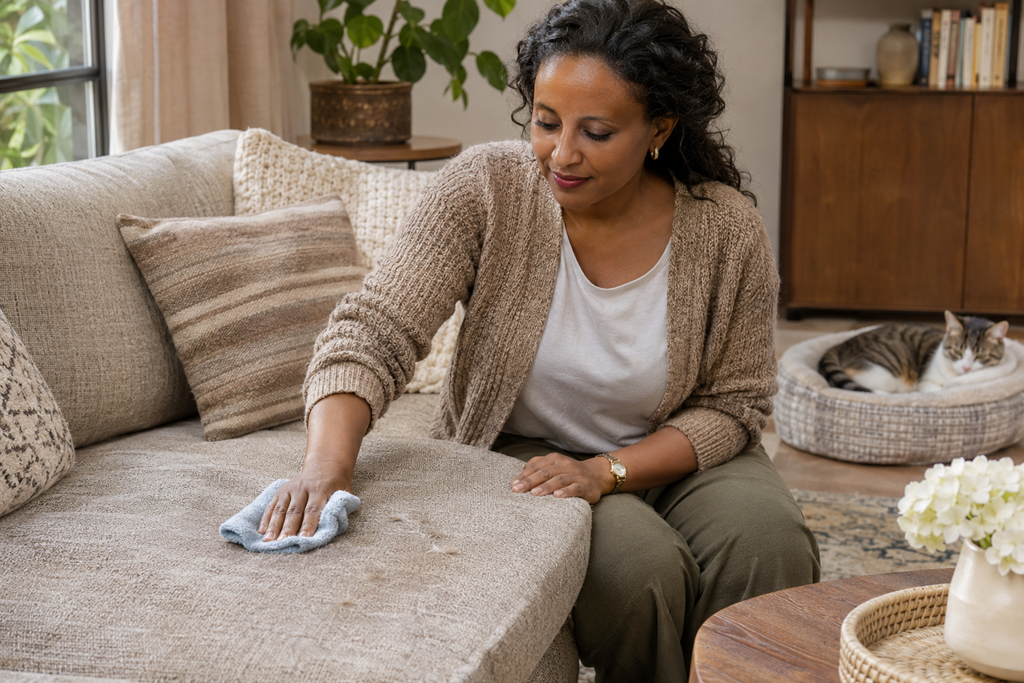
Try a clean, dry microfiber cloth
A soft microfiber cloth can help gather loose surface hair without introducing cleaning chemicals.
Move the cloth gently across a small section of upholstery and observe how the fabric responds.
Use light, controlled strokes rather than vigorous back-and-forth scrubbing.
On some surfaces, hair may collect into small groups that can then be lifted away by hand or vacuumed.
This method is particularly useful when the furniture needs only light maintenance rather than extensive hair removal.
If the cloth catches on the fabric or leaves visible changes in the surface, stop and choose another approach.
Consider an upholstery-compatible pet hair tool
Reusable pet hair removal tools are available in several forms, including fabric brushes and rollers designed to collect hair from household surfaces.
However, not every tool is appropriate for every upholstery material.
Some tools rely on textured surfaces, firm contact, or repeated brushing. Those mechanisms can be unsuitable for loose weaves, delicate fabrics, and upholstery with raised fibers.
Before using one:
- Check the tool manufacturer's stated surface compatibility.
- Confirm that the furniture manufacturer's instructions do not prohibit the method.
- Test it gently in a concealed area.
- Stop if the fabric snags, pills, stretches, or changes appearance.
A tool should help collect hair without requiring aggressive scraping.
If substantial pressure is necessary to make the tool work, it may not be a good match for that particular furniture fabric.
Use lint rollers selectively
A lint roller can be convenient for small amounts of visible hair on suitable upholstery.
It may be useful for touching up a chair cushion or cleaning an area where a pet rested briefly.
However, adhesive rollers should not automatically be used on every upholstery material.
Delicate finishes, loose fibers, and certain specialty fabrics may react poorly to repeated adhesive contact.
Test the roller first, avoid excessive pressure, and discontinue use if it pulls fabric fibers or leaves residue.
Lint rollers are generally better suited to light touch-ups than to repeatedly removing heavy buildup from an entire sofa.
Avoid techniques that create unnecessary fabric wear
Pet hair can be frustrating to remove, particularly when it remains visible after several attempts.
However, stronger cleaning is not necessarily better cleaning.
Several approaches deserve caution.
Aggressive scraping: Hard-edged scrapers or unsuitable grooming tools can catch threads, disturb the weave, or create visible wear.
Stiff brushing: Repeated brushing with coarse or rigid bristles may roughen the surface of certain fabrics, particularly delicate or loosely woven upholstery.
Excessive rubbing: Vigorous friction can contribute to pilling, flatten raised fibers, or change the appearance of textured material.
Unnecessary moisture: Wetting upholstery solely to loosen pet hair may create water marks, uneven drying, or other problems on materials that are sensitive to moisture.
Unapproved cleaning sprays: Fabric softeners, household sprays, and other improvised treatments should not be applied to upholstery without confirming compatibility. Removing hair usually does not require adding a chemical cleaning product.
Rubber gloves and damp cloths are sometimes suggested for collecting pet hair because they can create friction or help gather loose strands. However, they are not universally appropriate. Friction can disturb vulnerable fabrics, while moisture may be unsuitable for certain upholstery materials.
A dry, gentle approach is a better starting point unless the furniture's care guidance supports something different.
If hair remains embedded after reasonable attempts, continuing to scrape or scrub may cause more harm than leaving a small amount behind.
Pay attention to seams and cushion edges
Even after the main seating surfaces look clean, pet hair may remain along seams and in the narrow spaces between cushions.
These locations need a slightly different approach because the hair often collects in concentrated lines rather than spreading evenly across the fabric.
Start by gently separating removable cushions where the furniture's construction allows it.
Use a suitable vacuum attachment to collect loose hair from accessible creases and gaps.
For hair caught along piping, a soft cloth or upholstery-compatible brush may help loosen strands without pulling on the stitching.
Avoid inserting sharp objects into seams or using hard tools to dig hair out of narrow openings.
If the seam appears loose, damaged, or partially separated, avoid additional friction around that area.
Not every trapped strand needs to be removed immediately. Protecting the stitching and surrounding upholstery is more important than forcing a completely hair-free result.
Reduce how quickly pet hair builds up again
Furniture that pets use regularly will continue to collect hair.
Rather than expecting a one-time cleaning to eliminate the problem permanently, focus on making future maintenance less demanding.
One helpful approach is to remove loose hair before it becomes heavily embedded.
A brief cleaning of frequently used cushions may require less repeated friction than waiting until substantial buildup develops.
Other adjustments can also help.
Use washable furniture covers where appropriate
A removable, washable throw or furniture cover can create a separate surface for collecting loose hair.
This may be useful when a dog or cat consistently rests in the same location.
Choose a covering that fits securely without interfering with furniture use, and follow its washing instructions.
A cover can reduce direct contact between loose pet hair and the upholstery beneath it, although it will not prevent every strand from reaching the furniture.
Maintain the pet's coat
Routine grooming appropriate to the animal's coat can help manage loose hair before some of it reaches household furnishings.
Follow the grooming practices appropriate for the pet's breed, coat condition, and individual needs.
This does not eliminate shedding, but it can support a more manageable household cleaning routine.
Keep upholstery maintenance consistent
Furniture does not necessarily need deep cleaning every time pet hair appears.
A gentle vacuuming or light surface touch-up may be sufficient for ordinary shedding.
The appropriate frequency depends on how much the pet sheds, which furniture the pet uses, and how quickly hair becomes noticeable.
A consistent routine helps limit the need for forceful cleaning attempts later.
When ordinary pet hair removal is no longer enough
Most routine pet hair buildup can be managed without specialized professional cleaning.
However, certain furniture conditions deserve more caution.
If upholstery is unusually delicate, antique, or already damaged, repeated cleaning attempts may increase wear.
Visible snagging, weakened seams, pilling, or changes in fabric texture are reasons to stop using the method causing the problem.
Professional upholstery cleaning or fabric-care advice may be appropriate when the material requires specialized handling or when embedded hair cannot be addressed without potentially damaging the furniture.
It is also useful to distinguish pet hair from other problems.
Lingering odors, staining, and moisture-related concerns are different cleaning issues. Removing visible hair does not necessarily resolve them.
The appropriate response depends on the underlying condition and the upholstery's care requirements.
Keep the fabric's condition ahead of a completely hair-free appearance
Removing pet hair successfully does not mean forcing every strand out of the upholstery.
The more sustainable approach is to begin with gentle vacuuming, use compatible fabric-contact tools only when needed, and stop when a method begins to affect the surface.
For households with pets, protecting the furniture and maintaining it regularly are more useful goals than repeatedly applying aggressive cleaning methods.
If additional household cleaning supplies would support your routine, the Sacramento Local Pros Store has a Floor Care And Home Cleaning category where you can explore general cleaning supplies and accessories. Choose only items suitable for your furniture's care requirements.
Disclosure: Sacramento Local Pros may earn a commission from qualifying purchases made through links on the Sacramento Local Pros Store.
The most useful pet hair removal method is one that collects unwanted hair while leaving the fabric's texture, stitching, and appearance intact.