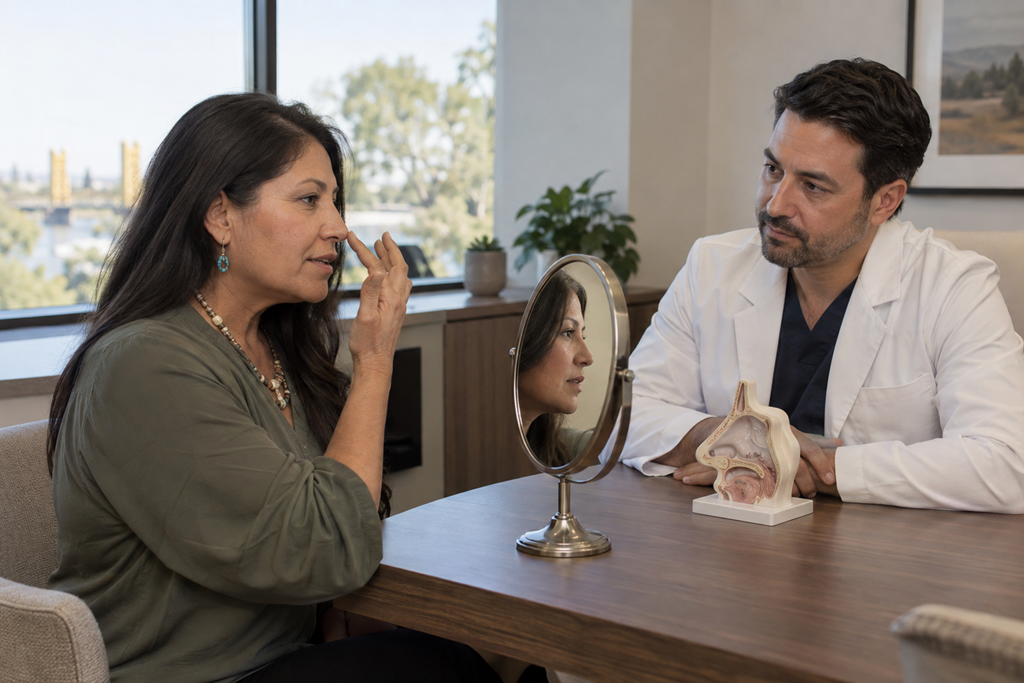
When someone is considering rhinoplasty and also has concerns about breathing, it can help to think of the consultation as more than a conversation about appearance alone. The key is to make both sets of concerns clear from the beginning so a qualified provider can evaluate them together, explain what may or may not be related, and discuss appropriate options for the individual situation.
That distinction matters because people do not always approach rhinoplasty with a single goal. Someone may be interested in changing the appearance of the nose while also wondering about ongoing nasal breathing difficulties. Another person may first seek help for breathing and then realize there are appearance questions they would also like to discuss.
For Sacramento-area residents preparing for a rhinoplasty consultation, the important point is not to decide for yourself whether the two concerns are connected. It is to make sure neither one gets lost in the conversation.
Appearance Goals And Breathing Concerns Are Different Questions
It can be tempting to think of rhinoplasty as either cosmetic or functional, with a clear line separating the two. Real consultations can be more nuanced.
A person might have a specific appearance goal while also noticing that breathing through the nose does not always feel as easy as expected. Those are two pieces of information worth discussing, but the presence of both does not automatically tell you what is causing the breathing concern or what type of care would be appropriate.
A qualified provider may need to evaluate the appearance of the nose, the person's concerns about airflow, relevant health history, prior injuries or procedures, and other individual factors before explaining what may be related.
That is why it is useful to describe what you are experiencing rather than arriving at the consultation with a self-diagnosis.
Start With What You Actually Notice
Before a consultation, think about the difference between what you know and what you suspect.
You may know, for example, that you dislike a certain aspect of your nasal profile. You may also know that breathing through your nose sometimes feels difficult or uneven.
What you may not know is why.
That uncertainty is normal. The purpose of a professional evaluation is partly to sort through those questions.
Instead of trying to decide which nasal structure is responsible or assuming that a cosmetic change will affect breathing in a particular way, describe the experience in straightforward terms. Explain what bothers you about appearance and separately describe what you have noticed about breathing.
This gives the provider clearer information to work with.
Do Not Assume One Goal Automatically Solves The Other
One of the easiest misunderstandings is assuming that changing the appearance of the nose will automatically improve a breathing concern.
The reverse assumption can also happen: someone may believe that addressing a breathing issue will automatically create the appearance change they want.
Neither conclusion should be taken for granted.
Rhinoplasty planning can involve individual anatomical, medical, and cosmetic considerations. A qualified provider can explain whether particular goals appear related, whether they should be evaluated separately, and what limitations or tradeoffs may need to be considered.
For the patient, the more useful question is not, “Will fixing one automatically fix the other?”
It is, “How do these two concerns affect the way my situation should be evaluated?”
That shift keeps the conversation focused on your actual goals rather than assumptions about the procedure.
Be Specific About What You Mean By A Breathing Concern
“Breathing problem” can mean different things to different people.
Someone may notice that one side of the nose seems easier to breathe through than the other. Another person may notice difficulty only during certain activities or at certain times. Someone else may simply feel that nasal breathing has never seemed as comfortable as expected.
You do not need to diagnose the reason yourself.
What can help is being able to explain what you notice, when you notice it, and whether anything seems to make it better or worse.
If you have previously discussed the issue with another healthcare provider, had prior nasal surgery, experienced an injury, or received relevant medical evaluation, that history may also be useful to mention.
The goal is not to build your own medical case. It is to give the provider enough context to understand what you are asking about.
Your Appearance Goals Deserve The Same Specificity
Breathing concerns can sometimes become the dominant subject once they are mentioned, but cosmetic goals should not become vague in the process.
Rather than saying only that you want your nose to “look better,” think about what has actually led you to consider rhinoplasty.
Perhaps you are thinking about the profile, overall proportions, the appearance from the front, or another feature you would like to discuss.
That does not mean you need to arrive with an exact surgical plan. In fact, deciding in advance what should physically be changed can make the consultation less useful.
Your role is to explain what you notice and what you hope to understand. The provider's role is to evaluate whether those goals are realistic and discuss what options, limitations, risks, and tradeoffs may apply to your situation.
A Good Consultation Should Leave Room For Both Conversations
When appearance and breathing concerns are both involved, it can be helpful to notice whether the consultation gives meaningful attention to each.
If most of the conversation focuses on appearance while your breathing questions receive little explanation, you may leave without understanding an important part of your decision.
The same is true in reverse. If a breathing concern is evaluated but your cosmetic goals are barely discussed, you may still be missing information you need before deciding whether rhinoplasty fits what you want.
You should have an opportunity to explain both.
That does not mean both concerns will necessarily have the same solution or carry equal importance medically. It simply means they should be acknowledged clearly enough for you to understand how the provider is thinking about them.
Ask How The Evaluation Will Separate What Is Known From What Is Assumed
A useful consultation should help replace assumptions with clearer information.
Questions that may help include:
- How will my breathing concerns be evaluated?
- Do my appearance goals and breathing concerns need to be considered together or separately?
- Are there parts of my concerns that require additional evaluation before discussing a surgical plan?
- What outcomes are realistic for the appearance changes I am considering?
- What limitations or tradeoffs should I understand?
- How could the proposed plan affect the way the nose functions?
- What risks and recovery considerations are important in my particular situation?
- Is there anything about my history that could affect the evaluation or planning process?
These questions are not a substitute for medical evaluation. They simply help keep the consultation centered on the issues that brought you there.
Be Careful With Before-And-After Thinking
Photos can help people describe aesthetic preferences, but they can also create unrealistic expectations if they are treated as predictions.
Another person's rhinoplasty result cannot show what will be appropriate or achievable for you, and an image cannot tell you how that person's breathing, anatomy, health history, or surgical considerations compare with yours.
The same caution applies when imagining your own outcome.
A consultation is more useful when the conversation focuses on your individual anatomy, goals, concerns, risks, and realistic possibilities rather than trying to duplicate someone else's appearance.
When breathing concerns are part of the picture, individualized evaluation becomes especially important because appearance alone cannot explain what is happening functionally.
Avoid Feeling Pressured To Simplify The Decision
Some people worry that mentioning breathing concerns will complicate a cosmetic consultation. Others may feel uncomfortable mentioning appearance goals when they originally sought help because of breathing.
You do not need to force your situation into one category before speaking with a qualified provider.
If both issues matter to you, say so.
The purpose of the consultation is to understand your situation more clearly before deciding whether to proceed. It is reasonable for that process to involve questions, further evaluation, or even recognition that different concerns may need to be handled differently.
A thoughtful decision does not require having everything figured out before the appointment.
Pay Attention To How Clearly The Provider Explains The Plan
Technical expertise matters, but communication also affects how well you can evaluate your options.
Listen for whether the provider clearly distinguishes between your cosmetic goals and your breathing concerns. You should be able to understand what is being evaluated, what remains uncertain, and what the proposed approach is intended to address.
Be cautious about relying on broad promises or assuming that a favorable cosmetic result automatically means a breathing concern will be resolved.
A qualified provider should be able to discuss realistic expectations, limitations, potential risks, recovery considerations, and unanswered questions without making guarantees.
If something remains unclear, asking another question is part of making an informed decision.
The Main Takeaway Before You Schedule
When rhinoplasty and breathing concerns overlap, you do not need to determine the medical connection yourself before seeking a consultation.
Your most useful preparation is to describe both concerns clearly, separate what you have personally noticed from what you are assuming, and give a qualified provider the opportunity to evaluate the situation.
For Sacramento-area residents comparing rhinoplasty providers or preparing for a consultation, that approach can make the conversation more useful. Instead of treating appearance and breathing as competing priorities, you can make sure both are understood before deciding what comes next.
Questions about candidacy, diagnosis, treatment, risks, recovery, breathing concerns, or expected outcomes should always be discussed with a qualified medical professional who can evaluate your individual situation.