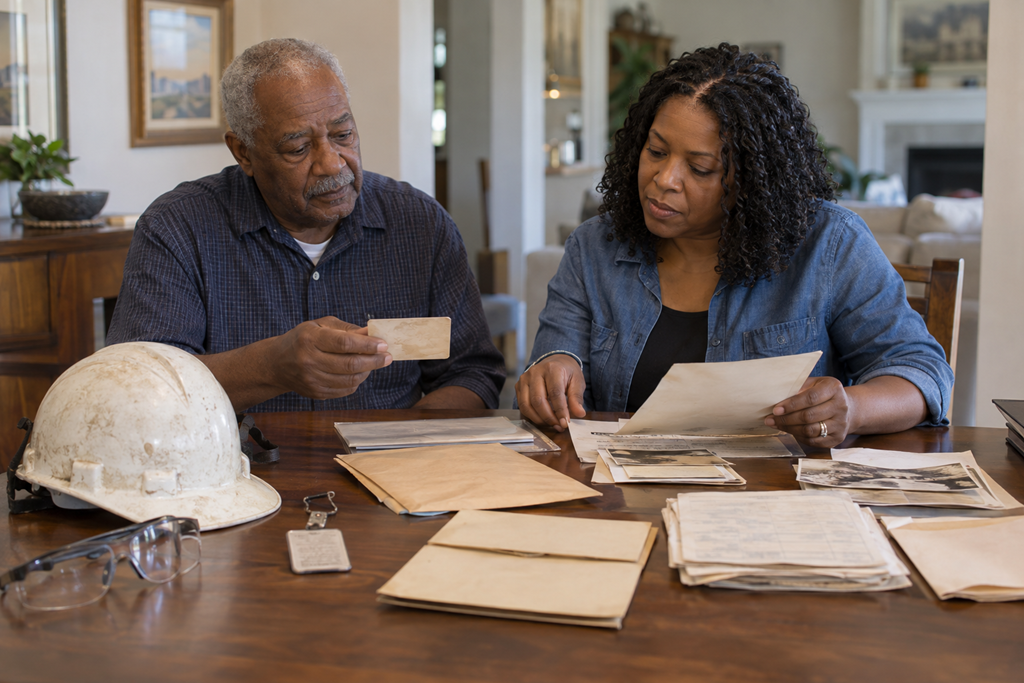
A person’s work history can be an important part of understanding a possible mesothelioma claim because it may help a legal professional identify where, when, and how asbestos exposure could have occurred. Families do not need to arrive with every detail already proven, but even partial information about past jobs, employers, worksites, trades, and coworkers can help make an initial legal conversation more focused.
For many families, however, reconstructing decades of employment is not simple. Job titles may have changed. Companies may no longer exist. A person may remember the work clearly but not the exact dates, product names, contractors, or companies that were present at a particular location.
That does not necessarily mean there is nothing useful to discuss. The goal at the beginning is usually to give a qualified attorney enough background to understand the employment history and determine what questions may require further investigation.
Work History Helps Put Possible Exposure Into Context
When an attorney evaluates a potential mesothelioma matter, work history can help create a timeline of places and circumstances that may be relevant.
A job title by itself may tell only part of the story. Two people with the same title could have worked in very different environments. What may be more informative is where the person worked, what the workplace was like, what tasks occurred nearby, what materials were present, and who else was working at the site.
For example, a family may remember that someone worked in maintenance, construction, manufacturing, transportation, utilities, shipyards, mechanical work, or another trade. But the more useful discussion may involve what that person actually did during a normal day and what other work was happening around them.
The purpose is not for the family to determine whether a particular job legally caused an illness. That is something a qualified attorney can investigate and evaluate based on the specific facts.
A Perfect Employment Timeline Is Not Required To Start Asking Questions
One of the easiest misunderstandings is assuming that every employer, date, jobsite, and product must already be identified before speaking with a lawyer.
Families may instead begin with what they reasonably know.
That could include approximate years, employer names, job titles, cities, work locations, major projects, supervisors, coworkers, contractors, or descriptions of routine job duties.
Someone might remember working for a company for several years without remembering the exact starting month. Another person may clearly remember a particular plant, construction project, warehouse, shop, or maintenance department but have difficulty remembering the names of every company operating there.
Those gaps are important to acknowledge rather than guess about.
An attorney can explain which missing details matter and whether additional records or investigation may help clarify them.
Small Work Details May Be More Useful Than Families Expect
Memories that initially seem ordinary can sometimes provide helpful context.
A person may remember working around insulation, pipes, boilers, machinery, construction materials, repair work, dust-producing activities, protective equipment, or coworkers performing particular trades nearby. They may remember changing jobs, moving between facilities, or spending part of their career at temporary project sites.
Family members may also remember conversations about work, uniforms brought home, repeated employers, major projects, or periods when the person traveled for a job.
None of these details should be treated as proof on their own. They can, however, give a legal professional additional places to begin asking questions.
This is one reason a conversation about work history is often more useful than simply creating a list of employer names.
Family Members Can Sometimes Help Reconstruct Missing Pieces
When years or decades have passed, one person may not remember everything independently.
A spouse might remember when the family moved because of a new job. An adult child may remember the name of a company printed on work clothing or the general area where a parent worked. A sibling may remember an earlier employer or trade that other relatives had forgotten.
Old household records may also refresh memories.
These recollections should be treated as pieces of a larger history rather than definitive conclusions. Different family members may remember dates or details differently, and that is normal.
It is usually better to identify uncertainty openly than to force everyone’s memories into an exact timeline that may not be accurate.
Existing Records Can Help Organize The Conversation
Families do not necessarily need to conduct their own extensive investigation before contacting an attorney.
If employment-related information is already available at home, though, it can be useful to gather it in one place.
That might include old resumes, tax or employment paperwork, pension information, job photographs, work identification, correspondence, certificates, personnel documents, or other records that show employers, locations, trades, or time periods.
The point is not to create a legal case file on your own.
The simpler goal is to preserve information that may help a lawyer understand the work history and recognize where additional questions could be useful.
For Sacramento-area families, bringing an organized but imperfect collection of what is already available may be more practical than delaying a consultation while trying to reconstruct every year independently.
Avoid Filling Gaps With Assumptions
When families know that employment history matters, it can be tempting to search for a complete explanation immediately.
That can create confusion if assumptions begin replacing memories.
For example, knowing that someone worked at a certain facility does not automatically establish what materials they personally encountered. Remembering a particular trade does not necessarily establish which products were present during a particular period.
Similarly, information found online about another worker or another location may not describe the circumstances of an individual case.
A more useful approach is to separate what the family knows from what remains uncertain.
An attorney can then determine what information deserves further investigation rather than beginning with conclusions that may later prove inaccurate.
Questions Worth Asking During A Legal Consultation
A consultation can be an opportunity to understand how the attorney approaches incomplete work histories.
Families might ask:
- Which parts of the work history are most useful for your initial evaluation?
- What should we do if exact employment dates are unavailable?
- Can your office help investigate former employers or worksites?
- Are coworkers or family recollections potentially useful?
- What existing documents would you like us to bring or preserve?
- What information should we avoid guessing about?
The answers can also help a family understand how much investigative work the law firm expects the client to handle and how much the firm may handle itself.
Work History Is One Part Of A Larger Legal Evaluation
Employment information can be important, but families should not assume they can determine the strength, eligibility, value, or outcome of a mesothelioma claim simply by identifying a possible workplace exposure.
Legal rights can depend on circumstances that go beyond a person's job history.
A qualified mesothelioma attorney can evaluate the facts, explain what additional information may be relevant, and provide advice about the specific situation.
That distinction can take some pressure off the family. The immediate task does not have to be proving the entire matter. It can simply be preserving what is known well enough for a knowledgeable professional to begin evaluating it.
A Useful Starting Point Is An Honest History
When a family is trying to understand whether past employment may matter to a mesothelioma claim, an incomplete work history is still a starting point.
Employer names, worksites, job duties, approximate dates, coworkers, projects, and existing records can help provide context. Just as importantly, identifying what the family does not know can prevent assumptions from becoming confused with facts.
Before a Sacramento-area family makes decisions about legal representation, a consultation with a qualified attorney can help clarify which parts of the work history matter, what may require additional investigation, and what the family realistically needs to provide.