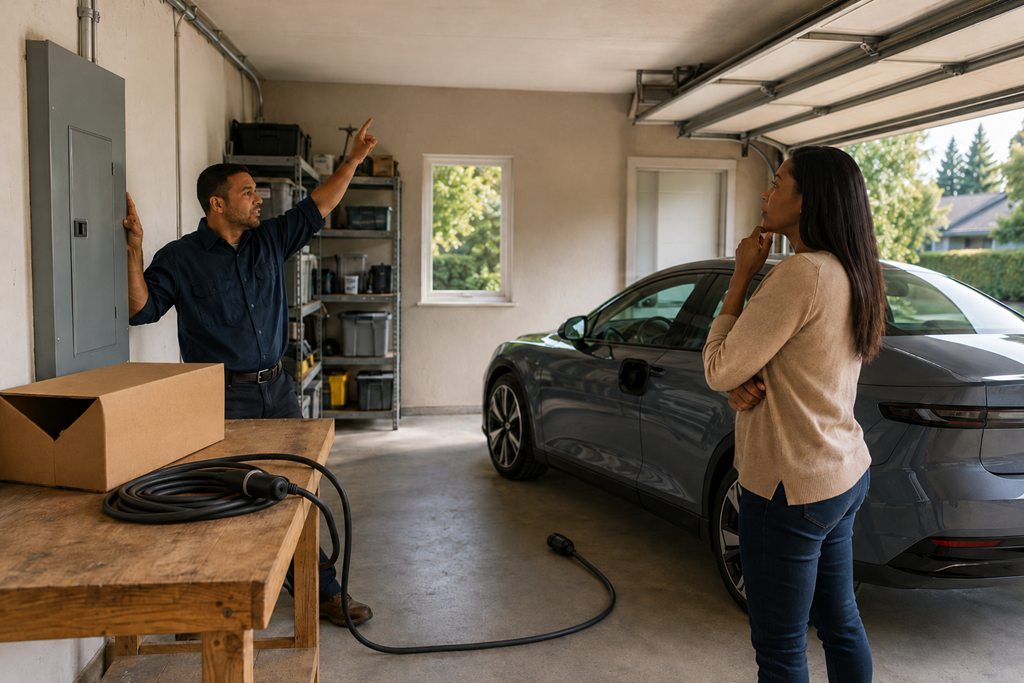
Setting up home EV charging is not simply a matter of choosing a charger and attaching it to the nearest wall. For Sacramento-area EV owners, the better starting point is to understand how the vehicle, daily driving routine, parking location, electrical system, and future plans fit together before requesting installation quotes.
This distinction matters because two homeowners with similar electric vehicles may need very different charging setups. One may have a short commute, predictable overnight parking, and an existing outlet that meets everyday needs. Another may drive farther, park outdoors, share the charger with a second vehicle, or need electrical work before faster charging can be added.
The most useful home charging setup is not necessarily the fastest or most expensive option. It is the one that safely and reliably replaces the energy you normally use while fitting the property and the way you live.
Start With Your Actual Charging Routine
Many EV owners begin by looking at charging equipment before thinking about how much charging they really need. That can make the decision feel more technical and expensive than it has to be.
A more useful question is: How much driving does the vehicle normally need to recover from while it is parked at home?
Some drivers use only a small portion of the battery during a typical day and leave the vehicle parked overnight for many hours. Others have long commutes, irregular schedules, frequent regional trips, or limited time between arriving home and leaving again.
These differences affect whether charging from an existing household outlet might be adequate or whether a dedicated Level 2 installation is worth discussing with a qualified professional.
The goal is not to install the most powerful option available simply because it is available. The goal is to establish dependable charging that supports the owner’s normal routine without creating unnecessary complications.
The Charger Is Only One Part of the Project
It is easy to focus on the charging unit because it is the most visible part of the setup. However, the equipment itself may represent only one part of the installation decision.
A professional evaluation may also consider:
- The home’s available electrical capacity
- The location and condition of the electrical panel
- The distance between the panel and the parking space
- Whether the vehicle is parked inside or outside
- The location of the vehicle’s charging port
- How the cable will reach the vehicle without crossing a walkway
- Whether walls, ceilings, concrete, landscaping, or other obstacles affect the route
- Whether future electrical changes are reasonably anticipated
These details help explain why a project that appears simple from the driveway may require a closer look before anyone can describe the full scope accurately.
They also explain why estimates from different providers may vary. One provider may be pricing only the charger installation, while another may be accounting for additional electrical work, a longer circuit route, weather-resistant placement, or permit and inspection coordination when applicable.
Faster Charging Is Not Automatically Better Charging
Charging speed is often treated as the main measure of a home charging system. In practice, more capacity is useful only when it meaningfully serves the household.
A higher-capacity charger may sound more future-ready, but the vehicle may not accept the full output. The electrical system may also require additional work to support it. Meanwhile, a more modest setup may still restore the owner’s typical daily driving well before the next departure.
This does not mean Sacramento EV owners should always choose the smallest option. It means charging speed should be matched to a realistic need rather than selected as a status feature.
A useful provider should be able to explain the relationship between the vehicle, the proposed equipment, the electrical system, and the owner’s routine in understandable terms. The recommendation should make sense even after the technical language is removed.
Parking Layout Can Change What “Simple” Means
The same charger can work very differently depending on where the vehicle is parked.
A garage installation may appear straightforward until cabinets, doors, storage areas, or the location of the vehicle’s charging port are considered. An outdoor driveway installation may need to account for cable reach, sun exposure, seasonal rain, accidental impact, and the path people use to enter the home.
Placement should be considered with the vehicle parked as it normally will be, not as it happens to be positioned during the estimate.
A cable that reaches today’s vehicle only when it is backed into a particular corner may become inconvenient later. A charger mounted beside the wrong end of the vehicle may force the cord across the garage floor or a walking path. An outdoor unit placed in direct Sacramento sun may also have different location considerations than one installed in a shaded or protected area.
The charger should fit the parking routine rather than requiring the household to rearrange itself around the charger every day.
Renters and Shared Properties May Have Additional Decisions
Home charging is not limited to detached homeowners, but renters, condominium residents, and people with assigned parking may need to clarify additional responsibilities before seeking installation.
The electrical panel serving the residence may not be close to the parking space. The proposed route may cross a shared area. Property-management or association approval may be needed before work begins. Questions may also arise about who owns the installed equipment and what happens if the resident moves.
These issues do not necessarily prevent home charging. They simply mean the property relationship should be understood before selecting equipment or accepting a quote.
A provider who evaluates only the vehicle and ignores the parking arrangement may be overlooking an important part of the project.
Think Beyond the Vehicle in the Driveway Today
Future planning can be useful, but it should remain realistic.
A household may expect to add a second EV, replace the current vehicle, rearrange the garage, install solar equipment, or make other electrical improvements. Mentioning those possibilities during an evaluation can help a professional explain whether the proposed setup leaves reasonable flexibility.
However, “future-proofing” should not become a vague reason to approve every available upgrade.
The better question is whether a proposed feature supports a likely household need. Preparing for a second EV that the family expects to purchase may be reasonable. Paying for substantially more capacity because an installer says it might be useful someday deserves a clearer explanation.
Good planning considers the future without losing sight of the current purpose of the project.
What a Useful Home Charging Assessment Should Clarify
Before comparing proposals, Sacramento-area EV owners should understand what each provider believes the project includes.
A productive conversation may clarify:
- What charging performance is actually needed for the owner’s routine
- Whether the proposed equipment is compatible with the vehicle
- What the provider observed about the electrical system
- Where the charger will be mounted and why
- How the wiring route affects the scope
- Whether the quote includes the equipment, installation labor, electrical changes, restoration work, and applicable coordination
- What assumptions could change the final cost
- Whether future expansion was considered
- Who is responsible for explaining equipment operation and warranty coverage
The provider does not need to bury the homeowner in technical details. The homeowner should still be able to describe what is being installed, where it will go, why it fits the property, and what is included in the price.
Similar Prices Can Cover Different Work
A lower quote is not automatically a better value, and a higher quote is not automatically more complete.
One estimate may assume the existing panel can support the installation without modification. Another may include a more detailed evaluation or a longer circuit route. One may include wall repair or trench restoration, while another may leave those items outside the quoted scope.
Equipment can also be handled differently. The homeowner may purchase the charger separately, the installer may supply it, or the proposal may allow several compatible choices.
Comparing only the total at the bottom of each estimate can hide these differences. The more useful comparison is between the assumptions, equipment, installation route, included work, and responsibilities described by each provider.
When two quotes differ significantly, asking each provider to explain the scope in plain language is more informative than asking only whether the other price can be matched.
Watch for Explanations That Arrive Too Quickly
Home charging projects vary, so a firm recommendation made without asking about the vehicle, routine, parking space, or electrical system may deserve a closer look.
Other communication concerns may include:
- Pressure to choose the largest charging setup without a clear reason
- A proposal that does not identify the equipment or installation location
- Important electrical assumptions that are not reflected in the estimate
- Unclear answers about what happens if additional work is discovered
- Dismissive responses to questions about permits, inspections, or property approval when those issues may apply
- Encouragement to perform unfamiliar electrical work independently to reduce the quote
- Promises that every installation is simple before the property has been evaluated
A provider does not need to predict every possible complication. However, the provider should be willing to distinguish what is known, what is assumed, and what still needs to be checked.
Dependable Home Charging Is the Real Goal
The best home charging decision is usually not the one with the largest electrical number or the most elaborate equipment. It is the setup that fits the vehicle, replaces the energy the owner normally uses, works with the parking space, and has a clearly explained installation scope.
Before hiring a local professional, Sacramento EV owners can benefit from describing their real driving routine, parking the vehicle in its normal position, and asking how the recommendation connects to the property’s electrical system.
When those pieces are considered together, home charging becomes easier to evaluate. The decision is no longer simply which charger to buy. It becomes a practical conversation about what the household needs, what the property can support, and what work is actually included.