During hot weather, pool owners should watch for changes in water level, clarity, surface condition, circulation, and equipment behavior. Heat does not automatically mean something is wrong, but it can make small problems show up faster. The goal is to notice unusual changes early enough to ask informed questions before a minor issue becomes a larger service call.
A pool may look perfectly normal one afternoon and slightly different the next morning. The water might appear duller, the level may seem lower, or debris may begin collecting in an area that usually stays clear. These changes do not always point to a serious problem, but they can provide useful clues about how the pool is responding to heat, sunlight, heavier use, and changing maintenance demands.
Hot Weather Can Magnify Conditions That Were Already Developing
Heat is not necessarily the original cause of every pool concern. It often makes an existing condition easier to notice.
A circulation issue that was barely affecting the pool may become more visible when the water is warmer. A filter that was already collecting debris may struggle to keep the water looking as clear as usual. A small water-loss concern may stand out more when evaporation is also occurring.
This is why Sacramento-area pool owners may benefit from looking for patterns instead of assuming that every change is simply caused by the weather.
The most useful question is often not, “Is the heat doing this?” but, “Is the pool behaving differently than it normally does under similar conditions?”
A Lower Water Level Deserves Context
Some water loss is expected during hot, dry, or windy conditions. Swimming, splashing, routine maintenance, and evaporation can all affect the water level.
What matters is whether the change seems consistent with the pool’s normal pattern.
A water level that repeatedly drops faster than expected, requires unusually frequent refilling, or falls even when the pool has not been used may be worth discussing with a pool professional. Damp areas near equipment, unexplained water around the pool structure, or a refill system that appears to run more often may also deserve attention.
A single observation may not reveal much. Watching whether the same pattern continues can provide a service professional with more useful information than relying on one hot afternoon.
Cloudy Water Is Not Always Just a Cosmetic Issue
Pool water does not have to turn green before something deserves attention.
Early changes may include:
- A faint haze that becomes more noticeable in deeper water
- Reduced visibility compared with the pool’s usual appearance
- Small particles remaining suspended in the water
- A dull or uneven appearance across the surface
- Debris settling in areas that normally stay clear
Cloudiness can be connected to several different factors, including filtration, circulation, debris, water balance, swimmer activity, or a combination of conditions. The appearance alone does not confirm the cause.
That distinction matters when speaking with a pool service provider. Instead of asking only for something that will “clear the water,” ask what may be preventing the pool from staying clear in the first place.
Notice Whether Water Is Moving Normally
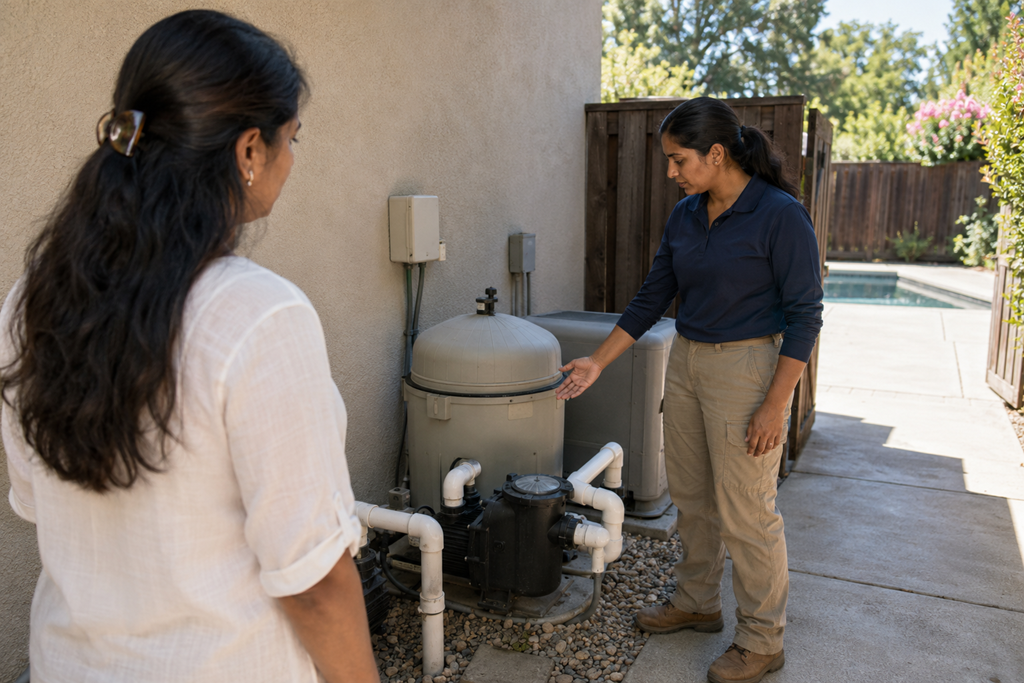
Pool owners do not need to diagnose circulation equipment themselves, but they can notice when the pool seems to be behaving differently.
Changes worth mentioning may include weaker-looking movement near return areas, debris repeatedly gathering in the same corner, unusual air bubbles, inconsistent skimming, or a pump that sounds noticeably different from its normal operation.
These observations can help a qualified professional determine whether the issue may involve routine maintenance, blocked flow, filtration performance, equipment operation, or another condition requiring evaluation.
Avoid opening, adjusting, or repairing unfamiliar pool equipment while it is operating. Equipment areas may involve electricity, pressure, moving components, and plumbing connections that should be handled appropriately.
The Pool Surface Can Offer Early Clues
The walls, steps, tile line, and shaded areas of the pool may show changes before the entire pool looks affected.
Watch for recurring discoloration, unusual residue, slippery areas, staining that appears to be spreading, or buildup that returns soon after normal service. Also notice whether one section of the pool consistently looks different from the rest.
A shaded corner with reduced water movement may behave differently from a sunny, open section. That does not automatically mean the pool is being maintained incorrectly. It may mean the provider needs to evaluate how sunlight, circulation, debris, and the pool’s layout are interacting.
Describing exactly where a change appears is often more useful than simply saying that the pool “doesn’t look right.”
Heavier Pool Use Can Change Maintenance Needs
Hot weather often brings more swimming, outdoor gatherings, sunscreen, landscaping debris, and repeated entry into the pool.
A maintenance routine that worked well during quieter periods may need to be reviewed when pool use increases. This does not necessarily mean that the service provider has missed something. It may mean that the conditions affecting the pool have changed.
Before assuming that more chemicals or a major repair is needed, ask whether recent use, debris, filtration demands, or service timing could be contributing to the problem.
The objective is to understand what changed and whether the existing service approach still matches the way the pool is being used.
One Symptom Rarely Tells the Whole Story
A lower water level does not automatically prove there is a leak. Cloudy water does not automatically mean the filter has failed. Debris in one corner does not necessarily mean the pump needs replacement.
Pool conditions are often connected.
For example, reduced circulation may affect how debris moves, how evenly water is treated, and how clear certain areas remain. Heavy use may place additional demand on water treatment and filtration. A maintenance concern may become more visible during a stretch of intense sun without being caused entirely by the heat.
This is why a professional evaluation should focus on the overall pattern rather than one isolated symptom.
When a Professional Evaluation May Be Worth Discussing
Consider contacting a qualified pool service provider when a change is persistent, worsening, or clearly different from the pool’s normal behavior.
Examples include water that remains cloudy after regular service, repeated unexplained water loss, equipment that starts and stops unexpectedly, unusual sounds, visible leaks near the equipment area, recurring surface growth, or debris that no longer moves toward the skimmer as expected.
A professional can help determine whether the concern is part of normal hot-weather maintenance, a service-frequency issue, an equipment problem, a possible leak, or something that should be evaluated by a specialist.
The goal is not to assume the most expensive explanation. It is to identify the most reasonable next step based on what is actually happening.
Questions to Ask a Pool Service Provider
A few focused questions can make a service conversation more useful:
- Which changes appear consistent with hot weather, and which seem unusual?
- Does the water appear to be circulating and filtering normally?
- Could recent pool use or debris be affecting the condition?
- Does the water-loss pattern warrant further evaluation?
- Is the current service schedule still appropriate for the pool’s use?
- What should I continue watching after the visit?
- Is any recommended work included in routine service, or would it require a separate estimate?
A clear provider should be able to explain what was observed, what may be contributing to it, and why a particular next step is being suggested.
Watch for Changes, Not Perfection
A pool does not need to look exactly the same every day to be functioning properly. Weather, use, wind, landscaping, and maintenance timing can all create temporary differences.
The more useful habit is noticing changes that are unusual for your pool, especially when several signs appear together or the same concern keeps returning.
By paying attention to water level, clarity, circulation, surfaces, and equipment behavior, Sacramento pool owners can give service providers better information and make more informed decisions about whether routine maintenance, closer monitoring, or professional evaluation is appropriate.