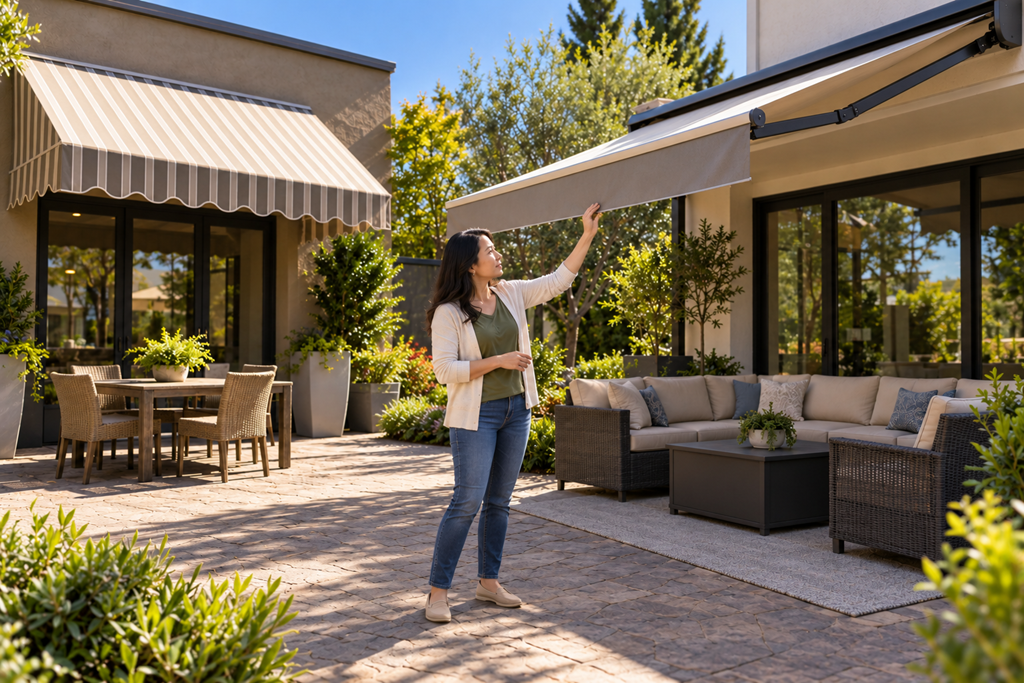
Adding an awning can make a patio, deck, window, or outdoor seating area more comfortable, but choosing one involves more than finding a design that looks attractive. Sacramento-area homeowners should consider where shade is needed, how the space is used, whether the home's structure can support the proposed installation, and what maintenance the awning may require. Understanding these factors before requesting estimates can help you determine which options deserve closer consideration.
An awning can change how a particular part of your home looks and functions. Depending on its design and placement, it may provide shade over an outdoor sitting area, help reduce direct sunlight reaching certain windows, or create a more defined space near an entrance.
However, an awning that works well on one property may not be appropriate for another. The amount of sunlight, available mounting surfaces, nearby obstacles, desired coverage, and exposure to wind and rain can all influence the decision.
For homeowners considering an awning installation in the Sacramento area, the most useful starting point is understanding what the awning is supposed to accomplish and what conditions could affect its performance.
Start with the area you actually want to shade
Before comparing awning styles or contacting installation companies, identify the specific problem you want the awning to address.
A homeowner who wants shade over a frequently used patio has different priorities from someone who wants to reduce direct sunlight through a west-facing window. An awning over an entrance may need to accommodate a doorway, while one above an outdoor dining area needs to account for furniture placement and how people move through the space.
These distinctions matter because an awning's location, dimensions, projection, and design should relate to its intended use.
Think about when the shade is needed
The sun's position changes throughout the day and across the seasons. A space that receives strong afternoon sunlight may have different shading needs from one primarily exposed during the morning.
Consider:
- When the area receives the most direct sunlight.
- Which times of day the space is normally occupied.
- Whether the main goal is to shade people, furniture, windows, or an entrance.
- How the desired shaded area changes as sunlight moves.
- Whether nearby trees, buildings, or rooflines already provide partial shade.
For example, if you mainly use your patio in the late afternoon, shade that looks sufficient during a morning measurement may not cover the area when you need it most.
An awning installer can help evaluate the proposed location and explain how dimensions, placement, and projection may influence shade coverage.
Consider how people use the space
The awning should work with the activities taking place underneath or around it.
For a patio, think about the location of tables, chairs, walkways, doors, and outdoor equipment. A shade structure that covers the center of a patio but leaves a frequently used seating area exposed may not accomplish what you intended.
Also consider whether the awning might interfere with:
- Opening doors or windows.
- Existing exterior lighting.
- Outdoor fans or other installed features.
- Normal movement through the area.
- Access to nearby gates or pathways.
- Future improvements to the outdoor space.
The goal is not simply to cover the largest possible area. It is to create useful shade without introducing avoidable access or usability problems.
Understand the differences between awning types
One of the most important decisions is whether a fixed or retractable awning makes more sense for your property.
Both can provide shade, but they differ in flexibility, operating requirements, maintenance considerations, and how they interact with the home's exterior.
Fixed awnings
A fixed awning remains in place rather than being extended and retracted as needed.
Fixed designs may be appropriate for areas where the homeowner wants a consistent shade structure, such as certain windows, entrances, or patios.
Potential advantages include a straightforward day-to-day arrangement without routinely extending or retracting the awning.
However, fixed awnings remain exposed to weather conditions throughout the year. Their suitability depends on their design, materials, location, structural support, and the environmental conditions they are intended to withstand.
Homeowners should also consider whether permanent coverage might reduce desired sunlight during cooler periods.
Retractable awnings
A retractable awning can be extended when shade is wanted and retracted when it is not.
Some operate manually, while others use a motorized system. Depending on the model, additional control features may be available.
Retractable designs can be appealing when a homeowner wants flexibility between an open outdoor area and a shaded one.
However, that flexibility comes with additional considerations.
You may need to think about how frequently the awning will be operated, who will operate it, what happens if the mechanism requires service, and whether the awning needs to be retracted under particular weather conditions.
Retractable does not automatically mean more durable, and fixed does not automatically mean more practical. The better fit depends on your actual needs and the proposed installation.
Compare the options according to daily use
Consideration | Fixed awning | Retractable awning |
|---|---|---|
Shade availability | Remains in place | Available when extended |
Flexibility | Limited after installation | Can be extended or retracted |
Operation | Generally no routine extension or retraction | Requires manual or powered operation |
Weather exposure | Remains exposed | May be retractable during unsuitable conditions |
Maintenance | Depends on materials and design | Includes materials and any operating components |
Main planning question | Is permanent coverage desirable? | Will adjustable coverage be useful enough to justify the added complexity? |
This comparison provides a starting point, not a substitute for reviewing the specifications of particular products.
The appropriate weather limits and maintenance requirements should always be confirmed for the actual awning being considered.
Evaluate whether the proposed location can accommodate an awning
An awning may look simple from the outside, but installation involves more than attaching a shade cover to an exterior wall.
The home's construction, available attachment surfaces, proposed awning dimensions, and nearby building features can influence what is practical.
The mounting surface matters
Not every exterior wall or roofline offers the same installation conditions.
The visible surface may be stucco, siding, brick, or another material, but the installer needs to determine whether the underlying construction and proposed attachment method can adequately support the specific system.
An awning creates loads that must be considered, including those associated with its own weight and expected environmental exposure.
Homeowners should not assume that an attractive installation location is structurally suitable simply because there appears to be enough wall space.
A qualified installer should assess the proposed mounting conditions and explain whether additional evaluation or a different installation approach is necessary.
Look for nearby obstacles
The position of an awning can be affected by features that are easy to overlook during early planning.
These may include:
- Roof overhangs and gutters.
- Exterior light fixtures.
- Doors and operable windows.
- Downspouts.
- Electrical equipment or wiring.
- Existing patio covers or other structures.
- Trees and landscaping close to the planned coverage area.
These features do not necessarily prevent installation, but they may influence placement, dimensions, access, or project scope.
A professional site assessment is particularly useful when the mounting area contains multiple architectural features or limited clear space.
Think about how far the awning will extend
The width of an awning and the distance it projects outward affect the area it can shade.
A larger awning is not necessarily a better choice.
The proposed projection needs to work with the mounting height, surrounding space, product design, structural conditions, and intended use.
For example, a deep projection may appear attractive when viewed in isolation but could be inappropriate where the mounting area or available clearance is limited.
Ask the installer to explain how the proposed dimensions relate to your actual shade goals, rather than selecting a size based only on appearance.
Account for Sacramento sun and changing weather
Sacramento-area homeowners often consider awnings because they want more usable shade during warm, sunny conditions.
Sun exposure is an important part of the decision, but it should not be the only environmental consideration.
An awning is an exterior feature that may also encounter wind, rain, seasonal changes, and accumulated outdoor debris.
Shade performance depends on placement
Awnings can help block some direct sunlight, but the extent of that benefit varies.
Coverage depends on factors such as:
- Awning dimensions and projection.
- The orientation of the installation area.
- The sun's position.
- Fabric or covering characteristics.
- The slope and design of the awning.
- Nearby structures and existing shade.
An awning that provides useful midday shade may allow sunlight to reach part of the same space when the sun is lower.
This is why observing your property at the times you intend to use the shaded area is more useful than assuming that any overhead cover will solve the problem.
Wind deserves separate attention
Awnings are not all designed to tolerate the same wind conditions.
The product type, size, installation method, and manufacturer's specifications influence appropriate use.
This matters particularly for retractable awnings, which may need to be retracted when conditions exceed their operating limits.
Some motorized systems offer wind-responsive features, but their presence should not be interpreted as a guarantee of protection.
Ask what weather-related operating instructions apply, whether there are restrictions on leaving the awning extended, and what responsibilities the homeowner has during changing conditions.
Rain protection should not be assumed
A shade awning is not necessarily a rain shelter.
Some awning materials and designs may resist certain amounts of moisture, but that does not mean the installed system is intended to function as a permanent waterproof roof.
Rain-related performance can depend on the product, slope, fabric, drainage design, and the manufacturer's limitations.
If rain coverage is one of your main goals, state that clearly before comparing products.
An installer should explain whether the awning under consideration is suitable for that purpose or whether another type of exterior covering would be more appropriate.
Choose materials with appearance and upkeep in mind
Fabric, metal, and other covering materials can differ in appearance, shade characteristics, cleaning requirements, and long-term maintenance.
The material decision should account for more than the color that looks best against your home.
Fabric awnings
Fabric awnings are available in different colors, patterns, constructions, and performance characteristics.
Some products are designed with particular attention to sunlight exposure, color retention, or moisture resistance.
However, performance varies by product. Homeowners should review the specific fabric characteristics rather than assume that all exterior awning fabrics offer the same protection or useful life.
Questions worth asking include:
- What is the fabric intended to resist?
- What cleaning methods are recommended?
- How should the fabric be handled when wet?
- Is replacement fabric available for this model?
- What conditions or maintenance practices could affect warranty coverage?
Color choice also has practical implications.
A fabric that coordinates well with the exterior should still be evaluated for the shade and light characteristics you want.
Metal and other rigid coverings
Some fixed awnings use metal or other rigid materials instead of flexible fabric.
These products can offer a different appearance and may require different maintenance practices.
Depending on the design, relevant considerations may include surface finishes, corrosion resistance, water management, and the way the structure integrates with the home.
A rigid covering should not automatically be treated as maintenance-free or suitable for every exposure condition.
Its design and installation requirements still matter.
Think beyond the initial appearance
When reviewing samples, consider how the awning may look and function after years of ordinary exposure and use.
Ask about cleaning, replacement components, finish care, and any limits on recommended maintenance methods.
A material that looks attractive in a showroom may require a level of upkeep you would rather avoid.
Conversely, a more expensive material may offer characteristics you do not actually need.
The goal is to choose a product whose appearance, performance, and ownership requirements fit your preferences.
Decide how much convenience you want from the operating system
For a retractable awning, the operating system deserves consideration before you select a model.
Manual and motorized systems can provide different experiences, even when the shade coverage is similar.
A manually operated awning typically requires someone to extend or retract it using the provided mechanism.
A motorized design may make everyday operation more convenient, particularly when the awning will be adjusted frequently.
However, motorization introduces additional components and may involve electrical work, service requirements, or controls that need to be understood.
Consider who will use the awning
Think about the people in your household and how the awning will be operated.
For example, if several household members will adjust it regularly, ease of operation may matter more than it would for an awning that is rarely moved.
Ask for a demonstration of the actual operating method when possible.
You should understand what normal operation involves, what to do if the system stops working, and whether there is a manual override or other manufacturer-approved procedure.
Avoid assuming that motorized operation eliminates the need to monitor weather conditions.
Review optional features realistically
Depending on the product, features may include remote controls, sensors, lighting, or other accessories.
These may improve convenience for some households, but they can also affect price, installation scope, maintenance, and future service needs.
Consider each feature according to whether it supports a real use.
For instance, an optional control system may be worthwhile if you expect to adjust the awning frequently, but less important if your main goal is occasional afternoon shade.
You do not need every available feature to obtain a suitable awning.
Consider how the awning will affect your home's appearance
An awning becomes part of the exterior visual composition of the property.
Even when its primary purpose is functional, its proportions, color, mounting location, and profile can influence how the home looks.
Match the design to the building
Consider the relationship between the proposed awning and existing exterior features.
An awning that is disproportionately large may dominate a small patio or window area, while an undersized design may not provide the desired coverage.
Look at the proposed awning in relation to:
- Windows and doors.
- Rooflines and architectural details.
- Exterior wall colors.
- Existing shade structures.
- Patio dimensions and outdoor furniture.
- Landscaping and outdoor circulation.
The objective is not necessarily to match every existing material or color. It is to choose a design that looks intentional and works with the building.
Ask to see relevant completed installations
Photographs of completed projects can help you understand how a particular style looks when installed on an actual property.
Try to review examples with similar architectural conditions, not just attractive finished projects.
A large retractable awning mounted above a spacious patio may not tell you much about how the same product would work above a smaller exterior area.
Relevant examples can help you compare proportions, mounting approaches, visual impact, and the overall appearance of different styles.
Understand what can influence installation cost and project scope
Awning installation costs can vary for reasons that are not immediately obvious from a product photograph.
Two homeowners choosing a similar-looking awning may have different project requirements because of the installation conditions and selected features.
Common cost influences may include:
- Awning dimensions.
- Fixed versus retractable design.
- Covering and frame materials.
- Manual or motorized operation.
- Additional controls or accessories.
- Installation access and mounting complexity.
- Structural assessment or additional work when needed.
- Electrical work where applicable.
- Removal of an existing awning, if included.
- Product customization and installation labor.
These factors do not mean every project will involve substantial additional work. They explain why an estimate should reflect the actual property and proposed system.
Distinguish the awning price from the installed project price
A product price alone may not represent the total amount required to complete the installation.
An estimate should identify what the installer plans to provide and which responsibilities remain outside the quoted scope.
For example, confirm whether the proposed amount includes the awning, mounting hardware, installation labor, operating controls, and any necessary related work.
If the installation may require electrical service or additional structural evaluation, clarify whether those services are included, arranged separately, or outside the provider's scope.
Also ask how potential changes will be handled and approved before additional charges are incurred.
Check property-specific approvals or restrictions
Before committing, ask whether the proposed work requires any permit review, property-owner approval, homeowners association approval, or other authorization applicable to your property.
Requirements should be verified for the specific location and project rather than assumed to apply uniformly throughout the Sacramento area.
If you are renting, obtain appropriate permission from the property owner before arranging a permanent installation.
An installer can explain the approval-related steps they normally address, but you should also confirm who is responsible for obtaining any required authorization.
Compare installation proposals based on the same goals
Once you understand your preferred location, shade needs, and possible product choices, you can begin comparing awning installation providers.
A useful comparison starts with giving each provider substantially the same description of the project.
If one installer is quoting a basic manually operated awning and another is proposing a larger motorized system, the estimates may not be directly comparable.
Look for a clear explanation of the recommendation
An installer should be able to explain why a particular awning type and size is being recommended for your property.
Pay attention to whether the explanation connects the proposed product to the conditions you identified.
For example, does the installer consider the time of day you want shade? Do they discuss the proposed mounting location? Do they explain weather-related operating limits?
A recommendation becomes more useful when you understand its reasoning.
Review what each proposal includes
When reviewing written estimates, look for details such as:
- The proposed awning type and approximate dimensions.
- Brand, model, and material specifications where applicable.
- Manual or motorized operating features.
- Installation work included in the scope.
- Any exclusions or separately arranged services.
- Expected scheduling and installation process.
- Payment terms and procedures for changes.
- Product and workmanship warranty information.
- Maintenance and operating guidance provided after installation.
You do not need a highly technical document, but the proposal should be specific enough to understand what you are purchasing.
Consider relevant experience and qualifications
Ask whether the company has experience installing the type of awning you are considering and working with exterior conditions similar to those at your home.
You can also review relevant customer feedback, completed projects, and the company's approach to addressing questions.
Where applicable, verify licensing, insurance, and other qualifications relevant to the proposed scope rather than relying solely on advertising language.
A company's willingness to explain limitations can be as useful as its ability to describe product benefits.
Be cautious about unclear recommendations
Some situations deserve additional questions or another estimate.
Examples include:
- A proposed installation location is approved without adequate consideration of the attachment conditions.
- The installer cannot explain the awning's intended weather limitations.
- Important installation details are missing from the written estimate.
- A provider promises complete shade at all times without explaining sun angles and coverage.
- A significant upgrade is recommended without a clear explanation of its value.
- You are pressured to commit before you understand the project scope.
These are not automatic proof of poor workmanship. They are reasons to seek clarification before proceeding.
Prepare your property and questions before requesting an estimate
You do not need to determine every technical detail before contacting an awning installation company.
However, a little preparation can make the first conversation more productive.
Start with the specific area you want covered and your main reason for adding shade.
It can help to gather:
- Photographs showing the proposed awning location.
- Approximate dimensions of the patio, window area, or other space.
- Notes about the times of day when sunlight is most bothersome.
- Details about how the area is normally used.
- Any known obstacles, such as light fixtures, gutters, or nearby doors.
- Your preference for fixed or adjustable shade, if you have one.
- Any existing awning or shade structure that may need to be removed.
- Questions about maintenance, operating requirements, and appearance.
Homeowner measurements can help communicate your goals, but final dimensions and installation suitability should be established by the qualified professional responsible for the project.
Questions worth asking during the estimate
A focused set of questions can help you understand the recommendation without turning the conversation into a technical examination.
- What awning type would you recommend for this location, and why?
- How will the proposed dimensions affect shade during the times I use this space?
- What needs to be evaluated before confirming the mounting location?
- What wind and rain limitations apply to this specific model?
- What maintenance and operating responsibilities should I expect?
- What work is included in the estimate, and what could require an additional charge?
- What warranties apply, and who handles future service questions?
- Are there approvals, inspections, or other project requirements that need to be clarified?
The answers should help you understand both the proposed awning and the practical responsibilities that come with it.
Think about ownership after installation
An awning is not just a one-time exterior improvement. It is a product you will need to operate, maintain, and occasionally inspect according to its manufacturer's guidance.
The amount of ongoing attention depends on the type of awning, its materials, how often it is used, and the conditions it experiences.
For fabric awnings, that may involve appropriate cleaning, debris removal, and attention to moisture or storage instructions.
For retractable systems, it can also involve maintaining operating components and following extension or retraction guidance.
Motorized models may have additional service considerations associated with their controls and electrical components.
Ask how replacement fabric, parts, or servicing would be handled if needed in the future.
Also clarify the difference between manufacturer warranty coverage and the installation company's workmanship coverage. These may involve different responsibilities, terms, and exclusions.
An awning that is slightly less convenient to purchase but better suited to your maintenance preferences may offer more practical value over time.
Make the decision around the space, not just the product
The most useful way to approach an awning installation is to begin with the space you want to improve.
A good-looking awning is only one part of the decision. It also needs to provide useful shade, fit the property, suit your preferred level of convenience, and have operating and maintenance requirements you understand.
For Sacramento-area homeowners, paying attention to the sun's position, exterior mounting conditions, changing weather, and daily use can make the available options easier to compare.
Before approving an installation, make sure you understand what the proposed awning will do, where its limitations are, what the complete project includes, and what ownership will involve afterward.
That approach helps turn an attractive exterior addition into a more carefully considered home improvement decision.