Artificial turf can make a Sacramento-area yard easier to manage, but choosing the right surface involves more than selecting a realistic-looking product. Heat exposure, how pets will use the space, and the comfort of walking or relaxing on the surface can all affect whether turf is a good fit. Before committing to an installation, homeowners should consider how these factors interact with their yard’s layout, daily routines, and expectations for maintenance.
A product that looks attractive in a showroom may feel very different after several hours of direct sunlight. A surface that works well for an occasional visit from a dog may not suit a yard used daily by multiple pets. And turf that feels comfortable under shoes may be less appealing for children playing barefoot or family members sitting directly on the ground.
These differences matter when comparing artificial turf materials, installation recommendations, and the practical tradeoffs of replacing natural grass.
The goal is not to find one product that performs perfectly in every situation. It is to determine whether artificial turf can meet the needs of a particular outdoor space—and what a prospective installer should be able to explain before the homeowner moves forward.
How heat changes the artificial turf decision
One of the most important considerations for Sacramento-area homeowners is how artificial turf behaves in direct sunlight.
Unlike living grass, artificial turf does not cool itself through the same natural processes. Synthetic turf fibers can absorb solar energy, and the surface may become considerably hotter than surrounding shaded areas or certain other landscaping materials.
That does not mean every artificial turf installation will reach the same temperature. Surface conditions depend on multiple factors, including the product, sunlight exposure, weather, surrounding materials, and time of day.
A sunny yard may behave differently throughout the day
Before choosing turf, consider where sunlight falls across the proposed installation area.
A backyard may receive morning shade but remain exposed during the hottest part of the afternoon. Another property may have mature trees, structures, or covered patios that reduce direct exposure over much of the surface.
Pay particular attention to:
- Areas receiving prolonged afternoon sunlight.
- Spaces where children regularly play.
- Routes pets use to reach doors, gates, or other parts of the yard.
- Places where family members may walk barefoot.
- Turf planned near patios, seating areas, or other commonly used outdoor spaces.
- Areas where reflected sunlight from windows or nearby surfaces may create concentrated heating.
These observations can help an installer understand where surface temperature matters most.
A small decorative turf area that people rarely touch may have different requirements from a large backyard intended for daily recreation.
Products marketed as cooler still need realistic expectations
Some artificial turf products are marketed with cooling features, specialized fibers, lighter colors, or material technologies intended to reduce surface heating.
Such features may be worth evaluating, but homeowners should not assume that a product described as cooling will remain comfortable in direct summer sunlight.
Ask what the manufacturer actually claims, how the product was tested, and whether the comparison reflects conditions similar to the intended installation.
For example, a reported temperature difference between two turf products is not the same as a guarantee that either surface will be comfortable for bare feet or animal paws.
The most useful distinction is between a product that may become less hot under specified conditions and a product that is consistently comfortable to touch. Those are not interchangeable claims.
Shade and landscaping design may matter as much as the product
If a yard receives extensive sun exposure, selecting a different turf product may not fully address the homeowner's concern.
The overall layout deserves attention.
A shaded seating area, alternative walking surface, or designated non-turf play area may provide more practical flexibility than covering every available space with synthetic grass.
Homeowners should also consider whether existing trees, fences, structures, and surrounding landscaping affect sunlight throughout the day.
For an area used heavily during hot weather, it may make sense to retain or create comfortable alternatives rather than relying exclusively on turf.
The question becomes: Will this surface support the activities planned for the yard during the times people and pets are most likely to use it?
What pet owners should evaluate before selecting turf
Pet-friendly artificial turf is often presented as an option for households that want a lawn-like surface without maintaining natural grass.
However, the term pet-friendly can describe different product features and installation approaches. It does not automatically establish that a particular system will meet every household's needs.
For dog owners, the decision should include how the surface handles regular use, waste, cleaning, drainage, odors, and heat.
Daily pet routines affect what the installation needs to accomplish
Consider how pets actually use the yard.
A dog that occasionally walks across a small turf section creates different demands from multiple dogs that regularly use the same area for bathroom breaks, exercise, and play.
Before contacting an installer, identify:
- Whether pets will use the turf primarily for recreation, bathroom needs, or both.
- How frequently animals use the area.
- Whether several pets share the space.
- Where urine tends to collect.
- Whether the proposed turf area receives substantial direct sunlight.
- How easily the surface can be accessed for routine cleaning.
These details can influence the suitability of different turf systems and installation recommendations.
A homeowner planning a decorative lawn with occasional pet access should not automatically receive the same recommendation as someone creating a heavily used dog area.
Drainage is more than a feature printed on a product label
Artificial turf systems may use permeable backing, drainage openings, and specially prepared underlying materials to allow liquids to move through the installation.
But drainage performance involves more than the visible turf product.
The underlying base, existing soil conditions, surface grading, and intended use can all affect how water and pet urine move through the area.
For a pet-oriented installation, homeowners should ask how the complete system is designed to handle liquids.
A product that allows fluid through its backing does not, by itself, establish how efficiently the entire installation will drain.
This distinction becomes particularly important where pets repeatedly use the same location.
An installer should be able to explain how the recommended components work together and what conditions on the property may need further evaluation.
Odor management requires realistic maintenance expectations
Artificial turf does not automatically eliminate pet odors.
Urine residue, accumulated waste, insufficient drainage, and cleaning practices can contribute to unpleasant smells. Warm conditions may make lingering odors more noticeable.
Some installers recommend particular backing materials, infill products, or cleaning systems for pet areas.
Rather than assuming these measures prevent every odor problem, ask how they are expected to perform and what maintenance remains necessary.
Questions worth exploring include:
- What cleaning does the manufacturer recommend for pet urine and waste?
- Are particular cleaners required or prohibited?
- How is the system intended to reduce retained residue?
- What maintenance differences should be expected with multiple dogs?
- What happens if odors persist after installation?
If odor control is a major reason for choosing turf, it deserves a specific explanation rather than a general promise that the material is suitable for pets.
Paw comfort cannot be separated from surface temperature
Pet comfort involves the physical feel of the turf, but heat exposure is particularly important.
A material may feel soft underfoot while becoming too hot for an animal's paws in direct sunlight.
Dogs also cannot always communicate discomfort before a surface causes problems.
Pet owners should plan to check surface conditions before allowing animals to use sun-exposed turf, provide access to shade and water, and avoid exposure when the material feels excessively hot.
A turf product described as pet-friendly should never be treated as a guarantee of safe paw temperatures.
For households with pets that spend substantial time outdoors, heat management and access to alternative surfaces should be part of the initial design conversation.
What surface comfort means in everyday use
Artificial turf products can differ considerably in texture, pile height, fiber shape, density, resilience, and how they feel when walked or sat upon.
These differences are easy to overlook when the main attraction is a uniform green appearance.
A homeowner who expects to admire a finished lawn from the patio may prioritize different characteristics from a family that plans to use the surface frequently.
Walking comfort and sitting comfort are not identical
An artificial turf product may feel reasonably comfortable when someone walks across it wearing shoes but feel less pleasant when used barefoot or while seated.
Fiber stiffness, pile construction, infill, and underlying surface conditions can influence the experience.
A softer-feeling product is not automatically the most durable or appropriate choice for every installation.
Likewise, a dense, attractive turf sample does not necessarily indicate how the finished installation will feel beneath a person's feet.
When possible, evaluate larger installed examples rather than relying exclusively on small samples.
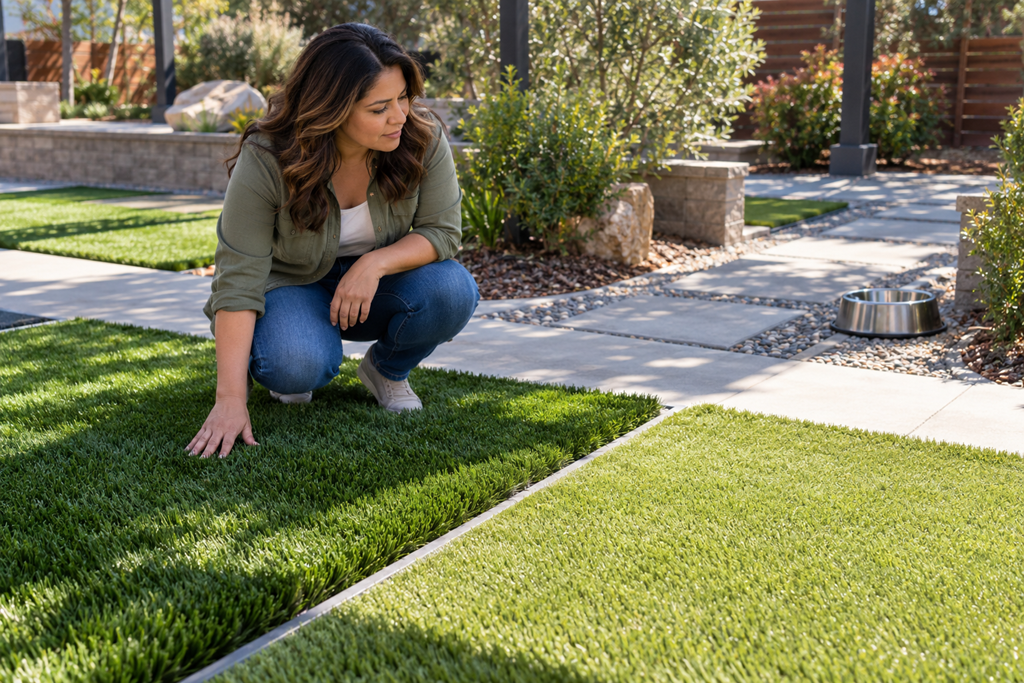
Notice how the surface behaves when someone walks, turns, kneels, or sits on it, where such testing is appropriate and permitted.
Surface temperature should be evaluated separately from softness.
Children and active households may have different priorities
A yard intended for active family use deserves more scrutiny than a purely decorative landscape.
Homeowners should consider the kinds of activities that will occur there.
Will children sit on the turf? Will people stretch, play casual games, or spend extended periods on the ground? Is the surface expected to accommodate occasional gatherings?
These questions affect what comfort actually means.
If the installation is intended for a play area, discuss the specific use and any applicable safety or impact-attenuation requirements with the installer. Ordinary landscape turf and specialized playground surfacing are not automatically equivalent.
No artificial turf product should be assumed to prevent injuries or provide adequate fall protection merely because it feels cushioned.
The underlying installation can affect the finished feel
Surface comfort depends partly on what sits beneath the artificial turf.
Base preparation, the existing ground conditions, installation methods, and any appropriate cushioning components can influence firmness, stability, and how consistently the surface feels.
For example, an installation designed primarily for a clean decorative appearance may not use the same supporting materials as a surface intended for a particular recreational application.
Homeowners do not need to master installation techniques. They do need to understand what the installer proposes and how that approach relates to the intended use.
If a homeowner specifically wants a softer area for sitting or playing, that expectation should be discussed before the project is quoted.
How the three concerns interact
Heat, pet use, and surface comfort are closely connected. Evaluating them separately can lead to a product choice that solves one concern while overlooking another.
Consider these common situations.
Planned use | Main consideration | What to clarify before choosing |
|---|---|---|
A sunny backyard used for recreation | Heat and contact comfort | Whether the surface will be practical during the hours of intended use |
A dedicated dog bathroom area | Drainage, odor management, cleaning | How the full system handles repeated pet waste exposure |
A yard shared by pets and children | Heat, comfort, maintenance | Whether one surface meets both groups' needs |
A decorative front lawn | Appearance and limited foot traffic | Whether higher-priced comfort or pet features are necessary |
A shaded outdoor gathering area | Sitting comfort and wear | How the material feels during actual use and what maintenance it requires |
A narrow pet access route | Paw temperature and frequent traffic | Whether an alternative surface or additional shade would be more suitable |
The same product does not have to be the right choice for every row in this table.
For instance, a household might find artificial turf appropriate for a shaded decorative section while preferring another material for a heavily sun-exposed pet route.
That is not necessarily a compromise in project quality. It may be a more appropriate response to how the property is used.
Do not assume one material must cover the whole yard
Homeowners sometimes approach an artificial turf estimate with a predetermined idea that every existing grass area should be replaced.
That may be reasonable for some properties, but it is worth considering mixed landscaping.
Depending on the site, artificial turf might be combined with planting beds, hardscaping, mulch, appropriate pet surfaces, or retained natural areas.
Each material has its own maintenance and comfort characteristics.
The objective is to arrange the property around actual activities rather than forcing every activity onto the same material.
This can be especially useful when pets and people have different needs.
How to evaluate turf samples and product claims
Product samples are useful, but they have limitations.
A small square of artificial turf may reveal fiber color and texture while telling the homeowner relatively little about performance after installation.
Ask to see a relevant installed example
When practical, request photographs or examples of completed installations that resemble the intended use.
A homeowner planning a dog-friendly backyard should look for evidence of work involving pets, not merely attractive decorative lawns.
Likewise, someone prioritizing comfort should ask about installed surfaces intended for regular foot traffic, sitting, or recreation.
Questions about the materials used in those examples can help distinguish general installation experience from experience with a particular household need.
Keep in mind that a finished-project photograph may establish appearance but cannot demonstrate temperature, odor resistance, or walking comfort.
Request specific explanations rather than broad descriptions
Marketing terms can sound reassuring without establishing measurable performance.
Examples include:
- Cooler turf
- Pet-safe
- Low-maintenance
- Soft and comfortable
- Superior drainage
These descriptions are not necessarily misleading, but each deserves context.
A useful provider explanation identifies what the product is intended to do, the limitations of that performance, and the conditions under which the claim applies.
For claims about temperature, ask about test methods and comparison materials.
For pet-related claims, ask about the complete drainage and maintenance system.
For softness, ask whether the recommended construction and base are appropriate for the actual activity.
Homeowners should avoid interpreting broad marketing language as a promise that the product will perform the same way under every condition.
Compare systems, not just rolls of turf
Two estimates may name different artificial turf products, but the meaningful differences may also involve installation preparation, drainage components, infill choices, and the finished layout.
A lower-priced quote may include a different scope rather than simply offering a better deal.
A more expensive proposal also does not automatically indicate better performance.
When comparing estimates, look for enough detail to understand the complete installation and why the proposed system is suitable for the property.
This is particularly important when a project must address several objectives at once.
Questions that reveal whether an installer understands your needs
An experienced artificial turf installer should be willing to discuss the intended use of the space rather than immediately recommending a product based on appearance alone.
A focused conversation can cover several important questions.
About surface temperature
- How does the recommended turf typically behave in prolonged direct sunlight?
- What supports any claims about reduced surface heating?
- Would shade, layout adjustments, or alternative materials be appropriate for the hottest areas?
About pet use
- What makes this particular system suitable for the number of pets and frequency of use I expect?
- How will the backing, infill, and base work together to handle urine and drainage?
- What cleaning and odor-management responsibilities will remain after installation?
About surface comfort
- Can I evaluate a larger installed example of the recommended turf?
- What differences in feel should I expect between the samples being considered?
- Does the proposed installation support sitting, walking, or other activities planned for this area?
About the complete project
- What is included in the proposed installation, and what is excluded?
- Are there property conditions that could change the drainage or base recommendations?
- What manufacturer care instructions and warranty limitations apply to my intended use?
The quality of the answers matters as much as the number of questions.
A provider who acknowledges tradeoffs and explains why a material fits a particular yard may be more useful than one who treats every product feature as universally beneficial.
What to prepare before requesting an installation estimate
A productive estimate begins with a clear understanding of how the yard will be used.
You do not need a technical design or detailed installation plan.
Instead, prepare practical information that helps an installer make a relevant recommendation.
Identify the most important activities
Think about the primary purpose of the proposed turf area.
Is the goal mainly to improve appearance, create a low-maintenance outdoor area, accommodate pets, or support frequent family use?
If several purposes matter, determine which have the greatest impact on product suitability.
For example, a household with dogs that use the yard throughout the day may place greater importance on heat and drainage than on achieving a particular decorative appearance.
Observe the property before the visit
Notice the areas that receive direct sunlight and the times when household members normally use the yard.
If pets are involved, identify their regular routes and bathroom areas.
You can also note where water tends to remain after rain or irrigation, without trying to diagnose underlying drainage conditions yourself.
Photographs of the property may help communicate these observations, especially when the installer visits at a different time of day.
Be clear about your expectations
Prepare a short description of what you hope the finished surface will accomplish.
For example:
"We want an outdoor area that our dogs can use regularly, but we also want to know how comfortable the turf will be during hot afternoons and what cleaning will be required."
That statement gives an installer more useful direction than simply requesting the most realistic-looking or lowest-maintenance turf.
It also creates an opportunity to discuss whether artificial turf is the right material for the full proposed area.
Reasons to reconsider a recommendation before committing
Not every concern indicates that an installer is unsuitable. Some questions require additional evaluation, and certain product limitations may be unavoidable.
However, several responses deserve a closer look.
A promise that turf will never become too hot. Artificial turf can heat significantly in sunlight. Broad assurances about comfort deserve supporting information and realistic limitations.
A claim that pet turf requires no cleaning. Artificial turf used by animals still needs routine waste removal and appropriate maintenance.
A recommendation based only on appearance. Color and realism matter, but a functional backyard also requires attention to its intended activities.
No meaningful explanation of drainage. If pets will frequently use the surface, homeowners should understand how the complete installation is intended to handle liquids.
Assurances that soft turf automatically creates a safe play surface. Comfort, cushioning, traction, and impact protection are different considerations.
Little interest in property conditions. Sun exposure, existing ground conditions, slope, and yard use can all affect the recommendation.
Pressure to approve a project before the scope is explained. Homeowners should have a reasonable opportunity to understand what they are buying.
These concerns do not automatically establish poor workmanship. They signal that additional questions, documentation, or another professional opinion may be appropriate.
When artificial turf may not be the right fit
Artificial turf can serve useful landscaping purposes, but it is not necessarily the most suitable choice for every location.
A household that expects children and pets to spend long periods on a completely sun-exposed surface may find that heat management becomes a significant limitation.
A homeowner seeking an entirely maintenance-free pet area may also be disappointed by the cleaning responsibilities involved.
And someone who strongly values the natural cooling characteristics or feel of living vegetation may prefer a different landscaping approach.
It is reasonable to consider a smaller turf installation, a combination of landscape materials, or an alternative surface altogether.
The decision should account for how the yard will function after installation, not just how it will look immediately afterward.
Choosing a surface that fits the way you live
Before approving an artificial turf project, consider three practical questions together: Will the surface be comfortable during the times it will be used? Can it accommodate the household's pets and cleaning expectations? Does the proposed product and installation method match the activities planned for the space?
A successful decision does not depend on choosing the product with the longest feature list or the most persuasive marketing description.
It depends on understanding the differences between appearance, heat performance, pet suitability, and everyday comfort.
For Sacramento-area homeowners, a thoughtful installation decision starts with the actual yard, the people and animals who will use it, and a provider who can explain both the benefits and limitations of the recommended system.