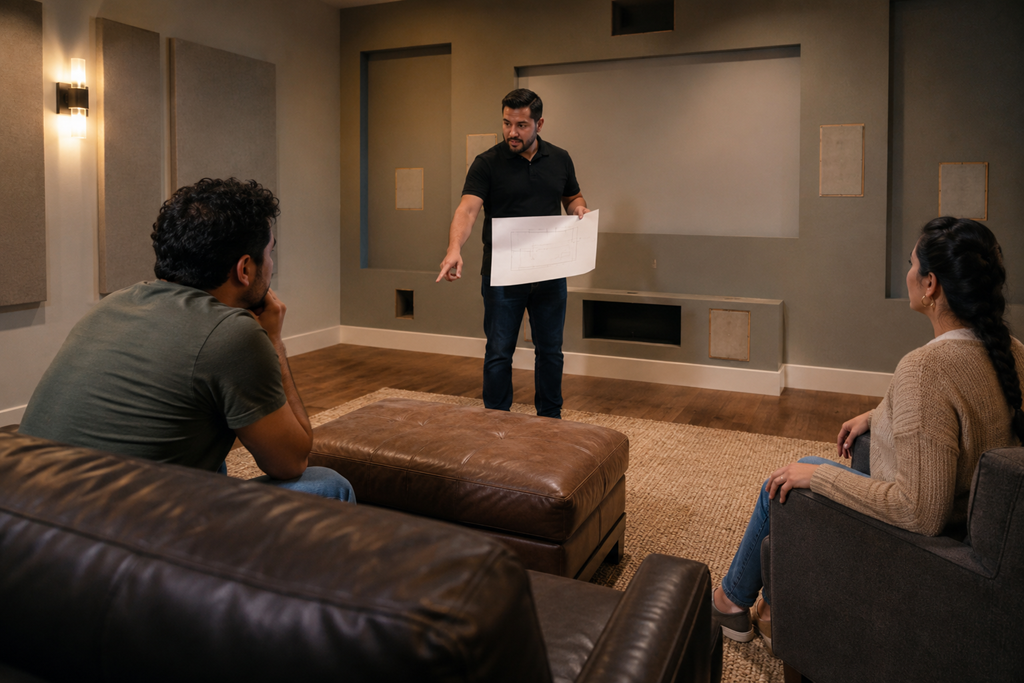
Before installing surround sound, it helps to understand that good sound is not just about buying more speakers. The room layout, seating position, wiring path, speaker placement, ceiling height, wall surfaces, and installer communication can all affect how the system feels once it is in use. For Sacramento-area homeowners, the smartest early step is usually not choosing the most complicated system, but getting clear on how the room will actually be used.
Surround sound can make movies, sports, music, and games feel more immersive, but it can also disappoint when expectations are built around equipment alone. A system that looks impressive on paper may not sound balanced if the room has awkward seating, hard surfaces, limited wiring access, or speaker locations that were chosen mostly for appearance.
That is why the planning conversation matters. Before comparing quotes or scheduling an installation, it helps to know what a qualified home theater installer is really evaluating.
More Speakers Do Not Automatically Mean Better Sound
One of the easiest misunderstandings is assuming that surround sound quality comes from the number of speakers. More speakers can help in the right room, but they can also create confusion when they are placed poorly or when the main seating area is not considered.
A smaller, well-planned system may feel more natural than a larger system squeezed into a room that cannot support it. The goal is not simply to fill every wall or ceiling with equipment. The goal is to create a listening experience that matches the room, the seating, and the way people actually use the space.
For example, a family room with one main sofa may need a different plan than a dedicated media room with multiple rows of seating. A room used for both everyday television and movie nights may need different priorities than a room designed mainly for gaming or home theater.
The Room Shapes The Sound More Than Many People Expect
Surround sound is affected by the room itself. Open floor plans, tile floors, large windows, high ceilings, built-in shelving, and hard wall surfaces can all change how sound reflects, fades, or feels from one seat to another.
This is especially important in homes where the entertainment area shares space with a kitchen, dining area, hallway, or stairwell. Sound does not stay perfectly inside an invisible rectangle around the television. It travels, bounces, and sometimes collects in unexpected areas.
That does not mean a room has to be perfect before surround sound is worth considering. It simply means the installer should talk about the room as part of the system, not treat the room as an afterthought.
A useful consultation usually includes questions about where people sit, how loud the system will normally be played, whether the room is used during quiet hours, and whether the homeowner cares more about cinematic impact, clear dialogue, balanced music, or a cleaner look.
Speaker Placement Is A Planning Decision, Not Just A Mounting Task
Many homeowners picture surround sound installation as a physical task: mount the speakers, run the wires, connect the receiver, and test the system. Those steps matter, but the bigger decision happens before the equipment goes in.
Speaker placement affects whether sound feels balanced or distracting. If speakers are too close to one seat, too far from another, too high, blocked by furniture, or placed only where wiring is easiest, the finished system may not match expectations.
This is why a careful installer may spend time studying the room before recommending locations. That can feel slower than simply pointing to walls and agreeing to install equipment there, but it often leads to a better result.
Good planning may also involve tradeoffs. A speaker location that looks clean may not be ideal acoustically. A location that sounds better may require more visible work or a more detailed wiring plan. A qualified installer should be able to explain those tradeoffs in plain language.
Wiring And Access Can Affect The Scope Of The Project
Surround sound often brings up questions about wires, wall access, attic access, crawl spaces, cabinetry, power, and future upgrades. These details can affect the complexity of the work, even when the room looks simple at first glance.
For Sacramento-area homeowners comparing local providers, this is one reason vague estimates can be hard to compare. One installer may be pricing a basic setup with minimal concealment, while another may be including more careful wire routing, wall plates, calibration, cleanup, or planning for future equipment.
The lowest number on an estimate may not always reflect the same scope. Before focusing only on price, it helps to understand what is included, what is not included, and what could change once the installer sees the home in person.
This does not mean every surround sound project needs major wiring work. Some systems can be simpler. The key is making sure the plan matches the home, not just the equipment box.
Dialogue Clarity May Matter More Than Loudness
Many people start thinking about surround sound because they want bigger, richer, more dramatic audio. But in everyday use, one of the most valuable improvements may be clearer dialogue.
If voices are hard to understand, people often turn the volume up, only to have music, sound effects, or bass become too loud. A well-planned system should consider the center speaker, seating position, room surfaces, and calibration so dialogue does not get buried.
This is a practical issue, not just a luxury feature. If the system will be used by a family, guests, older adults, or people watching different kinds of content, clear speech can matter as much as dramatic surround effects.
When talking with a provider, it is reasonable to explain what currently bothers you. “We cannot hear dialogue clearly” is a different problem than “we want more bass” or “we want speakers hidden.” The clearer the problem, the easier it is to evaluate whether the proposed setup addresses it.
A Clean Look And A Strong Sound May Require Tradeoffs
Many homeowners want surround sound that sounds good and blends into the room. That is reasonable, but it is also where expectations can get unclear.
In-wall speakers, ceiling speakers, compact speakers, soundbars, wireless components, and traditional speaker layouts can each serve different goals. Some options may look cleaner. Others may offer more flexibility. Some may require more installation planning. Others may be easier to adjust later.
The right choice depends on the room and the homeowner’s priorities. A qualified installer should not make the decision feel like a single “best” answer for every home. Instead, the conversation should connect the design choice to how the room will be used.
If appearance matters more than theater-style impact, say that early. If immersive sound matters more than hiding every component, say that too. Good planning starts when the installer understands the real priority.
Helpful Questions To Ask Before Hiring A Local Installer
Before choosing a home theater installation provider, Sacramento-area homeowners can learn a lot from how clearly the installer explains the plan. A few useful questions include:
- Where will the main listening position be, and how does that affect speaker placement?
- What parts of the room could make sound uneven or hard to control?
- What is included in the estimate besides mounting and connecting equipment?
- How will wiring be handled, and what areas of the home may need access?
- Will the system be adjusted or calibrated after installation?
- What tradeoffs are there between a cleaner look and better sound performance?
- What should I expect if I want to upgrade the system later?
The goal is not to become an audio expert. The goal is to see whether the provider can explain the project clearly, without rushing past the details that affect the finished experience.
Be Cautious When The Plan Sounds Too Vague
A red flag is not always a bad attitude or a high price. Sometimes the warning sign is a proposal that skips the room entirely.
If an installer talks mostly about equipment but does not ask about seating, room shape, wiring, content habits, volume expectations, or appearance preferences, the plan may be incomplete. The same is true if the estimate does not clearly explain what work is included.
Surround sound installation is not only about connecting devices. It is about fitting an audio system into a specific home. When the communication is vague, homeowners may discover too late that their expectations and the provider’s assumptions were not the same.
A clear provider should be able to explain why certain choices make sense, what limitations exist, and where the homeowner may need to decide between competing priorities.
The Best Starting Point Is The Way You Actually Use The Room
Before installing surround sound, think less about the ideal showroom setup and more about real life. Where do people sit? Is the room open to other spaces? Do you watch mostly movies, sports, streaming shows, games, or music videos? Do you care more about clean design, strong bass, clear dialogue, or balanced sound throughout the room?
These answers can shape the project more than the brand or size of the equipment. They also help you have a more useful conversation with local installers.
A surround sound system should fit the room, the people using it, and the expectations set before installation begins. When those details are discussed early, Sacramento-area homeowners are in a better position to compare providers, understand estimates, and choose a setup that makes sense for the way the space is actually lived in.