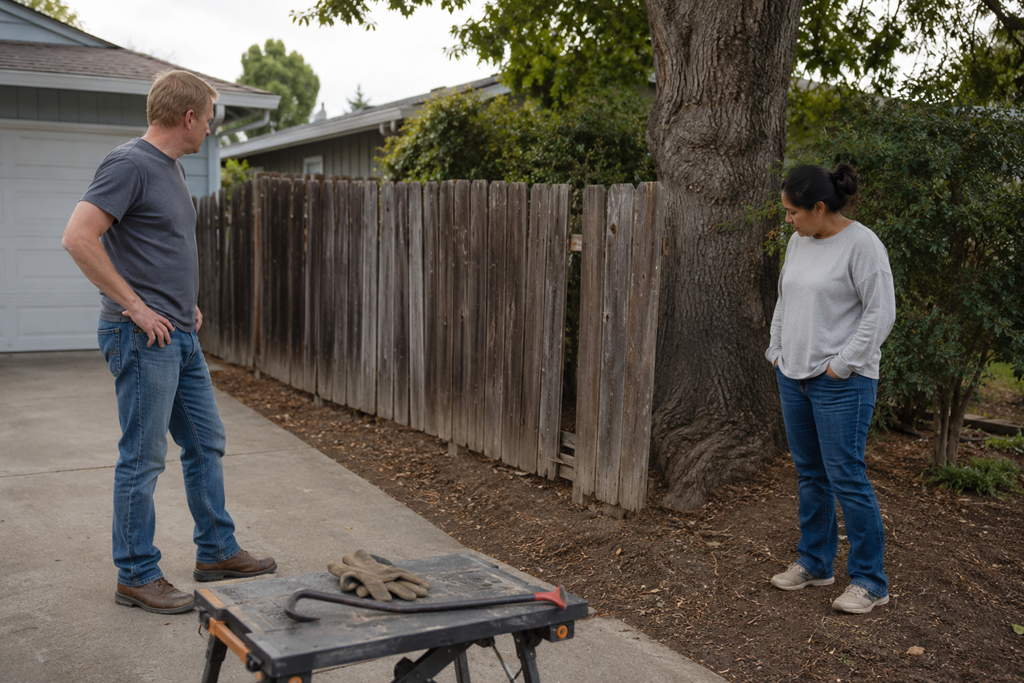
Before replacing a fence that sits along a shared property line, it helps to settle three questions first: where the boundary actually is, what each property owner expects, and what the contractor is being hired to remove and rebuild. The existing fence may look like an obvious dividing line, but appearance alone does not always answer questions about ownership, placement, access, style, or cost. A short conversation and a clearly defined scope can prevent a straightforward fence project from turning into a disagreement.
This situation often begins with what seems like a simple home improvement decision. The fence is leaning, boards are deteriorating, posts are failing, or both properties would benefit from better privacy. One homeowner may be ready to replace it, while the neighboring owner may not have considered the project at all.
That difference does not necessarily mean the project cannot move forward. It does mean the planning should cover more than lumber, posts, and installation estimates.
The Existing Fence May Not Mark the Exact Boundary
An older fence may have been installed directly on a property line, slightly inside one property, or along a path that was convenient at the time. Posts may also have shifted, panels may have been rebuilt in sections, or landscaping may make the original alignment difficult to recognize.
For that reason, the location of the existing fence should not automatically be treated as proof of the legal boundary.
A fence professional can evaluate the structure, explain replacement options, and identify installation concerns. However, a contractor may not be able to determine a disputed property boundary. When the line is uncertain or one owner questions the placement, property records or a qualified survey professional may be needed before the old fence is removed.
This distinction is important because rebuilding along an assumed line can preserve an old mistake rather than resolve it.
A Shared Fence Creates Two Sets of Expectations
Neighbors can agree that a fence needs replacement while imagining very different finished projects.
One person may want greater privacy. The other may want to preserve sunlight for a garden. One may prefer wood that resembles the existing fence, while the other may be concerned about maintenance, appearance, or how the finished side will face each property.
Other expectations can involve:
- The height and overall design
- The material and color
- The location of posts and rails
- The treatment of gates or connecting fence sections
- The protection or removal of nearby plants
- Temporary openings during construction
- Access through either property
- Cleanup and disposal of the old materials
These details can affect both the estimate and the working relationship between the neighbors. Discussing them before selecting a contractor is usually easier than trying to settle them after materials have been ordered.
Talk Before the Old Fence Comes Down
Removing a shared fence can temporarily affect privacy, security, pets, children, landscaping, and normal use of both yards.
A Sacramento-area homeowner may be focused on replacing sun-damaged boards or posts weakened by changing soil conditions. The neighboring owner may be more concerned about a dog entering the open area, workers crossing a planting bed, or a patio becoming exposed during the project.
A useful early conversation does not have to be formal or confrontational. It can simply establish:
- Why replacement is being considered
- Whether both owners believe the fence follows the correct line
- What type of replacement each person expects
- Whether both properties will need to provide access
- How temporary openings will be handled
- Who will communicate with the contractor
After the conversation, a brief written summary can help prevent different recollections later. This may be as simple as confirming the agreed design, estimated work area, access arrangements, and payment responsibilities.
A written summary does not replace professional legal guidance when ownership or boundary rights are disputed. It simply gives everyone a clearer reference point for the project they discussed.
Cost Sharing and Project Control Are Different Questions
A shared fence does not automatically mean both owners have agreed to divide every expense equally. It also does not mean the person paying more should make every project decision without discussing how the work affects the neighboring property.
Cost-sharing conversations are easier when the proposed scope is specific.
For example, replacing a basic section along the existing alignment is different from adding decorative details, changing the height, relocating the fence, rebuilding connected gates, or removing landscaping. One owner may agree to contribute toward the basic replacement but not toward optional upgrades.
Before comparing estimates, it helps to distinguish between:
- Work needed to replace the deteriorated fence
- Changes requested by one property owner
- Work affecting only one side or adjoining section
- Additional costs caused by limited access or landscaping
- Optional design or material upgrades
This makes it easier to understand what each estimate includes and what the neighbors are actually agreeing to fund.
The Contractor Needs a Clearly Defined Scope
A fence contractor should not have to arrive on installation day and determine which neighbor’s instructions take priority.
Before hiring, the contractor should know who is authorizing the work, where access will come from, which fence sections are included, and whether both owners have approved any work that affects their property.
The estimate should also make clear whether it includes removal, disposal, post replacement, gates, adjoining transitions, landscaping protection, temporary barriers, and cleanup.
Useful questions to ask a fence professional include:
- Does the estimate assume the replacement will follow the existing alignment?
- What happens if the post locations need to change?
- Will workers need access from both properties?
- How long might the yard remain temporarily open?
- How will connected gates or neighboring fence sections be handled?
- What parts of the project could change the final price?
Clear answers help both neighbors understand what will happen instead of relying on assumptions.
Access Can Affect More Than Convenience
Even when the fence line is agreed upon, installation may require room on both sides.
Shrubs, raised beds, patio structures, irrigation components, storage sheds, air-conditioning equipment, and narrow side yards can limit how workers reach the posts. A contractor may also need to protect nearby surfaces or approach part of the fence through the neighboring yard.
Access should be discussed during the estimate rather than after the project begins.
Homeowners can ask the contractor to identify where crews will stand, carry materials, remove debris, and stage the new fence components. This allows both neighbors to move personal items, address pet concerns, and discuss vulnerable landscaping before work starts.
It can also reveal whether the quoted price assumes access that has not actually been approved.
Uncertainty Is a Reason to Pause Before Removal
Replacing a worn fence may feel routine, but uncertainty about the property line, ownership, or permission to enter the neighboring property changes the decision.
It may be appropriate to pause when:
- The neighbors disagree about where the boundary is
- The proposed fence would follow a different alignment
- One owner believes the existing fence belongs entirely to them
- A structure, tree, gate, or retaining feature complicates the line
- The contractor cannot perform the work without unapproved access
- There is disagreement about who can authorize removal
Depending on the property, it may also be useful to review available property documents and check whether an association, easement, local requirement, or other restriction affects the project. A surveyor, title professional, relevant local authority, or qualified attorney can provide guidance when the issue goes beyond fence construction.
The goal is not to make every fence replacement complicated. It is to recognize when a contractor estimate cannot answer a boundary or ownership question.
A Better Project Starts With Shared Understanding
A well-prepared shared-line fence replacement has more than a chosen material and an installation date.
Both property owners understand what is being removed, where the replacement is expected to sit, how access will work, what the finished fence will look like, and who is responsible for each part of the cost. The contractor receives one clear scope rather than conflicting instructions from opposite sides of the fence.
For Sacramento-area homeowners, taking time to address those questions before hiring can make estimates easier to compare and reduce avoidable confusion once the project begins.
The old fence may be the visible problem, but the most important preparation often happens before anyone removes the first panel.