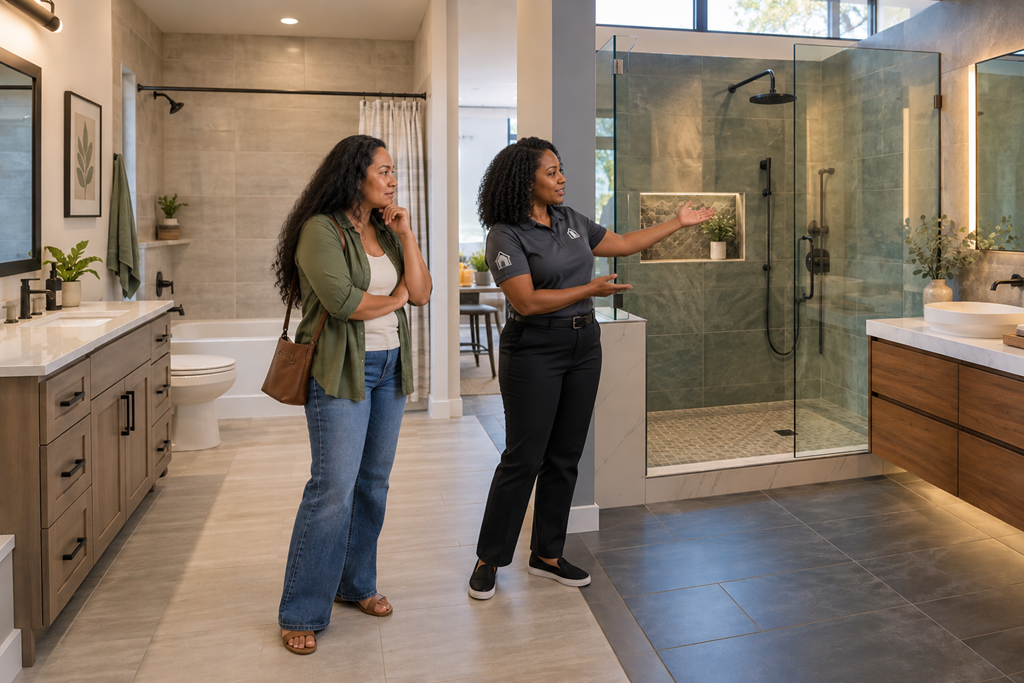
Comparing bathroom remodeling contractors involves more than looking at project photos, requesting estimates, and deciding which price feels reasonable. Before contacting Sacramento-area contractors, homeowners benefit from understanding the type of remodeling work they want, what may be involved in completing it, and how different contractors approach the same project. These details can help you recognize meaningful differences between proposals, ask better questions, and avoid comparing services that may not include the same work.
A bathroom remodel can involve anything from replacing visible finishes and fixtures to changing the layout, improving accessibility, or addressing conditions that become apparent during renovation. The contractor who is well suited for one type of project may not be the right fit for another.
The purpose of this guide is to help you understand what matters before you begin comparing bathroom remodeling contractors, so your conversations, estimates, and eventual decision are based on more than appearance and price.
Understand the type of bathroom remodel you are planning
Before evaluating contractors, identify what you want the finished bathroom to accomplish.
Two homeowners might both describe their projects as bathroom remodels while expecting substantially different work. One might want to replace an outdated vanity, flooring, lighting, and shower enclosure. Another might want to relocate fixtures, change the shower configuration, or make the bathroom easier to use as household needs change.
Those differences matter because they can affect the contractor's experience requirements, the professionals involved, project complexity, and how an estimate is prepared.
Cosmetic updates and larger renovations are not the same
A bathroom primarily receiving new finishes may have different planning needs from one involving substantial changes to plumbing, electrical systems, walls, or layout.
For example:
- Surface and fixture updates: Replacing selected visible features while keeping much of the existing arrangement.
- Full bathroom renovation: Updating several major components, potentially including the shower or bathtub, flooring, cabinetry, lighting, and surrounding surfaces.
- Layout changes: Moving or reconfiguring bathroom elements, which may involve additional planning and specialized work.
- Accessibility-focused remodeling: Considering entry clearance, bathing arrangements, fixture placement, and other features based on how the bathroom needs to function.
These descriptions are useful for early conversations, but they are not rigid project categories. A seemingly straightforward update can become more involved if existing conditions require attention.
Rather than deciding exactly how every improvement should be performed, identify your goals and ask prospective contractors what professional evaluation would be needed.
Separate essential improvements from preferences
A useful planning exercise is to divide your priorities into three groups:
- Necessary improvements: Conditions or functional problems you want professionally evaluated or addressed.
- Important preferences: Features that significantly affect daily use, such as storage, lighting, or bathing arrangements.
- Optional upgrades: Changes you would appreciate but could reconsider if they create a larger project than intended.
This distinction helps you communicate your goals without assuming every contractor will propose the same solution.
It also makes it easier to recognize whether a contractor is responding to your priorities or simply recommending a familiar remodeling package.
Recognize what contractors may need to evaluate before quoting the work
An early estimate is only as useful as the information supporting it.
Bathroom remodeling often involves existing features and conditions that cannot be fully understood from photographs or a short project description. A contractor may need to examine the space, discuss your goals, review accessible conditions, and determine whether additional evaluation is appropriate.
Existing conditions can change the project
The apparent condition of a bathroom does not necessarily reveal everything about the work that may be needed.
Relevant considerations can include:
- The condition of accessible plumbing fixtures and connections.
- The existing shower or bathtub arrangement.
- Signs of moisture-related problems that warrant professional evaluation.
- Flooring, wall, and substrate conditions.
- Ventilation and lighting needs.
- Available space and fixture clearances.
- How proposed changes interact with existing construction.
Some conditions may remain concealed until work begins. That does not automatically mean the contractor overlooked them or that a problem will occur.
What matters during comparison is whether the contractor explains which assumptions the estimate depends on and how previously concealed conditions would be handled if discovered.
A contractor who acknowledges reasonable uncertainty may be giving you more useful information than someone who presents every aspect of the project as completely predictable.
Layout changes deserve particular attention
Keeping major fixtures in their existing locations may differ significantly from moving a shower, toilet, or sink.
Changes involving plumbing locations, electrical systems, structural elements, or room configuration can affect the required work and the number of professionals involved.
Before assuming a proposed layout is practical, ask what the contractor would need to evaluate.
A photograph of an attractive bathroom can show the desired appearance, but it cannot establish whether the same arrangement is appropriate for your home.
A site visit should help define the project
When an in-person evaluation is appropriate, pay attention to how the contractor approaches it.
Do they ask how you use the bathroom? Do they examine the areas relevant to your requested work? Do they explain what can be assessed immediately and what remains uncertain?
You do not need to interpret technical findings yourself. The more useful question is whether the contractor's evaluation produces a clearer explanation of the proposed scope and its limitations.
Understand how project scope affects contractor fit
Not every contractor offers the same combination of remodeling services.
Some businesses focus on relatively defined installations or bathroom updates. Others undertake broader remodeling projects involving several trades, extensive coordination, or significant alterations.
A contractor's suitability depends partly on whether the business regularly handles projects comparable to yours.
Experience should match the work you need
A portfolio of attractive finished bathrooms provides a starting point, but photographs alone do not explain what the contractor was responsible for.
A business might have installed a shower enclosure in one project, completed a full renovation in another, or worked alongside other professionals.
When reviewing previous work, ask:
- Which parts of the featured project did your business complete?
- Have you handled renovations similar in scope to mine?
- Did the project involve layout changes or existing-condition complications?
- How was the work coordinated when different trades were needed?
You are not looking for an identical bathroom. You are trying to determine whether the contractor has relevant experience with the type of work your project requires.
Clarify who will perform and coordinate the work
Bathroom remodeling may involve several specialties.
Depending on the agreed scope, these can include plumbing, electrical, tile installation, cabinetry, painting, and other remodeling activities.
Ask whether the contractor's own employees perform the work, whether subcontractors are involved, and who is responsible for coordinating different stages.
Neither employees nor subcontractors automatically indicate better quality. The important distinction is whether responsibility and communication are clear.
You should know who supervises the project, who addresses scheduling concerns, and whom you contact when a question arises.
Verify qualifications that apply to the proposed work
For a Sacramento-area remodeling project, homeowners should independently verify applicable contractor licensing and ask about insurance and relevant qualifications.
In California, the Contractors State License Board provides a way to check contractor license information. The specific licensing and other requirements relevant to a project depend on the work involved.
Do not assume that a professional-looking website, attractive project photographs, or a positive review establishes that a business is properly qualified for your proposed remodeling work.
Likewise, do not assume that all bathroom-related businesses are authorized or equipped to perform every type of alteration.
These matters deserve verification before an agreement is made.
Know why bathroom remodeling estimates can be difficult to compare
Two contractors may produce substantially different estimates without proposing the same finished project.
One estimate might include removing existing components, preparing surfaces, supplying selected materials, installing fixtures, and completing finishing work.
Another might cover only part of those activities, assume that the homeowner is purchasing certain materials, or leave some decisions unresolved.
The total price does not tell you which situation applies.
Compare what the contractor is actually proposing
Before looking primarily at price, examine whether the estimates describe similar work.
Comparison area | What to clarify |
|---|---|
Removal and preparation | Which existing components will be removed, and what preparation is included? |
Materials | Which products, quality levels, and selections are included or assumed? |
Installation | Which components and associated work are covered? |
Plumbing and electrical | What work is included, excluded, or subject to further evaluation? |
Finishing details | Are trim, painting, sealing, and other finishing activities addressed? |
Project coordination | Who arranges and oversees the different stages of work? |
Cleanup | What cleanup and material removal responsibilities are included? |
Unanticipated conditions | How will additional work be evaluated, priced, and approved? |
This comparison is not intended to prescribe what every bathroom remodeling estimate must contain. It identifies areas where differences can be significant.
When an item is unclear, ask the contractor to explain it rather than assuming it is included.
Material selections can change the comparison
Bathroom remodeling materials vary in appearance, durability characteristics, maintenance needs, installation requirements, and cost.
Differences in tile, vanities, countertops, shower systems, fixtures, flooring, and other materials can affect the proposal.
One contractor may estimate using specific selected products. Another may use allowances for items you have not chosen.
An allowance is a budgeted amount included in the proposal for a selection or category of selections. If the actual chosen products exceed that amount, the project's price may change.
Ask how allowances work, which purchases they cover, and whether associated installation costs are already accounted for.
A lower initial estimate with unresolved selections is not necessarily less expensive than a more detailed proposal.
The lowest number is not always the clearest value
Price matters, especially when you are working within a budget.
But a meaningful comparison considers what you receive for the proposed amount.
Look at the quality and specificity of the scope, the materials being proposed, the contractor's relevant experience, project responsibilities, and the procedures for addressing changes.
A higher quote does not automatically mean higher-quality workmanship. A lower quote does not automatically mean corners are being cut.
The objective is to understand the differences well enough to make a reasoned decision.
Understand what a remodeling timeline actually tells you
Homeowners often want to know how long a bathroom will be unavailable.
That is reasonable, especially when the household has only one bathroom or several people depend on the same space.
However, a quoted project duration and the actual period of inconvenience are not always identical.
Scheduling and construction are separate considerations
A contractor may describe when the project could begin and approximately how long the planned work might take.
Those are different questions.
Ask about the anticipated start period, expected work sequence, and factors that could change the schedule.
Relevant considerations may include product availability, necessary evaluations or approvals, coordination among trades, and conditions discovered during the project.
A contractor should be able to explain what the schedule assumes, even when exact dates cannot be guaranteed.
Bathroom availability affects daily life
For a household with multiple bathrooms, temporary disruption may be manageable.
For a household relying on one bathroom, interruptions to bathing, toilet access, or sink use may require more advance planning.
Before comparing timelines, clarify which facilities are expected to remain usable and when interruptions might occur.
This is particularly important when household members have mobility limitations, health-related needs, or other practical requirements.
The contractor can explain the planned construction sequence, while your household can determine whether those arrangements are workable.
Identify who is responsible for delays and decisions
Some schedule changes may depend on homeowner selections or approvals. Others may depend on materials, inspections, unforeseen conditions, or work coordination.
Ask how schedule changes will be communicated and what decisions might require your attention.
A useful project timeline provides more than a completion estimate. It helps both parties understand dependencies and expectations.
Look beyond finished photographs when evaluating workmanship
A portfolio is valuable because it allows you to assess appearance, style, and the types of projects a contractor has completed.
It is less useful when treated as proof of everything that happened during construction.
A finished photograph generally cannot show how scheduling was managed, whether unexpected changes were explained, or how the contractor communicated with the homeowner.
Ask about completed projects similar to yours
When reviewing a portfolio, consider the relationship between the examples and your planned bathroom.
If your priority is an accessible bathing arrangement, examples of accessibility-related work may be more informative than photographs emphasizing luxury finishes.
If your bathroom has limited space, smaller remodeling projects may provide more relevant examples than large custom bathrooms.
If you are considering significant layout changes, ask whether the contractor has managed similar work.
The most visually impressive example is not necessarily the most relevant.
Reviews are evidence, not guarantees
Customer reviews can help reveal recurring themes in a contractor's work and communication.
Consider whether reviews describe:
- How clearly the project was explained.
- Whether expectations about scheduling were discussed.
- How the contractor responded when questions arose.
- Whether the final scope matched the homeowner's understanding.
- How concerns or changes were handled.
A few positive comments cannot establish that your project will proceed the same way.
Similarly, one negative review should be considered in context rather than automatically determining your decision.
Look for useful patterns across multiple sources, including how a business responds to concerns.
Understand what references can and cannot establish
If a contractor provides customer references, you may be able to learn about experiences with comparable projects.
Useful questions include whether the agreed scope was understandable, how changes were communicated, and whether the contractor was responsive during the work.
References can provide helpful perspective, but they do not replace reviewing the current proposal or verifying qualifications.
Your project still needs to be evaluated on its own terms.
Recognize the importance of changes and unexpected work
One of the most important distinctions between remodeling proposals is how they address work that was not fully defined at the beginning.
Bathroom renovations may involve conditions concealed by existing fixtures, walls, floors, or other finishes.
A contractor cannot necessarily identify every condition before construction starts.
The issue is whether there is an understandable process for dealing with discoveries and requested changes.
Unexpected conditions and homeowner upgrades are different
Additional work can arise for different reasons.
A concealed condition may require further professional evaluation after removal begins.
Alternatively, a homeowner may decide to select a different vanity, change the tile design, or add another feature after the original scope has been agreed upon.
Both can affect cost and timing, but they are not the same situation.
Ask prospective contractors how they distinguish necessary changes from optional homeowner requests.
A change process should establish expectations
Before hiring, find out how proposed changes will be explained and documented.
Helpful questions include:
- Who determines whether additional work is needed?
- How will the proposed change be described?
- When will additional costs be presented?
- What approvals are required before the changed work proceeds?
- How will the change affect the anticipated schedule?
The goal is not to eliminate every possibility of change. It is to understand how decisions will be made if circumstances differ from the original plan.
A contractor who explains this process during the estimate stage gives you an opportunity to evaluate communication before construction begins.
Pay attention to how the contractor communicates before hiring
Communication during the comparison process offers insight into how a contractor handles questions and expectations.
It does not guarantee future performance, but it is one part of evaluating fit.
Clear answers matter more than polished presentations
Notice whether the contractor listens to your priorities and responds to the actual questions you ask.
For example, if your concern is keeping the existing layout, does the contractor explain the feasibility of that approach? If accessibility is important, does the conversation address those needs?
A business may have an attractive website and well-presented project photos while still providing an estimate that leaves important questions unanswered.
The reverse can also be true: a less elaborate presentation may accompany a detailed, carefully considered proposal.
Evaluate the substance of the information rather than its appearance alone.
Understand how project communication will work
Find out who will be your primary contact once work begins.
Will you communicate with the owner, a project manager, or an assigned team member? How are questions, schedule updates, and change requests typically handled?
You do not need constant updates about every activity, but you should understand how relevant information will reach you.
Confusion about communication responsibilities can become particularly inconvenient when several trades or project stages are involved.
Know when to slow the decision
Consider seeking clarification or another estimate when:
- A contractor cannot clearly explain the proposed scope.
- Important exclusions remain vague.
- You are asked to make major selections without understanding their cost implications.
- The business avoids reasonable questions about qualifications or project responsibility.
- Promised completion dates sound unusually certain despite unresolved project details.
- You experience pressure to commit before reviewing the agreement.
- The process for authorizing added work is unclear.
None of these observations automatically proves a contractor will do poor work.
They are reasons to obtain better information before committing.
Prepare a useful project description before contacting contractors
You do not need architectural drawings or technical construction knowledge to begin discussing a bathroom remodel.
You do, however, benefit from communicating what you want, what you are uncertain about, and what limits or priorities matter to your household.
Gather the information that affects the conversation
Before contacting prospective contractors, prepare:
- A brief description of the bathroom and the changes you are considering.
- Photographs showing the current layout and relevant features.
- Your main functional concerns, such as limited storage or an inconvenient bathing arrangement.
- Features you want to retain.
- Examples of styles or finished results you prefer.
- Your approximate budget expectations, if established.
- Household scheduling or bathroom-access limitations.
- Questions about existing conditions that may need professional assessment.
Photos and inspiration images help communicate your preferences. They should not be treated as evidence that a particular design can be installed in your space.
Where appropriate, a contractor can explain what additional evaluation is needed.
Decide how flexible your plans are
Consider whether you are willing to change the layout, substitute materials, postpone optional features, or adjust the schedule.
A contractor may suggest an alternative that fits your goals differently from your original idea.
Understanding your own flexibility makes those recommendations easier to evaluate.
It also helps prevent an attractive design suggestion from gradually turning into a project that no longer matches your priorities.
Use focused questions to make contractor comparisons more useful
Rather than asking every contractor a long list of generic questions, focus on the issues most likely to affect your particular project.
These questions provide a starting point.
Experience and project fit
- Have you completed bathroom remodels with a similar scope?
- Which parts of this project would your business perform or coordinate?
- What aspects of my proposed remodel need further evaluation?
Estimates and included work
- What is included in the proposed price, and what is excluded?
- Which materials or fixtures are specified, and which are allowances?
- What assumptions could affect the final cost?
Timeline and household disruption
- What does the anticipated timeline depend on?
- When might the bathroom be unavailable?
- Who would keep me informed about scheduling changes?
Project responsibilities and changes
- Who will supervise the work and serve as my main contact?
- How will unexpected conditions or additional work be documented and approved?
- What should I understand about the agreement, payment arrangements, and completion process before signing?
You may not need every question for every project.
The most useful questions are the ones that reveal differences between contractors that could affect your decision.
Bring the information together before selecting a contractor
After gathering proposals, you may find that each contractor emphasizes something different.
One may offer a detailed scope and carefully defined material selections. Another may propose a different approach to the layout. A third may have particularly relevant experience with the type of bathroom you want.
The next step is to compare those differences systematically.
Use a consistent comparison method
Review each contractor across the same decision factors.
Factor | What a useful comparison establishes |
|---|---|
Relevant experience | Whether the contractor regularly handles projects similar to yours |
Qualifications | Whether applicable licensing and other requirements have been independently verified |
Proposed scope | Whether the work matches your stated priorities |
Materials | Whether selections, specifications, and allowances are understandable |
Estimate clarity | Whether included work, exclusions, and assumptions are identifiable |
Project management | Who coordinates the work and communicates with you |
Timeline | What the schedule assumes and how disruption is addressed |
Changes | How added work and costs would be explained and approved |
Reputation | What available reviews and references suggest about past customer experiences |
A comparison like this is more informative than assigning an overall score based only on personal impressions.
It also helps you identify where additional clarification is needed.
Make sure you are comparing equivalent proposals
Before selecting a contractor, consider whether the proposals need adjustment to describe the same intended outcome.
For instance, if one contractor includes a full shower replacement while another proposes updating selected shower components, the estimates should not be treated as interchangeable.
You may need to ask each contractor to clarify or revise the scope before making a meaningful comparison.
That is a normal part of evaluating remodeling proposals.
Review the agreement rather than relying on conversations
The final written agreement should be reviewed carefully before commitment.
Check that the agreed scope, material specifications or allowances, payment arrangements, anticipated timing, change procedures, and other important expectations are addressed as appropriate.
Also clarify how final completion, outstanding items, and any applicable workmanship or product warranties will be handled.
Verbal explanations can help you understand the project, but important commitments should be reflected in the written documentation.
If something in the agreement differs from your understanding, ask for clarification before signing.
Choose based on the project you actually need
The most useful bathroom remodeling contractor comparison begins before the first estimate arrives.
When you understand your priorities, the likely scope, the limits of early assessments, and the differences between proposals, you can evaluate contractors with more useful criteria.
You do not need to know how to perform the remodeling work yourself. You need to understand what the contractor is proposing, whether the business has relevant qualifications and experience, what remains uncertain, and how responsibilities will be handled.
For Sacramento-area homeowners, a well-informed decision is less about finding the most impressive presentation or the lowest number and more about selecting a qualified contractor whose proposed work, communication, and project approach fit the bathroom you want to improve.