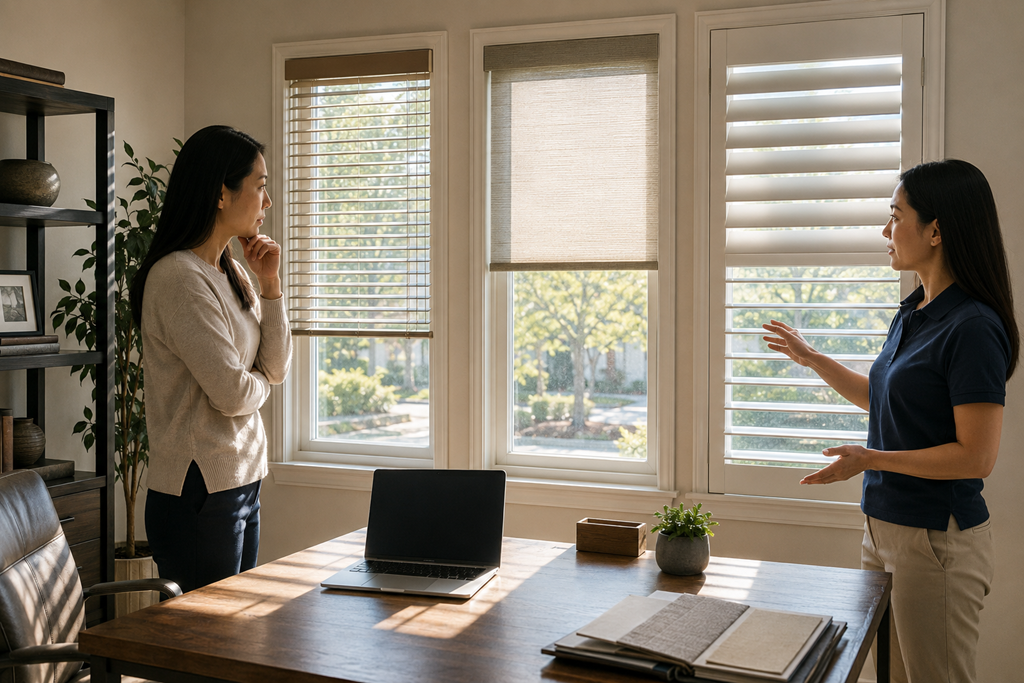
Blinds, shades, and shutters can all cover a window, but they solve room problems in different ways. The best fit depends less on which option looks most attractive in a sample book and more on how you need that particular window to handle sunlight, privacy, temperature, daily use, maintenance, and the character of the room.
This choice can feel surprisingly difficult because the products often look equally appealing when viewed as small samples. The differences become clearer when you picture how each covering will work on the actual window throughout an ordinary day.
A covering that looks ideal in a showroom may not provide enough privacy for a street-facing bedroom. A sturdy shutter may suit one room but feel too permanent or visually heavy in another. A soft shade may complement the décor while offering less precise control over changing sunlight than adjustable blinds.
The goal is not to find one option that is universally better. It is to match the operating style and construction of the covering to the way the room is used.
Begin With the Problem the Window Needs to Solve
Before comparing products, identify what is not working about the uncovered window or the covering you already have.
Is direct sunlight crossing a television or computer screen? Does the room feel exposed after dark? Do you want daylight without a clear view into the home? Is the window difficult to reach? Are you trying to soften the room visually, preserve an architectural style, or reduce the amount of heat entering during sunny parts of the day?
The most important need may also change from morning to evening. A Sacramento-area home office might need glare control during work hours and privacy after sunset. A bedroom may need stronger light reduction than an entryway. A kitchen window may need a covering that operates easily around counters, moisture, and frequent activity.
Defining the problem first prevents appearance from becoming the only deciding factor.
Blinds Offer Adjustable, Directional Light Control
Blinds are made with individual slats that can be tilted, raised, or lowered. Their main advantage is the ability to redirect light without necessarily uncovering the entire window.
This can be useful in rooms where sunlight changes position during the day. Tilting the slats may reduce glare while allowing some daylight to remain. Blinds can also offer flexible privacy because the slat angle can limit the view through the window.
They may fit well when:
- Directional light control is a priority.
- You want to adjust privacy without fully raising the covering.
- The room has changing sun or glare conditions.
- A clean, structured appearance suits the space.
Blinds are not automatically the easiest option for every household. Individual slats can collect dust, and their cords, wands, or motorized controls should be considered in relation to daily use, accessibility, children, pets, and furniture placement.
The material matters as well. Wood, faux wood, metal, and other materials can differ in weight, appearance, moisture resistance, and how they behave at wider window sizes. A professional can explain which construction is appropriate for the location rather than treating all blinds as interchangeable.
Shades Provide Broad Coverage and a Softer Appearance
A shade generally uses a continuous piece of fabric or material that moves up and down across the window. Depending on its design, it may filter light, darken a room, improve privacy, or add a softer visual layer.
Shades can be especially appealing when you want the window covering to blend into the room rather than emphasize horizontal or vertical lines. They are available in many operating styles, including roller, cellular, Roman, woven, and layered designs.
They may fit well when:
- You prefer a softer or less structured appearance.
- Broad light filtering or room darkening is more important than precise slat adjustment.
- You want fabric, texture, or pattern to contribute to the room.
- The window would benefit from a covering that stacks or rolls compactly.
One point that often causes confusion is the difference between light filtering and privacy. A material that softens bright daylight may still allow shapes or movement to be visible from outside, particularly after dark when interior lights are on.
Room-darkening and blackout materials can reduce more light, but the fabric alone does not determine the full result. Light may still enter around the edges depending on the installation method, window depth, and product design.
Before choosing a shade, ask to see how the material behaves under both daylight and interior lighting rather than judging it only from a handheld sample.
Shutters Become Part of the Window’s Architecture
Interior shutters use solid frames with adjustable louvers or panels. Unlike many blinds and shades, they often feel like a permanent architectural addition rather than a removable decorative layer.
Shutters can provide adjustable light and privacy while giving the window a substantial, finished appearance. They may be especially attractive in rooms where durability, structure, and visual consistency matter.
They may fit well when:
- You want the covering to feel integrated with the window.
- A traditional or architectural appearance suits the home.
- Durability and long-term use matter more than easy style changes.
- Adjustable louvers provide the type of light control you need.
Their substantial construction also creates tradeoffs. Shutter frames and panels occupy space within or around the window opening. Depending on the design, the panels may need clearance to swing open, and the frame may reduce part of the visible glass area.
This is why shutters should be evaluated on the actual window rather than selected from appearance alone. Window depth, trim, handles, locks, nearby walls, furniture, and opening direction can all affect whether they will operate comfortably.
They also tend to represent a more permanent commitment. Homeowners who frequently change colors, textures, or decorating styles may prefer a covering that is easier to replace.
The Same Home May Need More Than One Type
A common misunderstanding is that every window in a home should receive the same product.
Consistency can create a unified appearance, especially on windows visible from the front of the property. However, forcing one covering into every room can result in compromises that do not serve the way each space is used.
A household might choose shutters for prominent living areas, shades for bedrooms, and blinds for a home office where directional glare control matters. Another home might use the same exterior-facing color while varying the interior operating style.
The decision is not necessarily between complete uniformity and a random mix. A window-treatment professional can help identify where visual consistency matters and where room-specific performance should take priority.
The Window Itself May Narrow the Choice
The size, depth, shape, and operation of the window can eliminate some options before color or material is discussed.
A shallow window frame may not accommodate every inside-mounted product. A wide opening may require multiple sections rather than one oversized covering. A window that opens inward may conflict with hardware or a shutter panel. Cranks, handles, locks, trim, tile, and nearby cabinets can also affect placement.
French doors, sliding doors, bay windows, and unusually shaped windows present different operating concerns than a standard rectangular opening.
This is one reason accurate measuring matters before ordering. Measurements affect more than whether the product physically fits. They influence light gaps, panel movement, mounting position, visual balance, and access to the window itself.
Before approving an installation, ask how the proposed covering will interact with the window when both are fully opened, fully closed, and used during normal daily routines.
Think About What You Will Adjust Every Day
The right window covering should make sense when you are in a hurry, carrying something, working, resting, or moving through the room.
Consider whether you expect to adjust it several times a day or leave it in one position. A covering on a high window may be difficult to operate manually. A covering behind a deep sofa or desk may require a different control location. A heavy treatment on a frequently used door may become inconvenient even if it looks attractive.
Manual controls, cordless designs, and motorized options each have practical differences. The decision should be based on reach, frequency of use, household needs, electrical or charging considerations, and the level of convenience you expect.
Do not let a demonstration of a single sample replace a discussion about how the installed product will be operated in the room.
Maintenance Can Change How a Product Feels Over Time
All window coverings require some care, but the surfaces and construction determine what that care looks like.
Blinds and shutters have individual slats or louvers that may need periodic dusting. Fabric shades may require gentler cleaning methods, especially when textured, layered, or made from natural materials. Kitchen, bathroom, and entryway windows may be exposed to more moisture, airborne residue, or frequent contact than coverings in quieter rooms.
Ask how the specific material should be cleaned and whether parts can be repaired or replaced individually. A covering that is practical to maintain in one room may be less suitable in another.
This does not mean selecting the product that requires the least care in every situation. It means understanding the care requirements before they become an unexpected part of ownership.
Small Samples Do Not Show the Full Effect
Many selection mistakes happen because the homeowner evaluates color and texture without considering scale, movement, and changing light.
A woven shade may look warm and private when held against the window during the day but appear more transparent after dark. Wide blind slats may create a clean look when closed but stack more noticeably when raised. Shutter frames may complement the trim while also reducing the unobstructed view.
When comparing options, try to review larger samples or full-size displays. Observe the product from across the room as well as close to the window. Ask what it looks like when raised, lowered, tilted, partially opened, and viewed from outside.
The most useful comparison is not which sample looks best on the table. It is which covering behaves best on the window.
Questions That Can Make a Consultation More Useful
A few focused questions can help a Sacramento-area homeowner compare recommendations without turning the appointment into a technical interrogation:
- Which option best addresses the main light or privacy problem in this room?
- What will the covering look like when it is fully open?
- How much glass or view will the frame, stack, or hardware cover?
- Will the material provide privacy after dark with the interior lights on?
- How will the product interact with the window handle, trim, furniture, or door movement?
- What routine cleaning or maintenance does the material require?
- Are there repairable or replaceable components if one part is damaged?
- Is the recommendation based on the room’s needs, or mainly on appearance?
Clear answers should connect the proposed product to the window and the way the room is used. Be cautious when every room receives the same recommendation without a discussion of sunlight, privacy, operation, or physical fit.
Choose According to the Room, Not the Product Category
Blinds are often strongest when adjustable, directional light control matters. Shades can provide softer styling and broad coverage with many levels of light filtering. Shutters offer a durable, architectural treatment that becomes a more permanent part of the window.
None of those descriptions makes one category the automatic winner.
The best decision comes from identifying the room’s primary problem, understanding how the window operates, and comparing how each covering will perform during everyday use. A thoughtful consultation should help you see those differences on the actual window before you commit to a product based mainly on a small sample or showroom display.