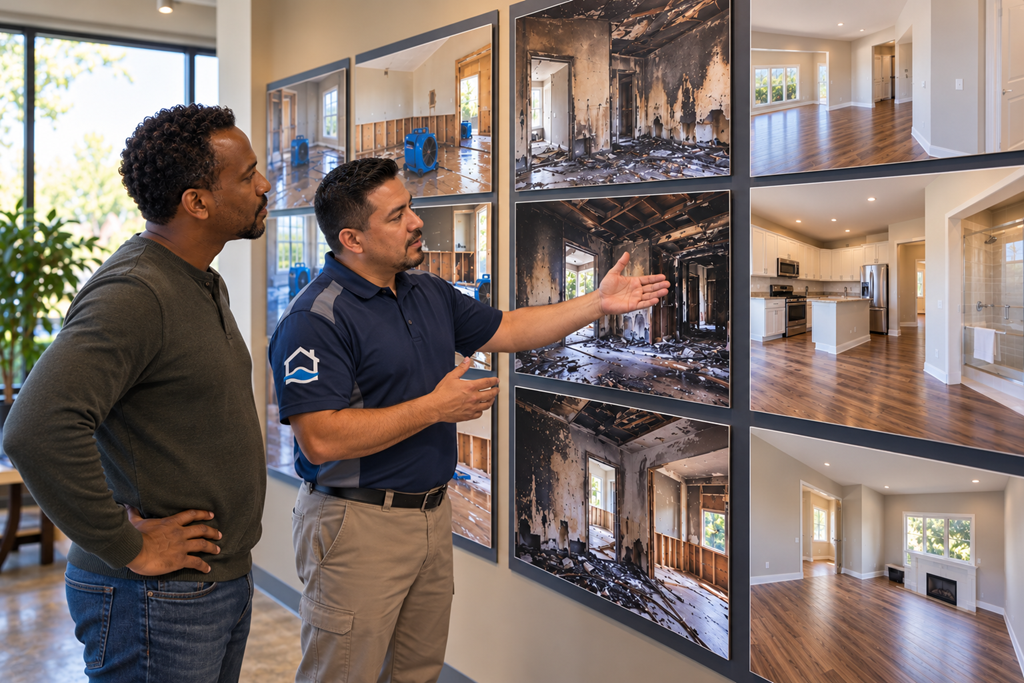
Hiring a damage restoration company is not simply a matter of finding someone who can start repairs. After water, fire, smoke, or another damaging event, the first decision is whether a provider can identify the affected areas, explain what needs attention, distinguish mitigation from rebuilding, and document the work clearly. For Sacramento-area property owners and renters, understanding those differences makes it easier to compare companies without mistaking a fast response or a low initial estimate for a complete restoration plan.
Property damage can make an otherwise familiar home or business difficult to use. A room may look mostly intact while underlying materials need evaluation, or visible damage may involve several different types of work. During these situations, property owners often need to make service decisions before they fully understand the condition of the building.
A damage restoration company may help assess the affected areas, limit further damage, remove certain damaged materials, clean affected spaces, or coordinate portions of the recovery process. However, companies differ in the services they provide, the damage they specialize in, and whether they handle repairs after the initial restoration work.
Before hiring, it helps to understand what kind of assistance the property needs, what the company will actually be responsible for, and how the proposed work will be evaluated and documented.
Understand what type of damage the company is equipped to handle
Damage restoration is a broad service category. A company that regularly handles one type of property damage may not have the same experience, equipment, or service capabilities for another.
The first step in evaluating a provider is identifying the general nature of the damage and whether the company has relevant experience.
Water damage restoration
Water damage may involve plumbing failures, appliance leaks, roof leaks, or water entering a building from outside.
Depending on the circumstances, restoration work may involve identifying affected materials, extracting standing water, assessing moisture conditions, drying the building, removing materials that cannot appropriately be restored, and documenting the results.
An important distinction is the difference between visible water and moisture that may remain within building materials or concealed spaces.
A company should be able to explain how it determines the affected areas and what information it uses to decide whether materials can remain or require further attention.
Fire and smoke damage restoration
Fire-related restoration may involve more than areas directly affected by flames.
Smoke residue, odors, firefighting water, and damage to building materials can create different restoration needs.
Some companies concentrate on cleaning and recovering affected materials, while others also provide structural repairs or coordinate reconstruction.
Ask whether the provider has experience with the specific type of fire-related damage involved and how it determines which work falls within its services.
Storm-related and other property damage
Wind, rain, falling debris, and other events may damage roofing, exterior materials, interiors, or building components.
Certain situations require temporary property protection before permanent repairs can begin.
A restoration company may provide some of these services directly or work alongside other qualified professionals.
Not every restoration provider handles every type of damage. The company’s actual experience with the property’s condition matters more than a broad description of its services.
Know the difference between mitigation, restoration, and reconstruction
One of the most important distinctions before hiring a damage restoration company is understanding where its responsibilities begin and end.
These terms are sometimes used together, but they describe different parts of the recovery process.
Mitigation focuses on limiting additional damage
Mitigation generally refers to work intended to stabilize conditions and reduce further damage.
Depending on the situation, this could involve water removal, temporary protective measures, or other appropriate actions after the source of damage has been addressed.
Mitigation does not necessarily return the property to its previous condition.
For example, a company may complete water extraction and drying while leaving certain finishes or building materials in need of later repair.
Restoration addresses affected materials and conditions
Restoration may involve cleaning, drying, treating, removing, or recovering materials affected by the event.
The appropriate work depends on the damage, material conditions, and professional evaluation.
Restoration does not always mean every damaged item can be returned to its original condition.
A provider should explain which materials it proposes to restore, which may require removal, and what uncertainties remain.
Reconstruction involves rebuilding or replacing damaged components
Reconstruction may include replacing flooring, drywall, cabinetry, or other building components after initial restoration activities are complete.
Some damage restoration companies handle both mitigation and reconstruction. Others specialize in initial damage response and coordinate with separate contractors for rebuilding.
This distinction affects scheduling, estimates, warranties, responsibility for unfinished work, and the number of companies involved.
Before signing an agreement, ask whether the company will handle the entire recovery project or only a defined portion of it.
A company that offers comprehensive restoration services may be convenient, but a specialized provider may also be appropriate when the responsibilities are clearly defined.
Determine what needs attention before choosing a provider
Not every property damage situation allows the same amount of time for comparing companies.
Some conditions require prompt professional attention to reduce additional damage or address potential safety concerns. Other decisions, particularly those involving later reconstruction, may allow more time for reviewing options.
The goal is to distinguish genuinely time-sensitive work from decisions that can reasonably be evaluated more thoroughly.
Immediate safety and property protection
If a building may have structural damage, exposed electrical hazards, contaminated water, or other unsafe conditions, occupants should avoid entering or disturbing affected areas until qualified professionals determine what is appropriate.
For fires, suspected gas leaks, or immediate threats to safety, contact the appropriate emergency service or utility provider.
When conditions are safe enough to discuss restoration services, ask the company what it believes needs prompt attention and why.
A reputable explanation should identify the concern without relying solely on pressure or generalized warnings.
Work that may require further evaluation
Some restoration decisions depend on conditions that are not immediately visible.
For example, the extent of moisture exposure, the condition of materials, or the presence of contamination may affect what work is appropriate.
An initial assessment may not reveal every problem.
A provider should be willing to explain which findings are confirmed, which are preliminary, and what additional evaluation may be necessary.
Repairs that can be planned separately
Once immediate concerns are appropriately addressed and the property is stabilized, some rebuilding decisions can be evaluated independently.
This may include reviewing replacement materials, repair options, contractor responsibilities, and scheduling.
Separating urgent protective work from later reconstruction can help prevent an entire project from being approved before its scope is understood.
Understand how the company assesses the damage
Before comparing restoration proposals, homeowners should understand how each company decides what work is needed.
The initial assessment can influence the proposed scope, equipment, materials, duration, and overall cost.
A detailed evaluation should provide more useful information than a quick opinion based only on the most visible damage.
What the assessment should help establish
Depending on the type of loss, the company may need to evaluate:
- The apparent cause and source of the damage.
- Which rooms, surfaces, materials, or building components are affected.
- Whether additional areas require evaluation.
- Whether certain materials may be restored or require removal.
- What work falls outside the company's expertise.
- Which conditions may need evaluation by another qualified professional.
- What further findings could change the proposed work.
The provider should explain the assessment process in language the property owner can understand.
For water damage, this may include explaining how moisture conditions are evaluated and documented.
For fire or smoke damage, it may involve describing how affected areas, residues, and materials are assessed.
The homeowner does not need to understand the technical details of every method. However, they should understand the purpose of the evaluation and how it informs the proposed service.
Recognize the limits of an initial inspection
Some property conditions become apparent only after restoration activities begin or affected materials are examined more closely.
A company that acknowledges this possibility is not necessarily less capable than one offering immediate certainty.
What matters is whether the provider explains how unexpected findings will be handled.
Ask what circumstances would require additional authorization, a revised estimate, or another professional evaluation.
This gives the property owner a clearer understanding of how decisions will be made if the original scope changes.
Review exactly what the restoration estimate includes
Restoration estimates can be challenging to compare because two companies may propose different work for the same visible damage.
One proposal might address only initial mitigation, while another includes cleaning, material removal, and reconstruction.
The difference in price may reflect the scope rather than the provider's overall value.
Look beyond the total estimate
A useful written proposal should make clear, where applicable:
- Which affected areas are included.
- What cleaning, extraction, drying, or removal activities are proposed.
- Whether equipment use and monitoring are included.
- What materials may require replacement.
- Whether disposal and cleanup are included.
- Whether reconstruction is part of the quoted work.
- Which services are excluded or charged separately.
- How additional work will be evaluated and authorized.
Not every restoration situation allows a complete final estimate before work begins. However, the company should explain what can be estimated now and what remains uncertain.
Compare the work, not just the amount
Consider a property with water damage affecting flooring and nearby wall materials.
One company may quote water removal and drying only. Another may include removal of damaged finishes and later repairs.
The estimates would not represent identical services.
The following comparison can help identify important differences:
Comparison factor | What to look for |
|---|---|
Assessment | How the company determines the extent of damage |
Service scope | Which affected areas and activities are included |
Materials | What may be restored, removed, or replaced |
Equipment | What equipment use and monitoring the estimate covers |
Reconstruction | Whether rebuilding is included or separate |
Additional charges | How unforeseen work or changing conditions are handled |
Documentation | What records and completion information are provided |
Responsibility | Who manages each stage of the project |
A higher estimate does not automatically indicate better service. A lower estimate does not necessarily mean an incomplete job.
The important question is whether the proposed work is appropriate, understandable, and comparable.
Clarify insurance involvement without assuming coverage
Property insurance can add another layer of complexity to restoration decisions.
A restoration company may regularly work with insurance claims, but that does not mean the company decides whether a loss is covered or how much an insurer will pay.
Those are separate responsibilities.
The restoration company's role
A restoration provider may document damage, prepare estimates, provide photographs, record completed work, or communicate with an insurer as authorized.
These activities may support the claims process.
However, a company's experience working with insurers should not be treated as a guarantee that an insurance claim will be approved.
The property owner's responsibility
Before authorizing substantial work, it may be appropriate to contact the insurance company to understand applicable policy conditions, reporting expectations, and claims procedures.
Ask the restoration provider how its agreement works when the insurer's determination differs from the contractor's estimate.
Other useful questions include:
- Will the company provide an itemized estimate?
- Who receives invoices and supporting documentation?
- How are supplemental charges communicated?
- What happens if certain work is not covered?
- Is the property owner responsible for amounts the insurer does not pay?
Property owners should understand their payment obligations independently of any anticipated insurance reimbursement.
If the property is rented, communication with the landlord or property manager may also be necessary before approving work that affects the building.
Evaluate the company's qualifications and service capabilities
Once the proposed work is reasonably understood, the next step is deciding whether the company is an appropriate choice to perform it.
A professional-looking website or broad service description does not establish experience with every kind of property damage.
Ask about experience with similar losses
Relevant experience should match the work actually needed.
A provider experienced in routine clean-water situations may have a different background from one handling complex contamination, extensive smoke damage, or structural reconstruction.
Consider asking:
- What experience do you have with this type of property damage?
- Which restoration activities does your own team perform?
- Do you use subcontractors for any portion of the work?
- What qualifications or training do the people performing the work have?
- Are there conditions that would require another specialist?
The goal is not to demand that one company handle every possible task.
It is to understand whether the provider recognizes its capabilities and limits.
Verify applicable credentials and insurance
Depending on the work proposed, contractor licensing, specialized training, certifications, and business insurance may be relevant.
For Sacramento-area properties, homeowners should verify any applicable California contractor license through the appropriate official licensing authority rather than relying only on a company's advertising.
They should also ask about insurance coverage relevant to the work.
Industry training or certification can provide useful information about a company's background, but it should not be confused with a government-issued contractor license or treated as proof that every service is authorized.
Consider communication and reputation
Customer reviews may reveal patterns in responsiveness, scheduling, work explanations, and follow-through.
Look for detailed accounts describing how a company communicated when a project became more complicated.
A few broad positive statements may be less informative than reviews explaining how the company managed expectations and resolved concerns.
During initial contact, consider whether the company listens to the specific circumstances and clearly distinguishes confirmed findings from assumptions.
Understand who will manage the work and communicate changes
Damage restoration projects sometimes involve several stages and different professionals.
Without clear coordination, homeowners may struggle to understand who is responsible for the next step.
Identify a primary point of contact
Ask who will explain the work, provide updates, answer questions, and communicate changes.
This is especially useful when multiple workers, subcontractors, or separate repair companies are involved.
The company should explain how the homeowner can reach the responsible person and what information will be shared as work progresses.
Discuss access and property use
Restoration work may affect access to rooms, personal belongings, household routines, or business operations.
Ask what areas the company expects to use, whether equipment may remain in place between visits, and what limitations occupants should anticipate.
For a small business, these questions may also involve employee access, customer areas, inventory, and operating interruptions.
A provider may not know every inconvenience in advance, but should be able to explain what is reasonably foreseeable.
Establish how changes will be approved
An important part of project coordination is understanding what happens when additional damage is discovered.
The property owner should know:
- Who explains the new findings.
- Whether photographs or other documentation will be available.
- How the additional work will be estimated.
- When the owner must approve changes.
- How schedule adjustments will be communicated.
These expectations are worth establishing before work begins rather than during a disagreement.
Know what documentation and completion should look like
The final stages of a restoration project deserve attention during the hiring decision, not only when the work is nearly finished.
The homeowner should understand how the company will determine that its assigned work is complete and what records will be provided.
Depending on the service, documentation may include inspection findings, photographs, equipment records, moisture readings, descriptions of removed materials, work summaries, invoices, or other appropriate records.
Not every project requires the same documentation.
The important distinction is between a provider who can explain what completion means for its scope and one who offers only a vague assurance that the property will be restored.
Completion is not always the same as rebuilding
A mitigation company may finish its contracted work while the property still needs reconstruction.
A cleaning contractor may complete cleaning activities without being responsible for every remaining building repair.
Similarly, a company may finish its portion of restoration while another qualified professional must evaluate an unresolved condition.
Before hiring, ask how the provider will communicate the boundary between completed work and remaining responsibilities.
If a warranty or workmanship commitment is offered, request the written terms and understand what it covers and excludes.
Recognize when a company's explanation deserves a second look
Restoration decisions sometimes happen under difficult circumstances, but property owners can still evaluate how clearly a provider communicates.
Certain patterns deserve additional questions before committing.
Pressure to authorize extensive work without an understandable explanation. Some protective measures may require prompt action, but that does not automatically justify approving unrelated reconstruction.
Promises that insurance will cover everything. Coverage decisions depend on the actual policy and claim circumstances.
Unclear responsibility for repairs. A company that handles only mitigation should explain who will address remaining reconstruction needs.
No meaningful explanation of the affected areas. The company should be able to describe what it has evaluated and why particular work is recommended.
Vague pricing or authorization terms. Initial uncertainty is understandable, but the provider should explain how additional charges and changes will be handled.
Unwillingness to discuss credentials or subcontractors. Homeowners should be able to learn who is responsible for the proposed services.
Broad guarantees without clearly defined conditions. Property damage varies, and a company should explain the limits of its services rather than promise an outcome it cannot independently control.
One concern does not establish that a company is unreliable. It does provide a reason to ask for clarification or consider another provider when circumstances allow.
Prepare for the first conversation with a restoration company
The initial conversation is more useful when the homeowner can describe the situation without attempting to diagnose the damage.
Before contacting a company, gather information that is already safely available.
This may include:
- The general type of damage.
- When the damage was first noticed or when the event occurred.
- Which rooms or areas appear affected.
- Whether the apparent source of the problem has been addressed.
- Any steps already taken by emergency services, utilities, or qualified professionals.
- Relevant photographs taken from a safe location.
- Whether the property is occupied, vacant, rented, or used for business.
- Any known access restrictions or immediate scheduling concerns.
Avoid entering unsafe areas, disturbing potentially hazardous materials, or attempting technical investigations to prepare this information.
A description of what is known, together with acknowledgment of what is uncertain, is sufficient for an initial inquiry.
Questions worth asking before hiring
Rather than asking every possible question, focus on those that reveal the company's approach and responsibilities.
- Have you handled damage similar to this, and what would your initial evaluation involve?
- What work do you believe needs prompt attention, and what can be determined after further assessment?
- Will your company handle mitigation, restoration, reconstruction, or only certain stages?
- What will the estimate include, and what circumstances could change it?
- Who will perform and supervise the work, including any subcontractors?
- What documentation will you provide, and how will you determine when your work is complete?
- How will additional findings, costs, or schedule changes be communicated and approved?
- How will billing work if an insurance claim is involved?
The answers should make the company's role easier to understand, even if some technical findings cannot yet be confirmed.
Make the hiring decision based on the work the property actually needs
When comparing damage restoration companies, avoid treating all proposals as interchangeable.
A company that responds quickly may be appropriate for immediate stabilization, but that alone does not establish its suitability for a complex rebuilding project.
Another provider may offer detailed reconstruction services but may not be the right choice for a specialized initial cleanup.
The right fit depends on the type of damage, required capabilities, clarity of the assessment, available services, and how the company will manage its responsibilities.
If conditions permit comparing more than one provider, use a consistent set of questions and examine differences in the proposed scope rather than simply comparing totals.
Where immediate protective work is necessary, it may be reasonable to address that need first while keeping later repair decisions clearly defined.
Before approving the work, make sure you understand what the agreement covers, what remains uncertain, and what happens if the findings change.
Move forward with a clear understanding of responsibilities
Hiring a damage restoration company involves more than choosing someone to repair visible damage. It requires understanding what has happened to the property, what professional evaluation is needed, which stages of recovery the company will handle, and what work may remain afterward.
For Sacramento-area homeowners, renters, and business owners, the most useful approach is to separate immediate property concerns from broader restoration decisions whenever circumstances allow.
A provider should be able to explain its assessment, qualifications, proposed work, documentation, and limits of responsibility.
When those details are understandable, it becomes easier to select a company whose services match the property's actual needs—and to approach the recovery process with more realistic expectations.