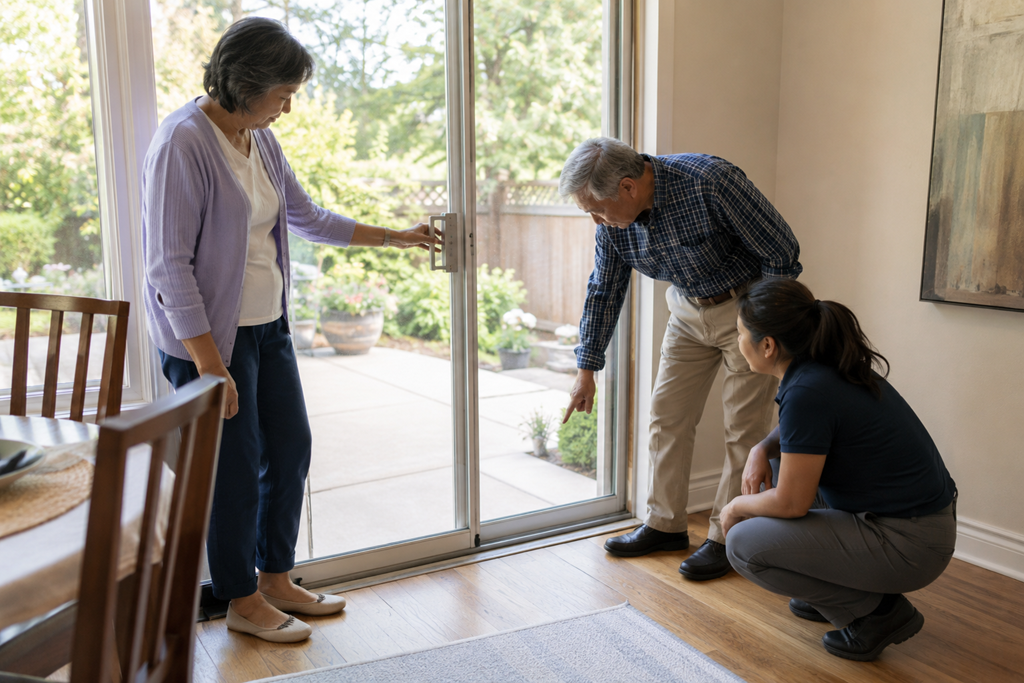
A sliding door usually gets harder to open because several small changes build up over time. The rollers may wear, the track may collect fine debris, the frame may shift slightly, or the panel may move out of alignment. What feels like a sudden problem is often the point when gradual resistance finally becomes noticeable during everyday use.
The change may begin with a slight hesitation when the door starts moving. Later, the panel may feel heavier, slow down in one section of the track, make a scraping sound, or require more force to close completely.
Because the door may still move, it is easy to treat the resistance as a minor inconvenience. However, the way the door moves can provide useful information about what is changing underneath the panel.
The Resistance Usually Develops Gradually
Sliding glass doors are heavy panels supported by small roller assemblies near the bottom. Those rollers travel along a narrow track every time the door opens or closes.
Over years of use, the rollers can develop worn surfaces, stiff bearings, flattened areas, or reduced adjustment. Fine dirt and outdoor debris can also collect along the track and around parts of the roller assembly that are difficult to see.
A homeowner may not notice these changes at first because the door continues to operate. The resistance becomes more obvious only after several small problems begin working together.
Common experiences include:
- The door starts moving only after a firm pull.
- The panel moves easily at first but slows halfway.
- One end of the door appears slightly lower than the other.
- The door feels smoother after cleaning but becomes difficult again.
- The lock no longer lines up as easily as it once did.
These patterns do not automatically identify the exact problem, but they can help a sliding door professional determine where to begin an evaluation.
The Rollers, Track, and Frame Work Together
A sliding door does not depend on the track alone. Smooth movement requires the rollers, track, panel, frame, and locking hardware to remain reasonably aligned.
The rollers carry most of the panel’s weight. The track guides the rollers. The frame keeps the opening square, while the lock and handle depend on the panel reaching the correct closing position.
A change in one component can affect the others. A worn roller may cause the panel to sit lower. That lower position can make the door scrape against the track and prevent the lock from lining up properly. Continued force on the handle may then place additional strain on the hardware.
This is why a door that is hard to open should be viewed as a movement problem rather than automatically being blamed on dirt, the handle, or the lock.
A Clean-Looking Track May Not Tell the Whole Story
Surface debris is one of the most visible causes of sliding door resistance. Dust, pet hair, leaves, small stones, and other material can interfere with the rollers’ path.
Cleaning away visible debris may improve movement when the obstruction is limited to the track surface. However, a clean track does not prove that the rollers are in good condition or that the panel remains aligned.
Debris can also collect beneath the door panel or around the roller housings. Those areas are less visible during ordinary cleaning. A damaged roller, worn bearing, or uneven panel may continue causing resistance even when the exposed track looks clean.
A useful distinction is whether cleaning produces lasting improvement. When the resistance quickly returns, stops in the same location, or remains uneven, the issue may involve more than surface buildup.
Different Movement Patterns Can Point to Different Problems
The way a door resists movement can be more informative than how heavy it feels overall.
A door that drags through its entire path may have worn or poorly adjusted rollers. A door that catches at one specific point may be encountering a damaged section of track, concentrated debris, or an uneven spot in the panel’s travel.
If the door moves but appears tilted, the rollers may no longer be supporting the panel evenly. If movement becomes difficult only near the closed position, alignment between the panel, frame, and locking hardware may be involved.
These observations are not a substitute for an inspection. They simply give a Sacramento-area homeowner useful details to share when scheduling a repair evaluation.
Heat, Dust, Moisture, and Daily Use Can Contribute
Sliding doors connect indoor spaces with patios, yards, balconies, and other outdoor areas. Their lower tracks are regularly exposed to fine debris carried by shoes, pets, wind, and routine household activity.
Sacramento’s dry conditions can allow dust and grit to accumulate along exposed thresholds. Direct sun and temperature changes may also affect how metal framing and surrounding materials expand, contract, or settle. Seasonal moisture can contribute to residue or corrosion in vulnerable components.
These conditions do not mean every difficult door has a weather-related problem. They help explain why a door can change gradually even when no single accident or obvious break has occurred.
Forcing the Door Can Increase Wear
When a sliding door becomes difficult to move, pulling harder may seem like the simplest response. The panel may still open, so the added force becomes part of the household routine.
Repeated force can place more stress on the handle, locking hardware, rollers, and track. It may also make an alignment problem more pronounced.
The concern is not that one firm pull will necessarily cause major damage. The larger issue is that continued resistance can encourage people to compensate for the problem rather than identify it.
A door that suddenly requires noticeably more effort, repeatedly catches, or no longer closes squarely may be worth evaluating before the movement becomes more difficult.
Difficulty Opening Does Not Automatically Mean Replacement
A hard-to-open sliding door does not necessarily require a complete new door system.
Depending on the cause and the condition of the surrounding components, a professional may discuss roller service, roller replacement, track correction, panel adjustment, hardware repair, or another focused solution.
Replacement may become part of the discussion when there is extensive frame damage, severely damaged track material, failed glass, significant structural movement, or a combination of problems that makes a limited repair less practical.
A clear evaluation should separate the current movement problem from unrelated upgrades. Homeowners should be able to understand which component is causing the resistance, what repair is being proposed, and why replacement is or is not being recommended.
What to Ask During a Sliding Door Evaluation
Before approving a repair, a Sacramento-area homeowner can ask a few direct questions:
- What appears to be causing the resistance?
- Are the rollers worn, misaligned, obstructed, or damaged?
- Is the track contributing to the problem?
- Does the panel sit squarely in the frame?
- Will the proposed work address the cause or only improve the symptom?
- Are there other damaged components that could affect the result?
A provider should be able to explain the problem in understandable terms. Be cautious when the explanation remains vague, the recommendation changes without a clear reason, or full replacement is presented without identifying why a focused repair would be unsuitable.
Notice the Pattern Before the Appointment
It can help to pay attention to when and where the resistance occurs.
The door may be harder to start than to keep moving. It may stop at the same place each time, scrape near one end, feel uneven, or move differently after the track has been cleaned. The lock may also require lifting, pushing, or repositioning the panel before it engages.
Sharing these details can help a sliding door professional reproduce the issue and evaluate the full movement path rather than focusing only on the most visible part of the track.
There is no need to diagnose the door yourself. The goal is simply to describe the experience accurately.
A Gradual Change Still Deserves a Clear Explanation
A sliding door usually becomes harder to open because wear, debris, alignment changes, or track problems gradually affect how the panel moves. The resistance may become noticeable only after several conditions have developed together.
Understanding that pattern can help Sacramento-area homeowners avoid assuming the door only needs more force or that complete replacement is the only option.
A useful repair evaluation should identify where the resistance originates, explain the condition of the rollers and track, and connect the recommendation to the actual movement problem. That gives the homeowner a better basis for comparing options before authorizing the work.